
Rented E-shop or Built for You? The 2026 Decision Framework for Online Stores
- Published —
The honest answer depends on one thing: whether you are still proving people will buy, or scaling a store that already works. Rent while you are validating demand: a platform like Shoptet gets you selling in days for a predictable monthly fee. Build when the template starts costing you sales, because that is the point where owning your store finally pays for itself.
A founder signs up for Shoptet on a Tuesday and is shipping orders by Friday. Two years later the same store is fighting the platform for every custom checkout field, every integration the template refuses, every design change the theme will not allow. Both moments are real. Both trace back to one decision made in week one: rent the store, or build it.
That decision matters more each year. Slovak e-commerce grew about 6% to roughly €1.84 billion in 2024, one of its strongest years on record, according to Heureka Group (2025). More shoppers are buying online and more merchants are competing for them, and the platform underneath your store quietly sets how fast you can move, how much you actually own, and what you pay for the next three years. Get it right and the store gets out of your way. Get it wrong and you spend years paying for that first click of a signup button. Most guidance on this comes from whoever is selling you the platform; here is the version with nothing to sell.
Three ways to sell online, not two
Owners usually frame this as Shoptet versus a custom build. There are really three routes, and the middle one gets forgotten most often.
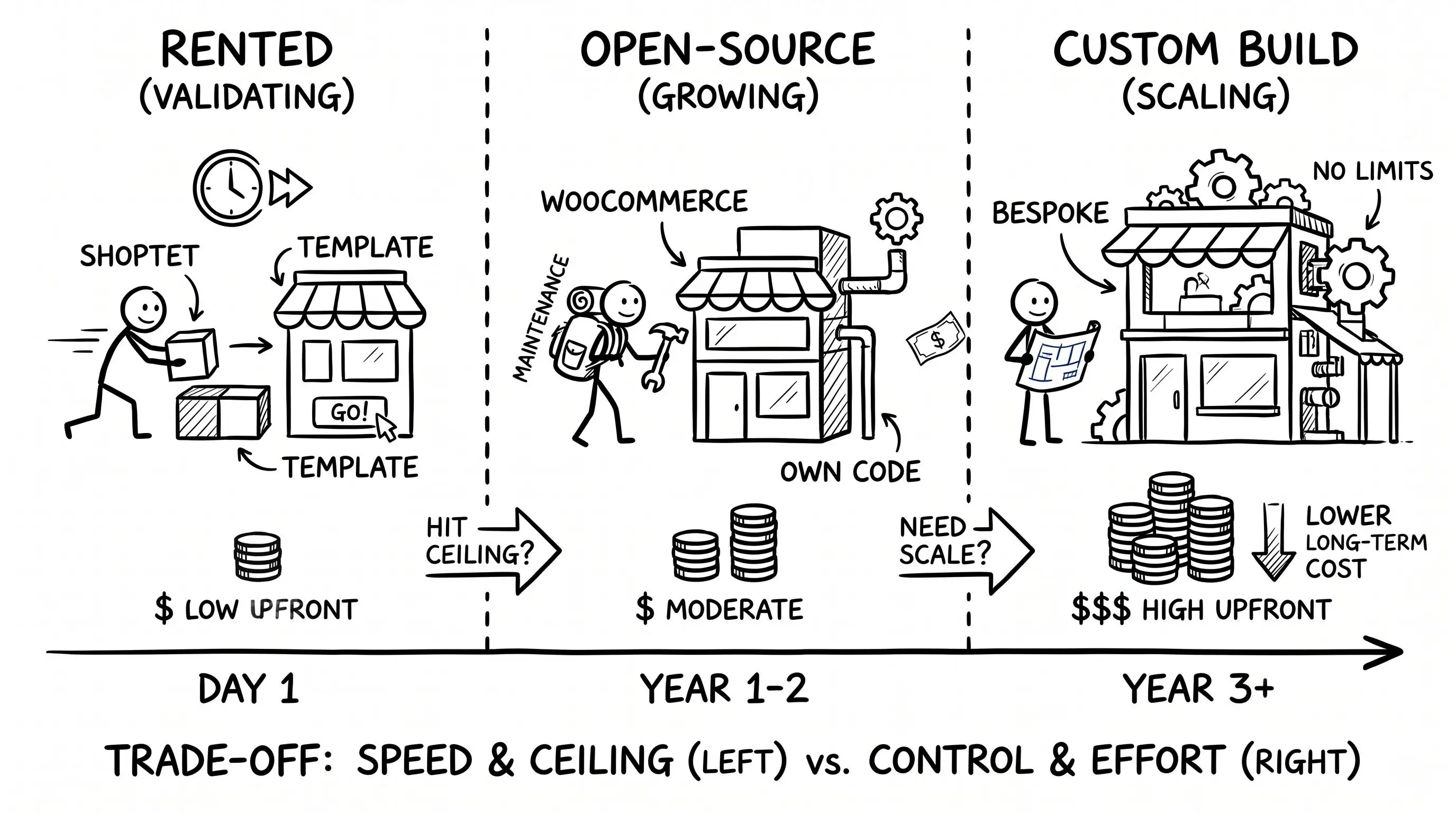
- Rented platform: Shoptet, Shopify. You pay a monthly fee for a hosted store you configure but never fully own. Fastest and cheapest to launch, capped at the edge of what the template allows.
- Open-source: WooCommerce and its relatives. You own the code and the data and host it yourself, in exchange for taking on the maintenance. The pragmatic middle ground.
- Custom build: a store designed and coded around your business. Highest cost upfront, no ceiling on control, justified at scale or when your model simply does not fit a template.
The real axis underneath all three is ownership. Renting buys speed and hands you a ceiling; building buys control and hands you a maintenance bill. The right route is rarely the most ambitious one. It is the one that fits where your business stands today and where it is credibly heading next.
Should I use Shoptet or a custom e-shop?
If you are still proving that people will buy what you sell, use Shoptet. If your store is the business and the template is now costing you sales, build. Everything else is detail on top of that.
A rented platform earns its keep at the start. Shoptet is built for the Slovak and Czech market, so local payment gateways, delivery integrations, and invoicing work out of the box, and someone else handles hosting, security, and the updates you never see. For a first store, that is exactly the right trade. You are buying speed and one less thing to worry about while you find out whether the business works at all.
You pay for that speed in three currencies. A monthly fee that never stops. A hard limit on how far the template will bend. And the quiet fact that you are renting, not owning — if you outgrow the platform and leave, you rebuild and migrate your catalogue, your customers, and your order history somewhere else. That migration is a real cost that never appears on the first invoice.
A custom store inverts the deal. You pay far more upfront and carry the maintenance yourself, but there is no ceiling and no landlord. The catch is that control is only worth paying for if you actually use it. This is where the Slovak market tips its hand: “Shoptet” is by far the most-searched store platform, while high-intent questions like eshop na mieru (custom e-shop) and tvorba eshopu cena (e-shop cost) stay comparatively under-served. A lot of merchants default to renting without ever pricing what they are giving up.
How much does an e-shop actually cost?
The honest answer: the sticker price barely matters. What decides the real cost is the three-year total, and the three routes trade places over that span.
- Rented: little or nothing upfront, then a predictable fee every month, without end. Premium themes, paid add-ons, and per-transaction charges stack on top. You pay it whether the store grows or stalls.
- Open-source: modest upfront, then hosting, security patches, and developer time whenever something breaks or needs extending. Lower licence cost in exchange for real operating effort.
- Custom: the largest upfront figure by a wide margin, and usually the lowest ongoing cost when it is built well, because you are not renting anything and not paying per feature.
Here is the crossover most comparisons hide. Rented is cheaper on day one and can quietly become the more expensive option by year three, once you add the recurring fees, the paid workarounds, and the sales lost to a checkout you were not allowed to change. Custom looks expensive on day one and can cost less across three years — but only if that control converts into revenue you can measure. The question is not “which is cheaper,” it is “cheaper over what horizon, at what volume.”
And the platform is only half the bill. A store nobody can find earns nothing, so visibility is a separate, ongoing line of its own: the same SEO and AI-search work every store needs to get found. How the buying experience is designed moves revenue far more than the logo does, which is why conversion-focused UX tends to repay itself faster than a cheaper monthly plan. Neither cost belongs to the platform decision, and both get forgotten when people compare price tags.
When is a custom online store worth it?
Custom pays off at the point where the platform costs you more than it saves: in lost sales, in monthly workarounds, in things you simply cannot do. A few signals tell you that you are there.
- Scale: order volume high enough that a small lift in conversion or fulfilment efficiency is worth real money every month.
- Unusual requirements: a product configurator, a subscription model, B2B pricing tiers, a booking-and-shop hybrid, or an integration the platform flatly will not support.
- The experience is the product: when the way people buy is itself a competitive edge, not a commodity checkout everyone else also runs.
- You keep hitting the ceiling: you are stacking apps and paid workarounds to force a rented platform to behave, and the total is drifting toward what a proper build would have cost anyway.
The counterweight matters just as much. If none of those are true, custom is usually premature. A bespoke store for a business still searching for product-market fit is money spent proving nothing you could not prove on a rented plan. Validate first, then build on what you have actually learned about your customers.
Match the tool to where your business is
Strip away the platform names and the decision comes down to which of three stages you are in.
- Validating an idea: rent. Shoptet or Shopify, minimum fuss. Spend your money and attention on finding customers, not on infrastructure you are not ready to use. Speed beats ownership here.
- Growing steadily: push the rented platform as far as it will go, or step up to open-source for more control without a full rebuild. Watch the ceiling approach and plan for it before you hit it.
- Hitting the ceiling: build, or move to a heavily customized setup. When the platform itself is what caps your growth, owning it stops being a luxury and starts paying for itself.
The two classic mistakes sit at opposite ends. Over-building too early: a beautiful custom store and no customers to visit it, capital sunk into infrastructure before anyone has proven the idea. Under-building too late: defending a rented template that is now quietly capping revenue because a rebuild feels like too much upheaval. Most platform decisions that go wrong are really one of those two, made by staring at the tool instead of the stage.
Where to start
Start with an honest read of where you actually are, not where you would like to be. Are you still proving demand, or has the platform become the thing holding you back? That one question settles more than any feature-by-feature comparison ever will.
This is the heart of how we approach e-commerce development: build the store that fits the stage you are in now, not the one you hope to reach eventually, and make the jump to custom only when the math and the ceiling both point that way. If you are weighing rented against built and want a straight read rather than a sales pitch, talk to us.