
Market Research for a Small Business: Ten Conversations Before Any Survey
- Published —
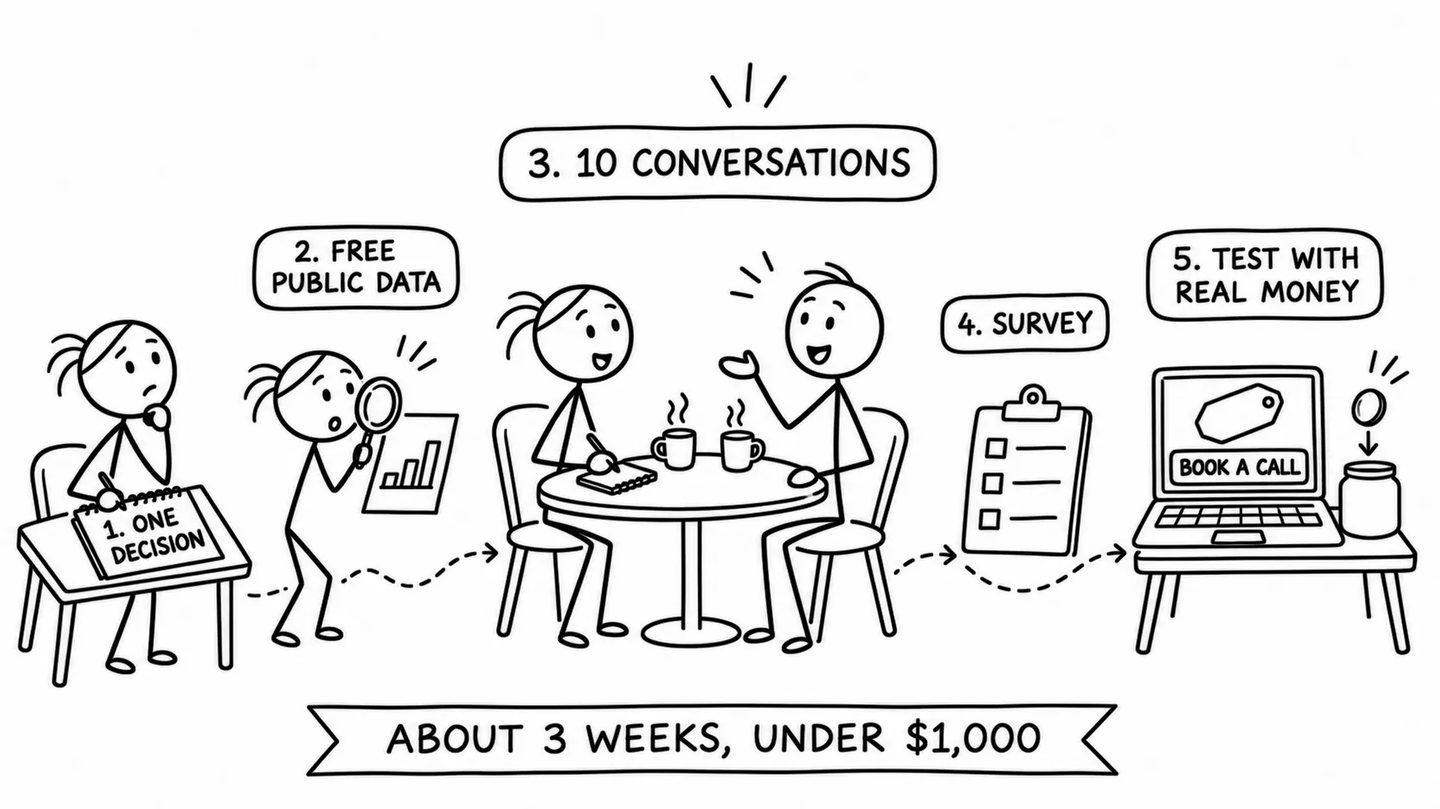
Short answer: write down the one decision the research has to settle and the result that would make you drop the idea. Read the free public data on your market, then interview five to ten customers about what they did the last time they had the problem. Run a survey only to measure how common the things you heard are, and test with real money where you can: a price on a page, a pre-order, a small ad. For a small firm the whole sequence takes about three weeks and costs less than $1,000.
Abbie Griffin and John Hauser once counted how many customer needs each additional interview turns up. Their answer, published in Marketing Science in 1993, was that 20 to 30 interviews reveal 90 to 95% of the needs in a fairly uniform group of customers (The Voice of the Customer). In their office-equipment study a single interview surfaced a third of the needs and two interviews surfaced half, about as many as one focus group.
Few of the guides that rank for small-business market research cite that study. Most are written by companies that sell survey panels or research software, and they start with a survey. A survey measures how many people pick each of the answers you thought to offer. A small business usually has an earlier question: whether an offer is worth making at all, at what price and to whom. Conversations with customers answer it, public statistics show how large the market is, and a small test with real money confirms it.
What is market research for a small business?
Market research for a small business is the work of settling one decision with evidence before you spend money on it: whether to launch an offer, at what price, for which customers, in which area. Write the decision down first, together with the result that would make you drop the idea. “We launch the freelancer package if at least four of the ten freelancers we interview already pay someone at tax time” has a stopping point. “Understand our market” has none, and tends to end in a report nobody acts on.
David Ogilvy opened the research chapter of Ogilvy on Advertising (1983) with a warning to his own trade: “Advertising people who ignore research are as dangerous as generals who ignore decodes of enemy signals.”
The U.S. Small Business Administration’s guide to market research lists the questions the work should answer: demand, market size, economic indicators, location, market saturation (“How many similar options are already available to consumers?”) and pricing (“What do potential customers pay for these alternatives?”). Pick the two or three your decision depends on.
What can you learn before you talk to anyone?
Start with the data you already own. Past enquiries, quotes you lost, the questions customers ask before they buy and the searches that bring people to your site are all evidence of demand. Search Console’s Performance report shows “which queries are bringing traffic to your site” and how often you appeared for each. Google Trends compares interest in search terms over time and by area on a scale of 0 to 100, each point being searches for the term “divided by the total searches of the geography and time range it represents” (Google Trends Help); it shows direction, never volume. Google’s Keyword Planner gives rounded monthly search volumes and is free once you have set up a Google Ads account with billing details (Google Ads Help).
Then read what the government has already counted, at no charge:
- County Business Patterns: the number of establishments with paid employees in each industry, for every county and ZIP code (U.S. Census Bureau). The latest year is 2023, released in June 2025. It shows how many competitors operate in your area and how large they are.
- Nonemployer Statistics: businesses with no paid employees, which covers most freelancers and sole proprietors (U.S. Census Bureau); the 2024 figures came out on 29 September 2026. Of the 36.2 million small businesses in the United States, 82.3% have no employees (SBA Office of Advocacy, 2026).
- Consumer Expenditure Surveys: what households spend in each category, from eating out to pets (Bureau of Labor Statistics). The average household spent $81,905 in 2025, according to the release of 29 October 2026.
- American Community Survey: income, age, household size and housing for your area, on data.census.gov.
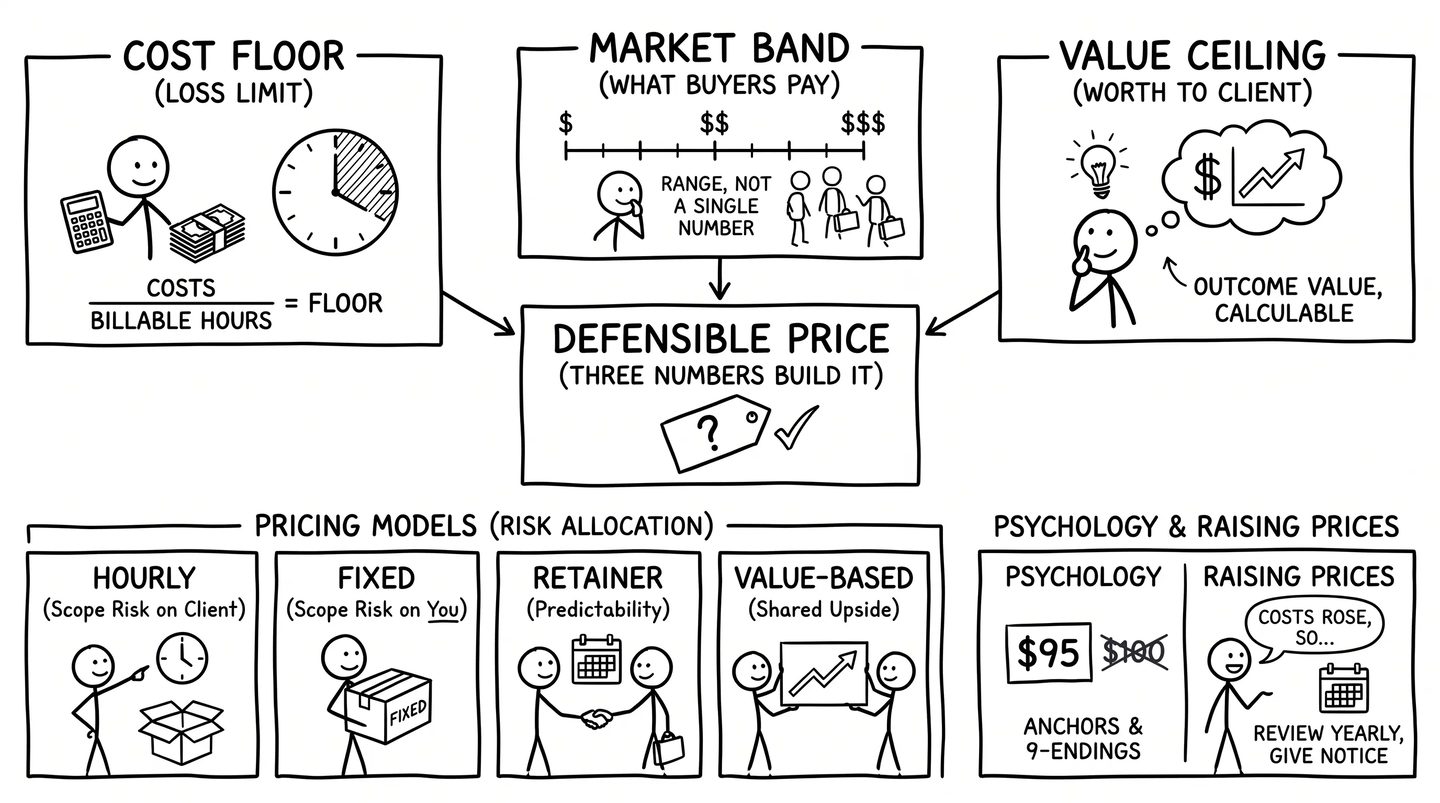
Competitors publish the rest themselves. Their price pages mark the edges of the market band described in how to price your services, and their two- and three-star reviews list what customers wanted and did not get.
How many customer interviews are enough?
For one decision about one kind of customer, five to ten interviews are a sound start, and 20 to 30 map nearly every need. Griffin and Hauser offered their figure as a hypothesis from two studies, and it describes a fairly uniform segment. Hauser’s later MIT course notes give a lower count: roughly ten one-hour interviews were enough to find 90% of the needs, and twenty usually suffice for each distinct segment (MIT OpenCourseWare, 2015). Usability research points the same way: Jakob Nielsen found that tests with five users uncover about 85% of the usability problems in a design, and advised three rounds of five users over one round of fifteen (Nielsen Norman Group, 2000, building on Nielsen and Landauer, 1993).
Both counts assume similar customers. If you sell to two groups, freelancers and small agencies for example, interview each group separately. Stop when two or three interviews in a row add nothing new.
Interview people who had the problem recently and did something about it: your current customers, prospects who chose someone else, customers of a competitor. Friends and family make the weakest sample, because they want to be kind. Recruit through your client list or a local business group, and offer something for the time, such as a $25 gift card for 30 minutes.
What should you ask in a customer interview?
Ask about what people did, and leave their predictions out. Rob Fitzpatrick’s interviewing handbook The Mom Test puts it in three rules: talk about their life instead of your idea, ask about specific past events instead of opinions about the future, and talk less than you listen. That leaves a handful of questions, each followed by “and then?”:
- The last time: “When did this last come up? Walk me through what happened.”
- What they did: “What did you do about it, and what did that cost you in money and time?”
- What they tried: “What else have you tried? Why did you stop?”
- Who decides: “Who else had a say, and who paid?”
- The gap: “What should I have asked that I didn’t?”
Leave out “Would you use this?” and “How much would you pay?”. Answers to them are forecasts, and forecasts of price run high. Across 77 studies, the price people said they would pay was on average 21% higher than the price they paid when real money was involved, and the gap was larger for more expensive products (Schmidt and Bijmolt, Journal of the Academy of Marketing Science, 2020). Stated intentions to buy also predict sales better for existing products than for new ones (Morwitz, Steckel and Gupta, International Journal of Forecasting, 2007), which is the wrong way round for anyone testing a new offer.
Record only with permission, and ask for it on the recording. Federal law allows a recording when one party to the conversation consents (18 U.S.C. § 2511(2)(d)); California requires the consent of all parties to a confidential conversation, with fines of up to $2,500 per violation (Penal Code § 632).
When is a survey worth it, and how do you write one?
A survey is worth running after the interviews, to measure how common the things you heard are. It cannot find a need you did not think to ask about, so the interviews supply its questions and its answer options.
Small changes in wording move the results. In one Pew Research Center example, 68% of Americans favoured military action in Iraq, and 43% did once the question added “even if it meant that U.S. forces might suffer thousands of casualties” (Pew Research Center).
- Alternatives instead of agree or disagree: respondents tend to agree with whatever statement they are shown, which Pew calls acquiescence bias, so offer “a choice between alternative statements”.
- Order: earlier questions give context to the later ones, Pew notes. Ask about the problem and how people handle it today before anything mentions your offer.
Panel responses are cheap. Pollfish charges from $0.95 a response, plus $0.50 for one screening question. SurveyMonkey Audience starts at $1 a response and rises with survey length and targeting (SurveyMonkey). On Prolific, participant pay is set by the researcher (at least $8 an hour, $12 recommended), with a platform fee of 42.8% added for companies. Two hundred answers to a five-minute survey cost roughly $200 to $300.
How do you test demand with real money?
What people do is stronger evidence than anything they say: a booked call counts, and a payment counts most. The cheap versions of the test take about two weeks:
- A price on a page: a page that describes the offer, states the price and asks for a booked call or a deposit, with $200 of search or social ads sending people to it. A one-page site is enough, which is also the case made in whether you need a website yet.
- A pre-order or a paid pilot: three customers who pay before the full service exists.
- An offer to existing clients: one email to your client list, with the price in it.
Count bookings and payments, and hold them against the result you wrote down at the start. For a one-person service business the first paid job is already this test, as the guide to starting a business with no money argues, and the conversion rate of the page decides how much traffic you need to buy.
Can ChatGPT do market research?
ChatGPT and similar assistants are useful for the desk research and unreliable as stand-ins for customers. They summarise public reports, list competitors and their prices, draft an interview guide and sort interview notes into themes; check every figure they give you against the original source.
When political scientists had ChatGPT answer a national election survey, its answers varied less than real ones, shifted with small edits to the prompt, and the same prompt gave significantly different results three months apart (Bisbee et al., Political Analysis, 2024). The authors of a Harvard Business School working paper that had reported encouraging results revised it in April 2026: willingness-to-pay estimates from language models “are sometimes comparable to estimates from human studies, but are often inaccurate and in some cases wrong-signed”, and “a researcher without a human benchmark would not have been able to identify the failures in advance” (Brand, Israeli and Ngwe, HBS Working Paper 23-062). They conclude that language models belong in market research as a supplement to human studies.
What does market research cost a small business?
| Step | What it answers | Cost | Time |
|---|---|---|---|
| The decision and the drop criterion | What you need to know | $0 | 1 hour |
| Desk research | How many competitors, what people search for and spend | $0 | Half a day |
| 10 customer interviews | What they do now, what it costs them, what would make them switch | $250 in $25 gift cards | About 10 hours plus scheduling |
| Survey, 200 responses | How common the main finding is | $200 to $300 | One week |
| A test with real money | Whether people act at your price | $200 in ads | Two weeks |
A two-person bookkeeping firm in Columbus, Ohio, is weighing a fixed monthly package for freelancers at $150 a month. It writes down the rule first: launch if at least four of ten freelancers interviewed already pay for help with their books, and if at least three people book a call from a test page within two weeks.
Desk research takes an afternoon. County Business Patterns for 2023 counts 118 “other accounting services” establishments in Franklin County, 83 of them with fewer than five employees, and 203 offices of certified public accountants (data.census.gov); bookkeepers who work alone are counted separately, in Nonemployer Statistics. The price pages of the nearest competitors give the range the package has to sit in.
Ten interviews with freelancers from the client list cost $250 in gift cards and about ten hours. They show what the survey should measure, for example whether freelancers struggle more with quarterly tax estimates or with receipts. A survey of 200 US freelancers on Prolific, five minutes long at the recommended $12 an hour, costs about $286 with the platform fee. The test page runs for two weeks on $200 of search ads. The total is $736 and about three weeks, or $450 without the survey, and if fewer than three people book a call, the firm learns it before building the package.
If you would rather have someone run the interviews and the desk research with you, that is our research work, and turning the findings into a plan and a price is part of consulting.