

Unpaid Invoice: What to Do, Step by Step, and What the Law Lets You Add to the Bill
- Published —
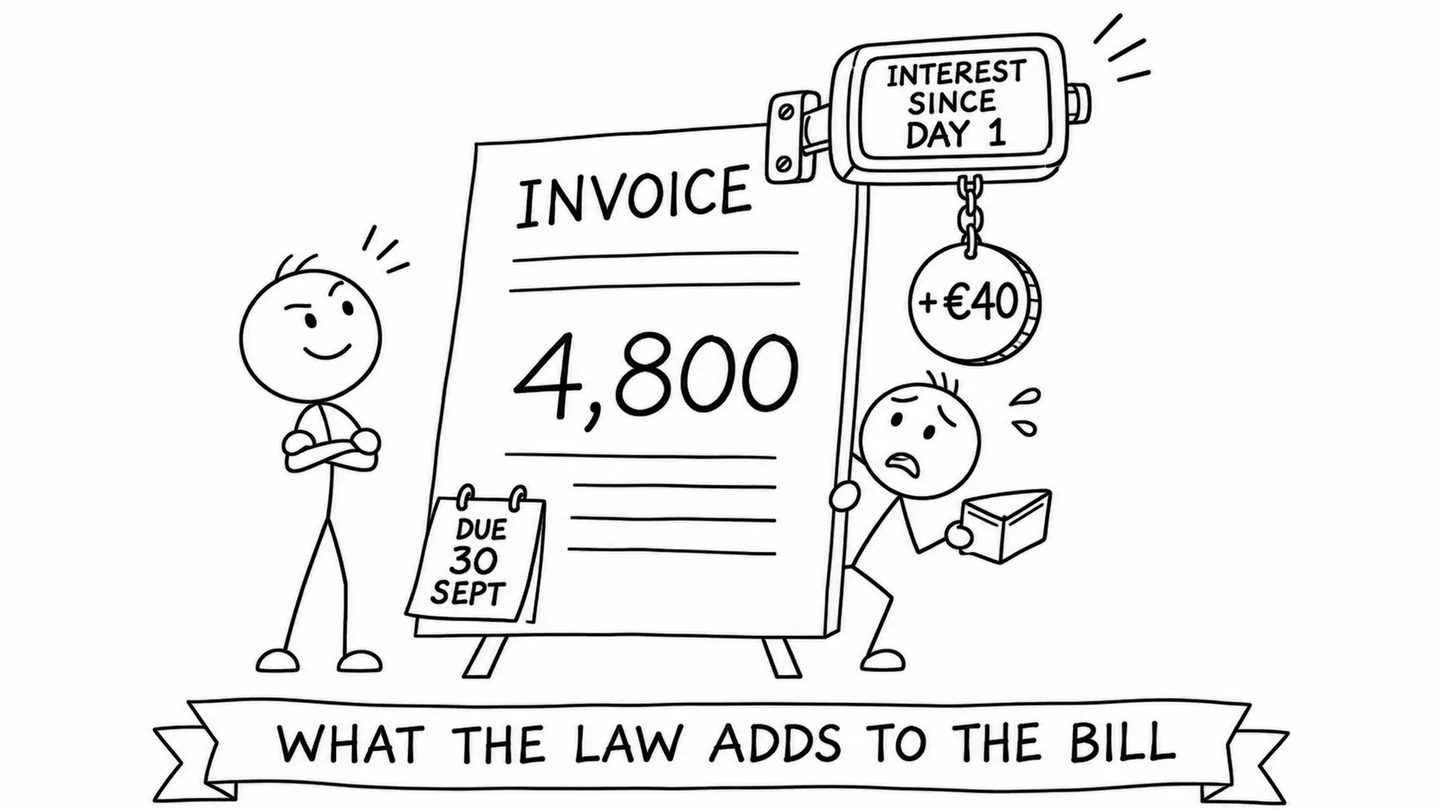
Short answer: send a reminder the day after the due date, addressed to the person who approves payment, with the invoice and a way to pay. Follow up after a week, then send a final demand with a deadline and your next step: small claims court, a collection agency or a lawyer. In the EU a late business invoice earns a fixed €40 and, unless the contract sets its own rate, statutory interest (at least 10.40% a year in the second half of 2026), without any reminder; in the UK, 11.75% and £40 to £100. In the US a late fee is owed only if your terms set one, while state law adds interest on the unpaid debt, 9% a year in New York and 10% in California.
Half of American small employers say uneven cash flow, which the Federal Reserve’s survey defines to include collecting on receivables, was a financial challenge in the past year (2026 Report on Employer Firms, Small Business Credit Survey). In Europe, companies give business customers 43 days to pay and are paid after 63 on average (Intrum, European Payment Report 2026).
What a late invoice earns its sender depends on where the client is. Under EU law, a business that pays another business late owes interest from the day after the due date and a fixed €40, with no reminder needed. UK law adds £40 to £100 and interest at 8 points over the Bank of England rate. The United States has no national rule: a late fee depends on your terms, interest on an unpaid contract debt depends on your state, and New York and California now let freelancers claim up to double what they were not paid.
What should you do the day an invoice goes unpaid?
Check that the invoice was correct and reached the person who approves payment, then send a reminder the day after the due date with the invoice attached and a way to pay. If that does not work, escalate on a fixed schedule:
- Day 1 after the due date: a short, friendly email to a named person, with the invoice, the amount, the due date and a payment link or bank details.
- Day 7: a second email and a phone call. State the amount again and, where your terms or the law provide it, the late fee or interest that has started to run.
- Day 14 to 21: a final demand letter with a calendar date for payment and the step you will take after it. If your contract lets you pause work for non-payment, say so here.
- After the deadline: file in small claims court, place the debt with a collection agency, or ask a lawyer to send a demand on letterhead.
Keep every email and note every call. If the dispute reaches a court, that record shows what you asked for and when.
How should a payment reminder be worded?
Address the person by name, state the exact amount and the date it was due, and make paying the easiest reply. We found no published field experiment on reminders for invoices between businesses; the evidence comes from governments collecting fines and taxes, and from banks.
- The recipient’s name: in a UK trial with 1,054 people who owed court fines, 5% paid with no text message, 23% after a standard text and 33% after a text that used their name (Behavioural Insights Team, Test, Learn, Adapt, Cabinet Office, 2012). A second trial with 3,633 people found that personalised texts also raised the average amount repaid by over 30%.
- What other people do: letters to overdue taxpayers saying that most people pay on time raised the share who paid within 23 days by 1.3 to 5.1 percentage points, depending on the wording (Hallsworth, List, Metcalfe and Vlaev, NBER, 2014).
- Timing: reminders of upcoming credit card payments cut late-payment fees by 14% (Medina, Review of Financial Studies, 2021).
A first reminder: “Hi Dana, invoice 2026-118 for $4,800 was due on September 30 and we haven’t received payment yet. I’ve attached it again, with a link to pay by card or bank transfer. Could you confirm it reached you and let me know when it is scheduled?” It names the person who approves invoices, gives the number, amount and date, makes payment one click, and ends with a question that is easy to answer. The second reminder adds what the terms or the law now add to the bill.
Can you charge a late fee or interest on an unpaid invoice?
In the US, a late fee is enforceable when your client agreed to it before the work, usually in the contract or quote. A fee that first appears on the invoice, after the client accepted your price, is one the client never agreed to. State law then decides how much you can charge and what interest a court awards. In the EU and the UK, statutory interest and a fixed recovery sum apply to a late business invoice whenever the contract sets no interest rate of its own.
- United States: no federal rule covers late fees on private business invoices. In California a liquidated-damages clause such as a late charge, in a contract that is not a consumer contract, “is valid unless the party seeking to invalidate the provision establishes that the provision was unreasonable” (Cal. Civ. Code § 1671(b)). A contract debt there bears interest of 10% a year after a breach if the contract sets no rate (§ 3289). New York awards interest “upon a sum awarded because of a breach of performance of a contract” (CPLR 5001) at nine per centum per annum (CPLR 5004), and a corporate client cannot use usury as a defense there except against rates above 25% a year (GOL § 5-521).
- European Union: a business creditor is “entitled to interest for late payment without the necessity of a reminder”, from the day after the due date, at the ECB’s main refinancing rate plus at least eight percentage points; the ECB rate in force on 1 January sets the first half-year and the rate on 1 July the second (Directive 2011/7/EU, Art. 2 and 3). The ECB rate was 2.40% on 1 July 2026, so the minimum for the second half of 2026 is 10.40% a year (ECB key interest rates). On top comes “a fixed sum of EUR 40” (Art. 6), owed for each late invoice (Court of Justice, C‑585/20, 2022), plus reasonable recovery costs above that. A contract term that excludes the interest altogether is “grossly unfair” (Art. 7).
- United Kingdom: statutory interest is 8% over the Bank of England rate in force on 30 June or 31 December before the debt fell due (SI 2002/1675). Bank Rate was 3.75% on 31 December 2025 and on 30 June 2026, so the rate is 11.75% for debts that fell due in 2026 (Bank of England). A different interest rate in your contract replaces it: “You cannot claim statutory interest if there’s a different rate of interest in a contract” (GOV.UK). The fixed sum is £40 under £1,000, £70 up to £9,999.99 and £100 from £10,000 (Late Payment of Commercial Debts (Interest) Act 1998, s. 5A).
One invoice for 4,800 dollars, euros or pounds, due on 30 September 2026 and paid on 14 November, 45 days late:
| Where the client is | What applies | Added to the invoice |
|---|---|---|
| US, contract says 1.5% per 30 days on overdue balances | The late fee you agreed, prorated by day | $108.00 |
| US, contract silent, client in New York | 9% a year from the breach, awarded by a court | $53.26 |
| EU, contract silent | 10.40% a year plus €40 | €101.55 |
| UK, contract silent | 11.75% a year plus £70 | £139.53 |
Member states can set the EU rate higher than the minimum; Slovakia, for example, also lets the creditor choose a fixed rate of the ECB rate plus 9 points. The European Commission’s 2023 proposal to cap business payment terms at 30 days would have tightened these rules. On 4 November 2026, the Commission said it would withdraw the proposal within six months because “a sizeable number of Member States opposes further work on the proposal” (Commission Work Programme 2027, Annex III). In the UK, the Commercial Payments Bill, which would cap large firms’ terms with small suppliers at 60 days, was still before the House of Commons in November 2026.
In Intrum’s 2026 survey, 60% of European companies said they use their rights under the directive, up from 42% in 2021. In its 2025 survey, 56% said they had accepted longer payment terms than they were comfortable with to avoid damaging a client relationship.
What can you do if the client still won’t pay?
Send a final demand letter, then choose between small claims court, a collection agency and a lawyer, depending on the amount and on whether the client disputes the work. The letter states the invoice numbers, the amount with any fee or interest, a calendar date for payment and what you will do after it; send it in a way you can prove, such as certified mail and email.
Small claims court is designed to be used without a lawyer, and an unpaid service invoice is a typical case, but the limits and the rules for businesses differ by state:
| State | Limit | Rules for a business plaintiff |
|---|---|---|
| California | $12,500 for individuals, $6,250 for a business | No more than two claims over $2,500 a year; a company appears through an officer or employee (Code Civ. Proc. § 116.220 to § 116.540) |
| New York | $10,000 in New York City, $5,000 in City Courts, $3,000 in Town and Village Courts | Corporations cannot use small claims; they file in the commercial claims part, up to five claims a month (NYC Civil Court Act § 1801 and § 1801-A) |
| Texas | $20,000 in justice court | A corporation does not need a lawyer (Gov’t Code § 27.031) |
A collection agency is the other route, and a business debt sits outside the main federal law on collectors: the Fair Debt Collection Practices Act defines a debt as an obligation “primarily for personal, family, or household purposes” (15 U.S.C. § 1692a). What a collector may do and charge then comes from your contract with the agency, so read its fee terms before you sign.
The time limit runs from the due date: four years on a written contract in California (Code Civ. Proc. § 337) and on a debt in Texas (Civ. Prac. & Rem. Code § 16.004), six years on a contract in New York (CPLR 213).
Do freelancers have extra protection?
In several places, yes, with remedies a general contract claim does not give.
- New York State: since 28 August 2024, any engagement worth $800 or more, counting all work for the same client over 120 days, needs a written contract, and the client must pay by the date in it or “no later than thirty days after the completion of the freelance worker’s services” (N.Y. Gen. Bus. Law §§ 1410–1414). A client who pays late owes double damages and attorney’s fees; a missing written contract costs $250. New York City has had the same rules since 2017.
- California: since 1 January 2025, the same 30-day rule and written-contract duty apply to “professional services” worth $250 or more over 120 days. The Labor Code lists marketing, graphic design and writing, among others, but does not name web or software development. A court can award up to twice the unpaid amount plus fees (Bus. & Prof. Code § 18106).
- Illinois: since 1 July 2024, contracts worth $500 or more over 120 days must be paid within 30 days of completion if they set no date (Illinois Department of Labor). Los Angeles has a similar ordinance for contracts of $600 or more.
Businesses that sell to the federal government have their own rule: an agency that pays late owes an interest penalty “without regard to whether the business concern has requested payment” (31 U.S.C. § 3902), at 4.75% a year from July to December 2026 (Treasury).
How do you keep the next invoice from going late?
Payment terms are agreed before the work starts, and in the US they are the only source of a late fee.
- Deposits and milestones: on any job longer than a few weeks, split the price into a deposit and payments at milestones, as set out in the payment terms of a well-written quote.
- A late-fee term and a calendar due date: “Due 30 October 2026; balances unpaid after that date carry 1.5% a month” leaves nothing to argue about. In the EU and the UK the statutory rate applies when the contract sets none; in the US this sentence is what makes a fee collectable.
- Retainers billed in advance: for ongoing work, invoice at the start of the month; how to set that monthly price is covered in how to price your services.
- Invoice the day you deliver: payment periods run from the invoice, so every day it waits in a draft delays the money by a day. Across Europe, structured e-invoices are becoming mandatory between businesses on the EU e-invoicing timeline to 2030, and a machine-readable invoice is also easier to match to its payment automatically.
This is general information about the rules, not legal advice on a particular claim. If you want reminders and late-fee calculations to go out from your invoicing system on their own, that is part of our automation work, and a review of your contracts and payment terms is part of consulting.