
How Much Does an App Cost in 2026? The Build Got Cheap. Owning It Didn't.
- Published —
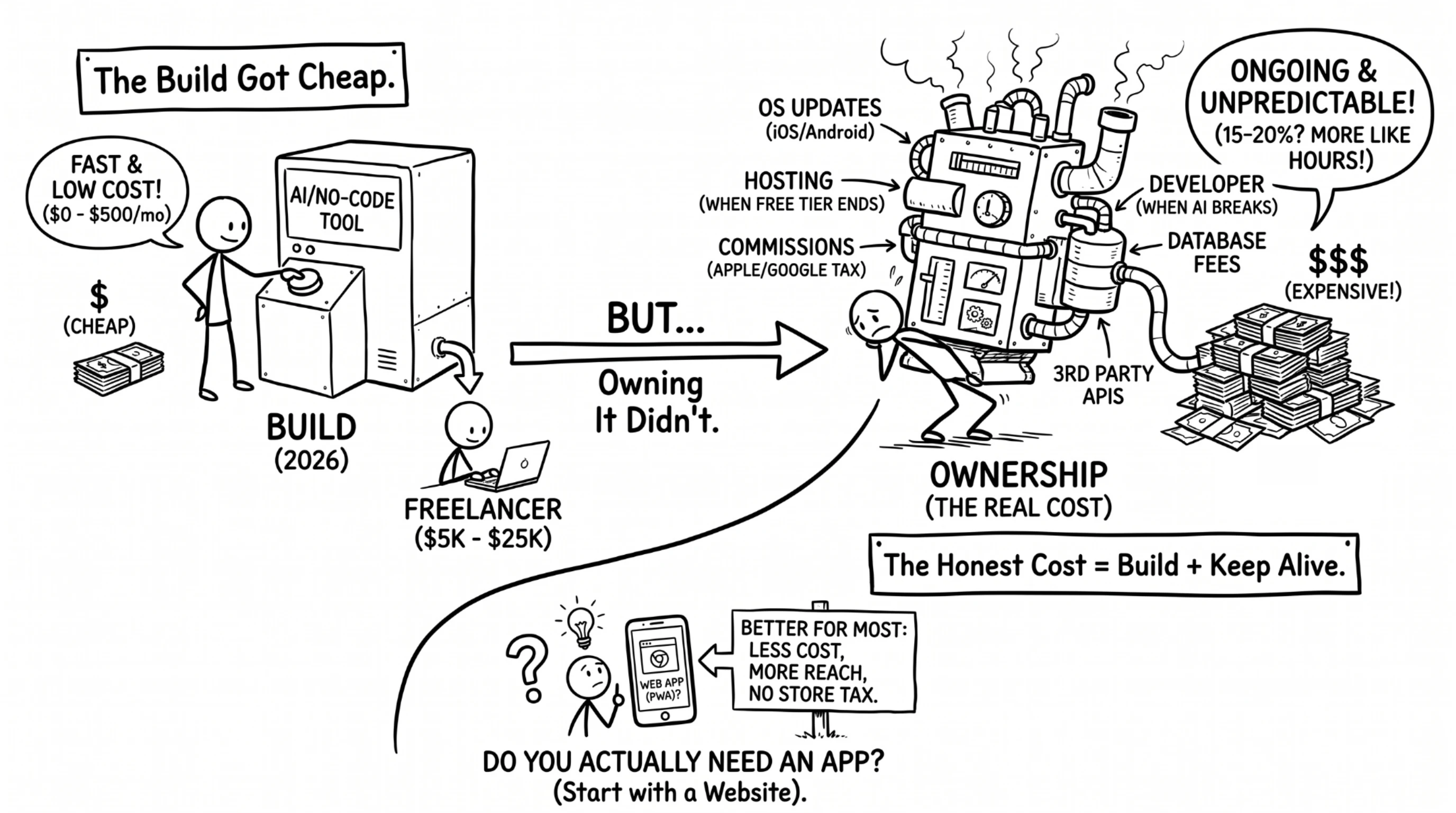
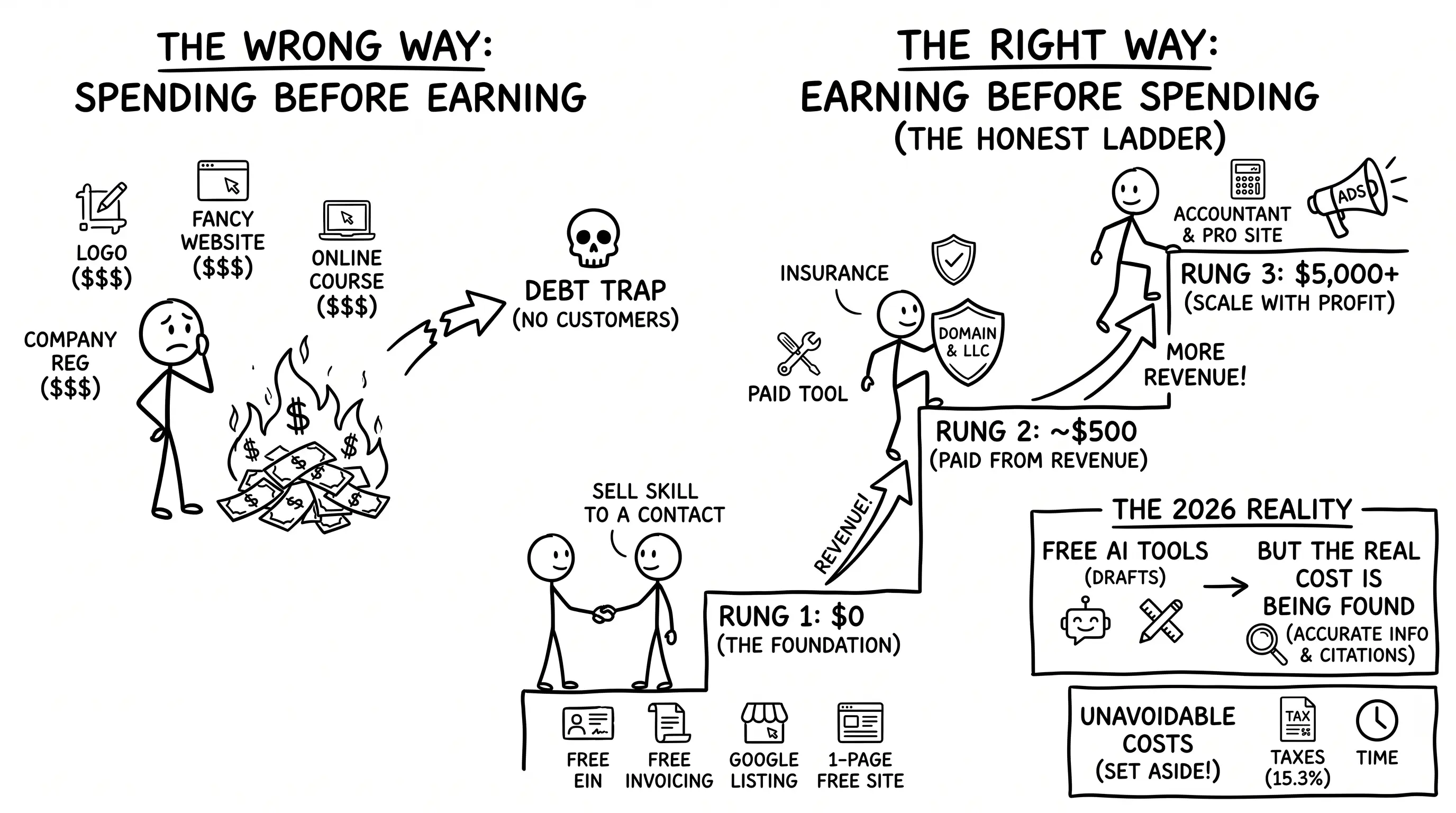
Short answer: a working first version can cost almost nothing to build in 2026, from an AI or no-code tool at $0 to $500 a month to a freelancer at $5,000 to $25,000 and an agency from about $25,000 upward. Publishing it costs $99 a year at Apple and $25 once at Google, and a small app can run on free hosting tiers for months. The real number is what it costs to own the thing: updates every time iOS and Android move, hosting the day the free tier ends, commissions on every sale, and the developer you will need when the AI-built version breaks. Most of the guides on page one skip that part, because they are written by the people selling the build.
The most repeated number in app pricing has no author. Every guide ranking for this question tells you to budget 15 to 20 percent of the build cost, every year, to keep an app alive. Google’s AI Overview calls it “a common industry standard.” Slovak development studios quote it in euros. We went looking for where it comes from. The earliest dated version is a 2012 column in a developer trade site that called it “the industry norm for software maintenance” and cited no one (FierceDeveloper, May 2012). The likeliest origin is a 2010 Forrester note about the annual fees enterprise vendors charge on perpetual software licences, “typically set at 18% to 22% of initial license fees” (Forrester, June 2010), which has nothing to do with keeping a mobile app running. Between those two documents a licence-fee convention turned into a rule for app owners, and it has been copied from one price guide to the next since.
It matters more now than it did five years ago because the question has moved. The first version of an app no longer costs much to build. An AI tool will produce a working prototype in an afternoon; a no-code platform will host one for a monthly fee; a freelancer in the right time zone will build a serious first release for the price of a used car. What did not get cheaper is everything around the build: the developer accounts, the store commissions, the hosting that stops being free, the annual operating-system updates, and the engineer you will eventually need. The useful question in 2026 is what an app costs to own, and, before that, whether you need one. What follows puts a source next to every figure.
What does it cost to build an app in 2026?
An app gets built one of four ways, and the price follows who does the work and what you own at the end. The ranges come from the sources named, not from our rate card.
| Route | What it costs | What you get | What it hides |
|---|---|---|---|
| An AI or no-code builder, yourself | $0 to about $500 a month for the platform (Base44 puts its own tier at “$0-500 a month,” and Bubble quotes “$59/month,” both August 2026) | A working app in days, hosted for you, with your time as the main cost | The app lives on the platform’s terms. Export is limited or absent, the monthly fee never ends, and Apple’s guidelines say “apps created from a commercialized template or app generation service will be rejected unless they are submitted directly by the provider of the app’s content” (App Store Review Guidelines, 4.2.6, 2026) |
| A freelancer or a small studio | Upwork’s own worked example is “800 developer hours at a rate of $18-$39 per hour,” which “would cost between $14,400 and $31,200” (Upwork, fetched 2026). Clutch’s 2026 pricing guide puts most reviewed projects “between $10,000 - $49,999” at “$25–$49/hour” (Clutch, September 2026). In Slovakia, the studios that publish prices put a simple app at “do 3 000 EUR” and a first release with user accounts and a database at roughly 3 000 to 15 000 € (rrcodes.sk, October 2025; grow-app.sk, geniumlab.com and techweb.sk, 2026) | Code you own, one or two platforms, a first release with real accounts and a database | Quality varies as widely as the rate. The cheap end is one person; when they stop answering, so does the app |
| An agency | GoodFirms, aggregating 267 development companies, puts a basic app at “$15,000 - $40,000” and a mid-level one at “$40,000 - $120,000,” with agencies charging “around $75 to $250/hour” (GoodFirms, May 2026). Business of Apps benchmarks a simple app at “$5,000 – $50,000” and a medium one at “$50,000 – $120,000” (June 2026). Slovak agencies publish 15 000 to 40 000 € for a mid-sized app with accounts, a database and integrations (regulus.team, August 2025; techweb.sk, 2026) | Design, engineering, project management and someone accountable for the whole thing | The quote is for version one. The team that built it is the team you will pay to change it |
| Enterprise | “$250,000-$500,000+” (GoodFirms, May 2026) | Compliance, integrations, real-time systems, dedicated teams | Not a small-business decision, and not what most people searching this question are buying |
The ranges disagree by an order of magnitude because they measure different things. Clutch’s figure is the median project on its platform, which is what most buyers spend; GoodFirms’ tiers are what agencies charge when the scope is serious. Both are real, and both come from someone with a stake in the answer. Bubble and Base44 sell the cheap route; GoodFirms, Clutch and Business of Apps are marketplaces for the expensive one.
Wage data is the exception. The US Bureau of Labor Statistics puts the median software developer at $135,980 a year, or $65.38 an hour, and the median web developer at $92,650 (BLS Occupational Employment and Wage Statistics, May 2025). That is what a competent developer costs an employer in the United States before overhead, and it is why US agency rates start where freelance rates elsewhere end. Upwork’s regional table for mid-level developers runs from $80 to $120 an hour in the US and Canada, $70 to $90 in Western Europe, $35 to $50 in Eastern Europe and $25 to $40 in Asia (Upwork, fetched 2026). The Slovak studios that publish an hourly rate sit inside that Eastern European band: “Agentúra typicky 40–70 €/hod na Slovensku,” and 45 to 85 € an hour for mobile work specifically (techweb.sk, 2026). A 400-hour build costs $16,000 at $40 an hour and $60,000 at $150, for the same hours. Most of the spread on page one is that multiplication.
Why did building get so cheap?
Because the first eighty percent of an app is now written by a machine, and the tools that do it charge by the month. In Stack Overflow’s 2025 survey, 84% of developers said they were using or planning to use AI tools in their development process, up from 76% the year before; in the same survey, more developers distrusted the accuracy of those tools (46%) than trusted it (33%) (Stack Overflow Developer Survey, 2025). The people who build apps for a living have adopted AI almost universally and do not trust what it writes without checking. The checking is what a developer’s fee buys in 2026; the typing has become cheap.
The demand side moved just as fast. In the AI-prompt demand data we pulled for this piece, the number of people asking an AI assistant “how to make an app” peaked in January 2026 and had fallen by roughly two-thirds by August, while in Google’s own trend data the question of what an app costs held steady every week of the year. Many people tried to build one and are now asking what it costs to keep.
The cheap route does not give you ownership, and Apple’s rules say as much. Apple’s 4.2.6 rejects template-generated apps unless the content owner submits them. A no-code platform’s export, where it exists at all, is rarely a codebase a developer will agree to maintain. And an AI-built app has a failure mode of its own, which we covered in where vibe-coded MVPs break and what fixing them costs: it works for the demo and the first fifty users, then breaks in a way nobody can debug, because nobody who can be called wrote it. The catch in the $0 build is that you pay for the build later, usually in a hurry.
Can I build an app for free?
You can build one for nothing. Publishing it costs money, because both stores charge for a developer account.
- Apple: “The Apple Developer Program is 99 USD per membership year” (Apple Developer, 2026). The fee is waived only for “a legal entity with a status as a nonprofit organization, accredited educational institution, or government entity,” explicitly “not an individual, sole proprietor, or single-person business,” and only if you do not sell anything digital inside the app (Apple, membership fee waiver, 2026). The Enterprise Program for in-house distribution is 299 USD a year and requires 100 or more employees.
- Google: “There is a US$25 one-time registration fee” for a Play Console account (Google Play Console Help, 2026). Personal accounts created after 13 November 2023 must also run a closed test with “a minimum of 12 testers who have been opted in continuously for at least 14 days” before they can publish to production (Google, 2026). The 20-tester figure still circulating is the 2023 rule; the current page says 12.
Do I need an LLC to start an app? No. Apple’s enrollment page is explicit: “If you’re enrolling as an individual, you don’t need a D‑U‑N‑S Number.” The number only matters if you enrol as an organization, in which case both Apple and Google require one, Apple adds that “we do not accept DBAs, fictitious business names, trade names, or branches,” and Google warns that getting the number “can take up to 30 days so you should plan ahead” (Apple Developer and Google Play Console Help, 2026). Whether you want a company for liability or tax reasons is a separate question, covered in what a legal form actually costs. The stores do not require one.
Google is adding a requirement on Android. Google’s developer verification requirement, announced in August 2025, takes effect for apps distributed through participating stores in Brazil, Indonesia, Singapore and Thailand on 30 September 2026, with a global rollout planned for 2027 and beyond (Android Developers Blog, June 2026). Enforcement at that date is scoped to those stores; installing through developer tools remains possible. For a small business it means the identity checks Apple already runs will soon apply on Android too.
How much does it cost to run an app per month?
It depends on scale more than the guides admit. The AI Overview on this exact question answers “$500 to $5,000+ per month for most standard business applications,” sourced to two development shops. That describes an app with tens of thousands of active users, not the first version most readers will launch. The table lists each monthly cost with its free tier and the point at which the free tier ends.
| Line item | Free tier | Where free ends | Source |
|---|---|---|---|
| Database and login (Firebase) | Spark plan: “1 GiB total” Firestore storage, “50K reads/day,” “20K writes/day,” “50K MAUs” for authentication, no card required | Any server-side function: “to deploy functions, your project must be on the Blaze pricing plan,” which is pay as you go | Firebase pricing and docs, 2026 |
| Database and login (Supabase) | “$0/month,” “Limit of 2 active projects,” “500 MB database size,” “50,000 monthly active users” | “Free projects are paused after 1 week of inactivity”; Pro is “from $25/month” | Supabase pricing, 2026 |
| Web app hosting (Vercel) | “$0/mo.” | The day you charge money: “Our Hobby plan is for personal, non-commercial use.” Pro is $20 per seat a month | Vercel pricing, 2026 |
| API and static hosting (Cloudflare Workers) | “100,000 per day” requests | Paid plan “$5 USD per month for an account” with “10 million included per month” | Cloudflare, updated August 2026 |
| Building the iOS and Android binaries (Expo EAS) | “15 Android and 15 iOS builds” a month on a low-priority queue | Starter at “$19/month plus additional usage cost” | Expo pricing, 2026 |
| Transactional email (Resend) | “3,000” emails a month, “100 emails per day” | Pro “$20/mo” for 50,000 | Resend pricing, 2026 |
| SMS (Twilio, US) | None | “$0.0083” per outbound message segment | Twilio US SMS pricing, 2026 |
| Card payments (Stripe) | No monthly fee | “2.9% + 30¢ per successful transaction for domestic cards” in the US; “1.5% + €0.25 for standard European Economic Area cards” | Stripe pricing, 2026 |
| Subscription plumbing (RevenueCat) | “Pay nothing for up to $2,500 in monthly tracked revenue” | “Then pay 1% of what you track” | RevenueCat pricing, 2026 |
| Store membership | None | $99 a year (Apple), $25 once (Google) | Apple Developer, Google Play Console Help, 2026 |
Add that up for an app with a few hundred users and a login and our estimate is roughly $10 to $50 a month, most of it the Apple fee amortised and a paid database tier once the free one pauses. Add it up for an app with 20,000 monthly users, background jobs, SMS verification and a support inbox and the vendor figure of several hundred dollars a month becomes realistic, because every free tier in that table has been crossed. Both figures are right for different apps. The error is budgeting for the second while you still have the first, or the other way round.
Two lines in the table catch people out. Vercel’s free plan is where many AI-built prototypes end up, and its terms limit it to personal, non-commercial use; the first paying customer moves you to the paid tier. Supabase pauses idle free projects after a week, which is why a prototype that worked last month sometimes greets its first real user with an error.
What do the stores take from every sale?
It depends on what you sell and where, and the answer changed twice in the last eighteen months.
If the app sells something digital, a subscription, premium content, a full version, Apple’s rule is unambiguous: “you must use in-app purchase” (App Store Review Guidelines, 3.1.1, 2026). Apple’s standard commission is 30 percent. The App Store Small Business Program cuts that to “a reduced commission rate of 15% on paid apps and In-App Purchases” for developers who “made up to 1 million USD in proceeds in the prior calendar year” (Apple, 2026). On subscriptions “you receive 70% of the subscription price” in a subscriber’s first year and 85% after that; Small Business Program members get 85% from day one (Apple, subscriptions, 2026). For almost every business reading this, Apple’s cut on digital sales is 15 percent.
If the app sells something physical or a service delivered outside the app, a table, a haircut, a delivery, a course taught in a room, the commission is zero, because Apple forbids in-app purchase for it: “you must use purchase methods other than in-app purchase to collect those payments, such as Apple Pay or traditional credit card entry” (App Store Review Guidelines, 3.1.3(e), 2026). That app pays its card processor, which at Stripe is 2.9% plus 30 cents in the US and 1.5% plus 25 cents on European cards, not the store.
In the United States, since Apple’s guideline update of 1 May 2025 following the court ruling in Epic v. Apple, apps on the US storefront may link out to external purchases, and Apple has charged no commission on those purchases since. The Ninth Circuit found in December 2025 that a 27 percent commission “had a prohibitive effect” and sent the case back to set a permissible rate, which has not yet been fixed, so the zero is provisional (Ninth Circuit, No. 25-2935, December 2025; Apple Developer News, May 2025). On Google Play, for transactions with users in the US, the EEA and the UK from 30 June 2026, the old “15% for the first $1M” then 30% structure was replaced by a service fee plus a separate 5 percent billing fee, with new installs of most apps at 10 percent plus the billing fee up to $1 million a year and subscriptions at 10 percent plus the billing fee (Google Play Console Help, 2026). Outside those regions the 15 and 30 percent tiers still apply. A guide that quotes one flat number for Google is out of date.
In the European Union the picture changes again on 1 October 2026. Under the Digital Markets Act, EU users can already install apps from alternative marketplaces or “directly from an authorized developer’s website,” and Apple’s interim EU terms, with their per-install Core Technology Fee and separate acquisition and store-services fees, are being replaced by a single set: 26 percent on App Store in-app purchases (15 percent for Small Business Program members and for subscriptions after their first year), 20 or 10 percent when an app uses its own payment processing, 15 or 10 percent on purchases made within seven days of a link out of the app, and “a simple 5% commission on digital transactions in apps distributed outside the App Store” (Apple Developer, terms updated 18 August 2026). Google’s external offers program for the EEA has moved the same way: since 4 June 2026 it charges no initial acquisition fee and an ongoing 10 percent on subscriptions or 20 percent on other digital items sold after a link out, 10 percent on the first million dollars a year (Google Play Console Help, 2026). Both stores are moving the same way: lower headline rates, more ways to pay outside the store, and nothing at zero.
Where does the 15 to 20 percent maintenance rule come from?
From a licence-fee convention, as far as the trail goes. The Forrester note the figure appears to descend from was about the fees enterprise vendors charge on perpetual licences: “software maintenance fees … typically set at 18% to 22% of initial license fees” (Forrester, June 2010). Two years later a developer trade column turned that into advice for app owners: “the industry norm for software maintenance is about 15 to 20 percent of the original development costs. So if your app cost $100,000 to build, roundly estimate to pay about $20,000 per year” (FierceDeveloper, May 2012). No study is cited in either place, and none of the 2026 guides that repeat the figure cite one either; the ones that name “Gartner” or “Forrester” as the source do not link a document, and the Forrester document says something else. The academic literature on software maintenance measures it as a share of lifetime cost, not a yearly percentage of the build.
In practice, maintenance in 2026 is a short list of predictable jobs:
- Operating-system updates: Apple and Google each ship a major release every autumn, and each one deprecates something. An app that is not rebuilt against the new version eventually stops passing review or stops working.
- Dependency updates: the libraries inside your app get security patches, and the stores increasingly require you to take them.
- Store policy changes: the 12-tester rule, developer verification, privacy labels, new fee structures. Every one of these arrives as an email with a deadline.
- Bug fixes and small changes: the real cost, and the only one that scales with how much the app is used.
Budget them in developer hours, which is what you are buying. A small app with a few thousand users typically needs three to five developer days a quarter to stay current, which at the BLS median of $65 an hour is on the order of $1,500 to $2,600 a quarter in the US, and at the 40 to 70 € an hour Slovak agencies publish, roughly 1 000 to 2 800 € a quarter. That is our estimate; set it against your own quote. It has no relationship to what the build cost. A $5,000 AI-assisted build and a $50,000 agency build of the same app need the same operating-system update.
Do you actually need an app?
For most small businesses, no, and Apple says so more bluntly than any agency will. Guideline 4.2, Minimum Functionality, opens: “Your app should include features, content, and UI that elevate it beyond a repackaged website. If your app is not particularly useful, unique, or ‘app-like,’ it doesn’t belong on the App Store” (App Store Review Guidelines, 2026). The subclause after it adds that “apps shouldn’t primarily be marketing materials, advertisements, web clippings, content aggregators, or a collection of links.” A restaurant menu, a salon’s booking page, a shop’s catalogue, a company brochure: these are websites, and the store that would host them as apps has written down that it does not want them.
The alternative has matured. An installable web app, the thing the industry calls a PWA, needs two things to be installable: it “must be served using the https protocol” and it must ship a web app manifest with a name, an icon and a start URL (MDN, September 2026; web.dev install criteria, 2024). A service worker is optional and only needed for offline use. On an iPhone, “you can add a website icon to your iPhone Home Screen,” and since iOS 16.4 the same site can be installed from the Share menu in Safari and other browsers and can receive push notifications once it is on the Home Screen (Apple iPhone User Guide, 2026; MDN, 2026; WebKit, 2023). Apple briefly planned to remove Home Screen web apps in the EU in early 2024 and reversed within weeks, stating “we will continue to offer the existing Home Screen web apps capability in the EU” (Apple statement, 1 March 2024).
A web app costs what a website costs, which we have priced separately in how much a website costs, and it carries none of the lines above: no store fee, no commission, no review, no annual rebuild against a new operating system, and it is findable by Google and by AI assistants, which an app is not. It is the same test we applied to whether a business needs a website at all.
Native is the right call when the phone’s hardware or the store’s distribution is the product. That means apps that use the camera, GPS in the background, Bluetooth, or the file system in ways a browser cannot; apps whose users expect to find them by searching the store; apps that must work with no connection at all; and apps whose whole business is a subscription that people will pay for inside the store. If your idea is one of those, build the app. If it is a website with ambitions, build the website first and let the customers tell you whether the app is missing.
Is owning an app profitable?
Usually not, on the largest dataset available. RevenueCat’s 2026 State of Subscription Apps report, drawn from “over 115,000 apps, representing more than $16 billion in revenue,” finds that across all categories 17.3% of newly launched apps reach $1,000 in monthly revenue within their first two years, and 4.6% reach $10,000. One year after launch, “if you’re at ~$72/mo, you’re at the overall median”; the top quartile is above $429 a month and the top 10 percent above $2,574 (RevenueCat, March 2026). Half of all apps grew monthly revenue by at least 5.3 percent year on year, while the bottom quarter shrank by a third.
Those are subscription apps, the category with the clearest path to revenue, and the median one earns less in a month than its Apple membership costs in a year. The report also settles a design argument: apps that ask for payment up front convert “~5× higher than freemium,” a median of 10.7 percent of downloads against 2.1 percent, and after a year both models retain almost the same share of subscribers (RevenueCat, 2026). On that data, free-to-download is the more expensive model.
The same data answers the follow-up question, what an app with 100,000 users is worth: on its own, nothing. An app is worth what its users pay, multiplied by how long they stay, minus what it costs to keep them. A hundred thousand free users on a $0 plan is a hosting bill. Ten thousand users who pay and renew is a business. Before the build starts, the useful exercise is to write down who pays, how much, and how often, and to notice whether that sentence still makes sense with 15 percent taken off the top.
How do you get a quote you can actually compare?
By making every bidder price the same thing in the same unit. The reason five quotes for “an app” come back between $8,000 and $80,000 is rarely that four of them are dishonest; it is that each studio priced a different app. Three things help.
- Write a one-page brief before you ask anyone. The screens, in order. The accounts and roles. What the app stores and what it fetches from elsewhere. Which platforms. What happens when the user is offline. What you sell inside it and how. A page is enough; a studio that needs more will ask, and the questions it asks tell you how careful it is.
- Ask for hours and a rate, not a number. “About 300 hours at 60 € an hour” is a quote you can compare and negotiate. “18 000 €” is not. If a studio will not break its price into time, it is either guessing or hiding a margin, and either way you cannot tell which parts are expensive.
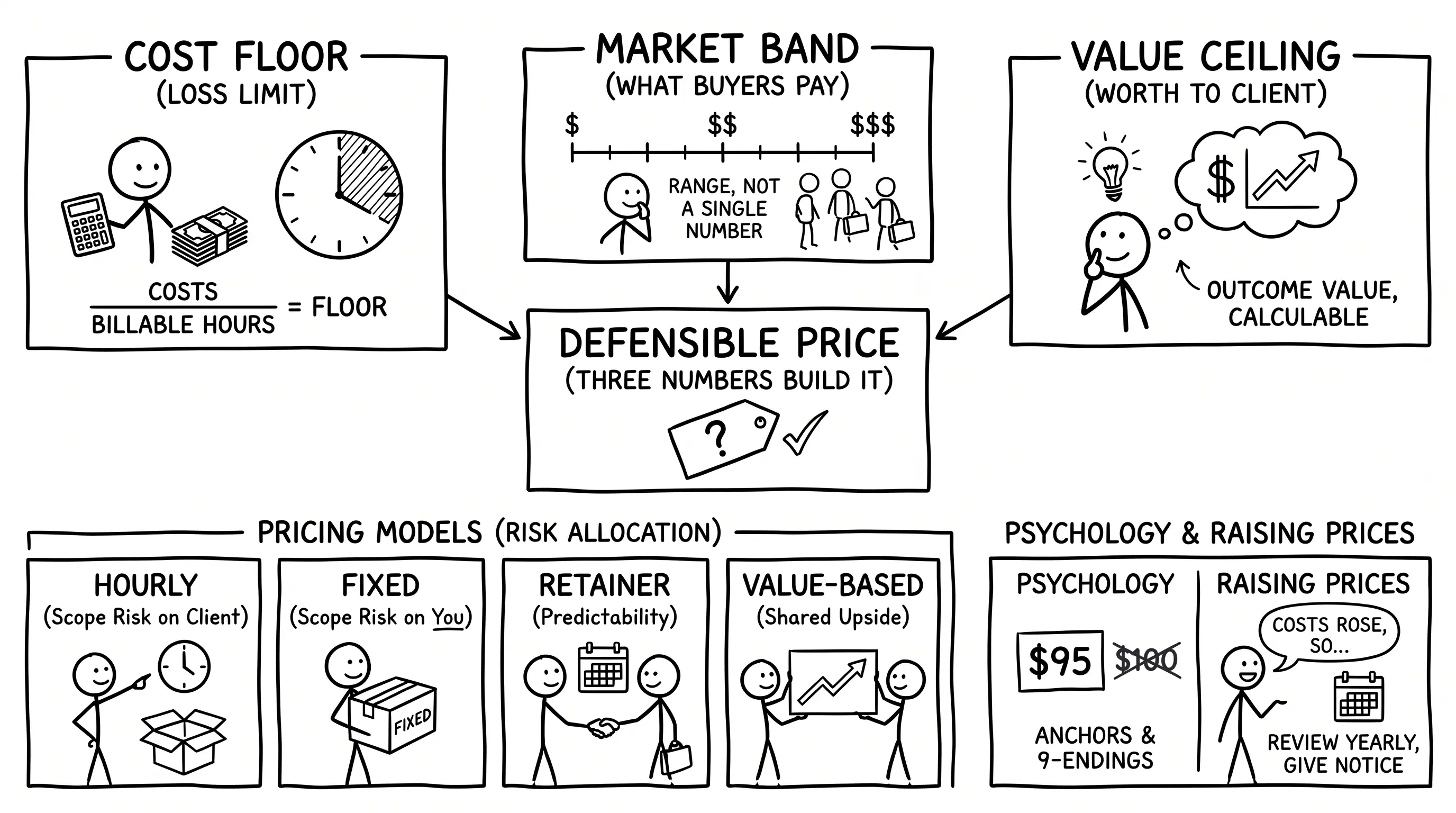
- Price version one, then stop. The quote should cover a first release with the features on your page and nothing else. The second version is priced when the first one has users, and the same logic that applies to pricing your own services applies to buying them: the scope sets the price, and an open-ended scope cannot be priced.
A fair quote from a small studio in 2026 will separate the build from the run, name the platforms and services in the table above, tell you which of them will cost money in month one and which in month twelve, and say who owns the code and the accounts when the engagement ends. If it does not, ask.
Building the right first version, and knowing when a web app is the right first version, is the work we do in MVP development and web and app development; if you have the one-page brief and want a number for it, send it over.