
Your Vibe-Coded MVP Worked — Until It Didn't: Where AI-Built Apps Break and What Fixing Them Costs
- Published —
The honest answer: AI app builders are brilliant at getting you to a working demo and unreliable at everything after it. A vibe-coded MVP proves your idea can exist. It does not prove the thing can be run securely, scaled, or handed to the next engineer without a rewrite. The break points are predictable, and the bill for fixing them usually beats the cost of building it properly once.
A vibe-coded MVP has a very specific life cycle. It works in the demo. It works for the first fifty users. It works right up until a paying customer does something you never tested, or a stranger notices the signup form trusts whatever the browser tells it, and then it breaks in a way you cannot debug, because you did not write the code and neither did anyone you can call.
That is the moment this article is about: the flip from look what I built in a weekend to why is production on fire and who do I pay to fix it. AI app builders are genuinely good tools. They are also the reason a lot of founders are about to spend more money undoing an app than they would have spent building it once. Both things are true, and knowing which side of that line you are standing on is worth real money.
Where AI app builders genuinely earn their keep
Start with the honest good news, because the skeptics overcorrect. For a whole class of work, an AI app builder is the right call and hiring a studio would waste your budget.
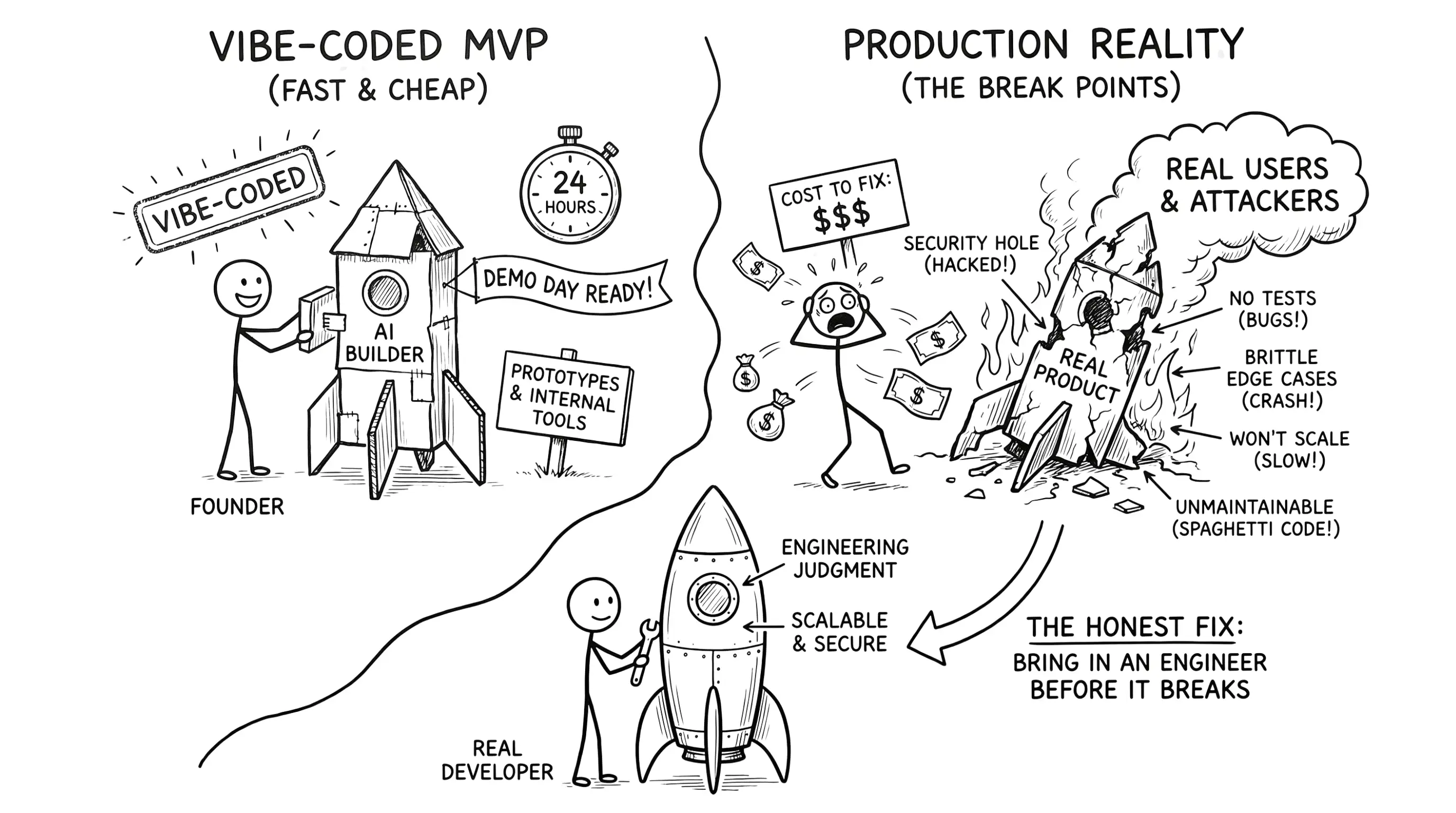
- Prototypes and pitch demos. If you need something clickable to put in front of an investor or a first customer next week, a vibe-coded build gets you there in hours. Disposable by design is the point, not a flaw.
- Internal tools. A dashboard five colleagues use behind a login, a script that reformats your exports, an admin panel no outsider will ever touch. The blast radius is small and the stakes are low.
- Testing a demand hypothesis. The fastest way to learn whether anyone wants the thing is to ship a rough version and watch. An AI builder is a superb instrument for discovering you were wrong before you spend three months being wrong expensively.
The common thread: none of these has to survive contact with real users, real money, or real attackers. That is exactly where speed beats rigor. The trouble starts when a build meant to answer a question quietly becomes the actual product.
Is vibe coding good or bad?
Neither, and the question is a trap. Vibe coding is a tool, and tools are good or bad only relative to the job. The more useful signal is that the market’s own mood has turned, and you can watch it turn in what people search for.
The term is still enormous: “vibe coding” draws about 110,000 US searches a month, roughly double its mid-2025 baseline, according to Google keyword trend data from 2026. But the growth has moved into the doubts. Searches for “is vibe coding bad” are up 212% year over year in that same data, and “vibe coding security” is up 80% at a startling ~$83 cost-per-click — a number you only see when people are paying real money to fix a real problem.
Good uses and bad uses split cleanly. Vibe coding is fine when the cost of being wrong is low and the code is disposable. It turns risky the moment the code becomes load-bearing: handling other people’s data, taking payments, or standing in for a product you intend to sell. The danger is not that the tool is bad. It is that the same fifteen-minute build feels identical whether you are in the safe zone or the dangerous one.
Where vibe-coded apps break
When these builds fail, they fail in the same five places almost every time. None of them show up in a demo, which is exactly why they are dangerous.
- Security. AI-generated code introduced a real security vulnerability in 45% of cases, according to Veracode’s 2025 GenAI Code Security Report, and the models did not get better at security even as they got better at writing working code. A vibe-coded app will happily ship an auth check that runs in the browser, a database query open to injection, or an API key sitting in the front end. It runs perfectly and it is wide open.
- No test coverage. AI builders optimize for code that runs now, not code you can change later without fear. With no tests, every future edit is a gamble: fix one thing, silently break two others, hear about it from customers.
- Brittle edge cases. The happy path works because that is what got demonstrated. The empty state, the duplicate submission, the expired token, the user in a different timezone with a name the form did not expect — those are where it cracks, and real users find every one.
- Architecture that will not scale. Choices that are invisible at fifty users turn fatal at fifty thousand: no caching, no rate limiting, queries that reload the world on every click. The app does not slow down gracefully. It falls over.
- Code no one can maintain. The quiet killer. The build works, but it is a pile of generated code with no structure, no documentation, and no author. The founder who prompted it cannot explain it, and the next engineer has to reverse-engineer intent before touching a line.
Can you build a real product with AI?
Yes, with an asterisk that changes everything. You can build a real, revenue-earning product with heavy AI assistance. Plenty of shipping software today was written faster because of it. What you cannot do is skip the engineering judgment about what the AI produced.
The distinction is AI as an accelerator versus AI as a substitute. As an accelerator, in the hands of someone who reads the code, tests it, hardens the security, and structures it to grow, it is one of the best productivity gains software has seen in years. It is the same technology that, properly supervised, lets AI agents do real operational work. As a substitute for that person, it is a loan with a hidden interest rate: you get the app now and pay for it later, with interest, when it breaks.
The buying journey shows founders learning this in real time. Searches for “mvp development” have fallen 70% year over year and “hire app developer” is down 80%, while “ai app builder” climbed 124%, according to Google keyword trend data from 2026. Founders are trying the builder first. Many will ship something real. Some will hit one of the five break points above and go hunting for a developer at the worst possible moment: after the thing is live and failing.
When do you need a real developer instead of an AI app builder?
Draw the line the moment the app stops being an experiment and starts being a promise. A few concrete triggers:
- You are handling other people’s data. Logins, personal details, anything covered by GDPR. That 45% security-failure rate stops being a statistic and becomes your liability.
- Money moves through it. Payments, subscriptions, payouts. A bug here is not a support ticket, it is a refund, a chargeback, or a fraud case.
- Downtime costs you customers. Once people rely on the app to run their day, “it fell over and I can’t fix it” is an existential problem, not an inconvenience.
- It changes every week. A living product that keeps shipping features needs a codebase built to be changed. Vibe-coded builds are built to be finished, which is not the same thing.
- The founder is moving on. The instant the person who prompted it is no longer the person maintaining it, undocumented generated code becomes a business risk.
If none of these apply, keep vibing. If one does, you do not necessarily have to throw the build away. You need someone to look at it before it becomes the thing your business depends on.
What does it cost to fix a vibe-coded app?
Honestly, it depends on when you ask. The cost tracks how late you catch the problem, and it climbs steeply.
Caught early, while the app is small and the founder still remembers what they prompted, a fix is usually a focused audit and a hardening pass: close the security holes, add tests, restructure the risky parts. Caught late, after the app is live, tangled, and load-bearing, the same problems compound. Now there is production data to migrate, live users who cannot be interrupted, and generated code so opaque that reading it costs more than replacing it. That is why the honest recommendation is often a partial rebuild rather than a patch: cheaper to replace an unmaintainable core than to keep paying rent on it.
The market has already priced this in. That ~$83 cost-per-click on “vibe coding security” in 2026 Google keyword data is founders bidding real money to find someone who can undo the damage after the fact. The cheapest version of this fix is the one you plan for before you ship, not the one you buy in a panic. Building it right the first time is almost never more expensive than building it twice.
None of this is an argument against AI builders. It is an argument for knowing which build you are doing. If your vibe-coded app is still an experiment, carry on. If it has quietly become the product your business runs on, the move is to bring engineering judgment to it before the next outage does that for you.
That is the core of how we approach MVP development: AI-accelerated where speed helps, with senior engineering and product judgment on top so the thing survives its own success. We have taken projects from rough idea to funded product this way, like Remojii. If you are staring at a build that worked until it didn’t, talk to a person before you rebuild in a panic.