

Short answer: building it yourself on a platform runs about $15 to $50 a month, a freelancer charges $500 to $5,000 for a custom build, and an agency project starts around $3,000 and climbs past $10,000 for anything complex. The spread is that wide because "a website" covers a one-page brochure and a custom booking system in the same breath, so the real answer depends on what you need it to do.
Ask a web studio what a website costs and the honest ones start with “it depends.” That is true, and it is useless to anyone trying to set a budget. So here is the version with actual numbers attached, written by people who build these for a living rather than by a platform hoping you pick its monthly plan.
Quotes for the “same” website land anywhere from a few hundred to tens of thousands because the word covers wildly different things. A template you fill in yourself and a bespoke site with a booking engine, a payment flow, and a content system your team can run are both “a website.” The price tracks the scope, not the label.
What a website costs, by who builds it
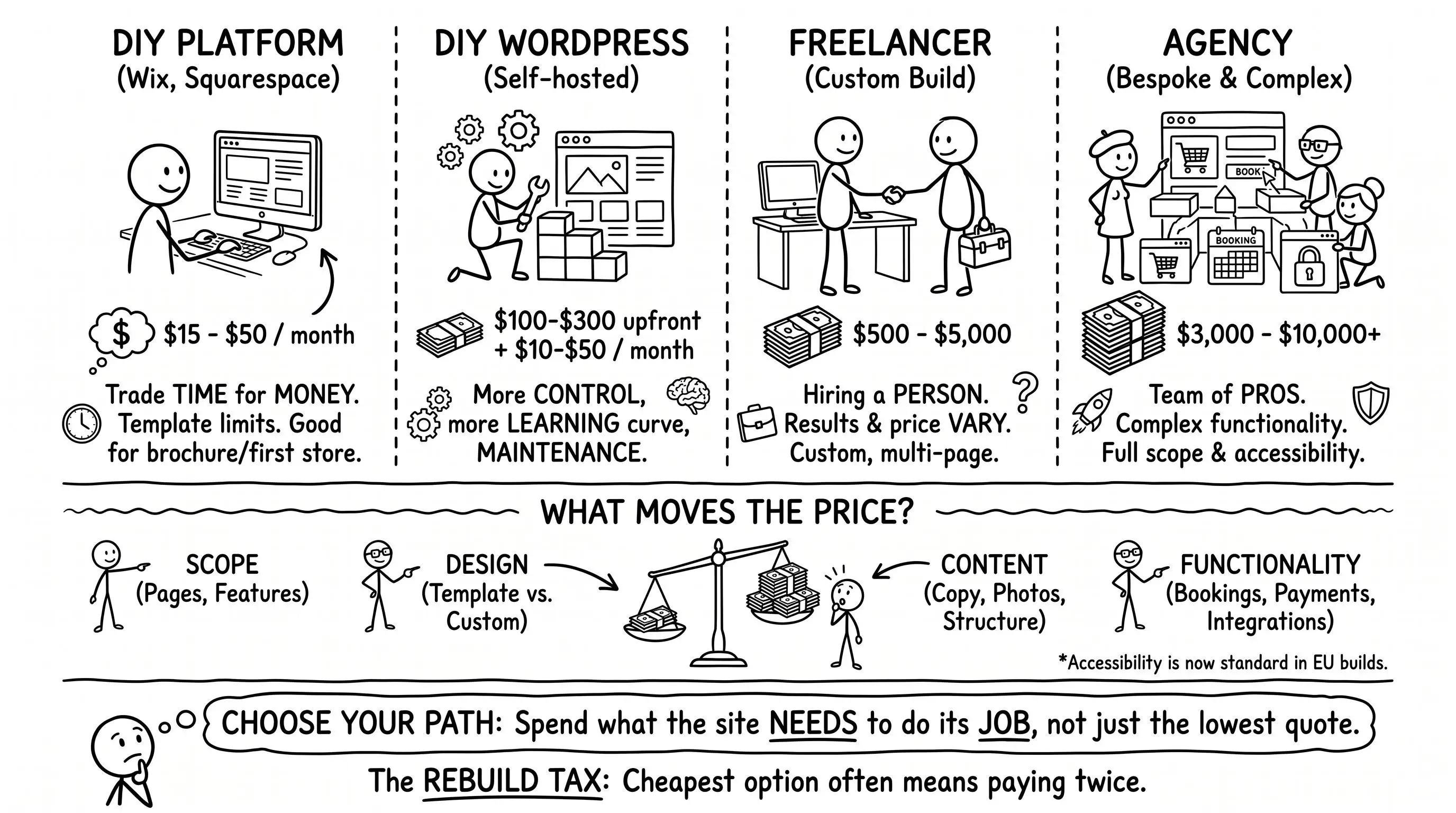
In 2026 the price of a website falls into four bands, set mostly by who builds it and how much is custom.
- Do it yourself on a platform: $15 to $50 a month on Squarespace, Wix, or Shopify. You trade your time for money and stay inside the template’s limits. Fine for a simple brochure or a first store.
- WordPress you host yourself: roughly $100 to $300 upfront for a domain, theme, and plugins, then $10 to $50 a month to run. More control, more maintenance, and a genuine learning curve.
- A freelancer: $500 to $5,000 for a custom, multi-page site or a simple online store. You are hiring a person rather than a platform, and the results vary as much as the price.
- An agency: from around $3,000 for a straightforward business site to $35,000 and up for complex, bespoke builds with custom functionality.
Those bands line up across the 2026 pricing guides that rank for this question, from Forbes Advisor and GoDaddy to Wix and Elementor. They agree on the shape even when the exact figures wobble, which is a good sign the ranges are real and the false precision is not.
What actually moves the price
Two websites in the same band can cost five times as much, because a handful of decisions do most of the work on the invoice.
- Scope: a five-page brochure and a forty-page site with gated content are different amounts of work, and the quote knows it.
- Custom design versus a template: a theme you adapt is cheap; a design drawn for your brand from a blank page is where both the real cost and the real differentiation live.
- Content: copywriting, photography, and structure are the quiet budget line. A polished build wrapped around thin content underperforms, and good content is rarely free.
- Functionality: a contact form is trivial; bookings, payments, logins, multiple languages, and third-party integrations each add design, build, and testing time.
One more driver hides in plain sight. Since June 2025 the European Accessibility Act has required many consumer-facing sites sold in the EU to meet accessibility standards, so accessibility is now part of the build rather than an optional extra, and a quote that ignores it is quietly cheaper for a reason.
Is $1,500 a good price for a website?
$1,500 can be a fair price or a warning sign, depending on what it buys. At that level you are paying a freelancer or getting a lightly customized template, which is perfectly reasonable for a small, straightforward site. The risk is not the number; it is what a low quote silently drops: original design, real content, testing, accessibility, and someone who still answers the phone six months later. A cheap site you rebuild in a year costs more than the right one built once.
The costs the quote leaves out
The build price is not the full cost of owning a website. A few line items follow you every year:
- Domain: $10 to $20 a year for the address itself.
- Hosting: from a few dollars a month on shared hosting to more for a busy custom site; SSL security is usually bundled in free now.
- Maintenance: $50 to $200 a month is typical for updates, security, and small changes, whether you pay someone or spend your own hours.
- The rebuild tax: the largest hidden cost is picking the cheapest option, outgrowing it, and paying again to do it properly.
So what should you actually budget?
The right budget is the smallest one that covers what the site has to do, plus a little for the content that makes it work. Match the spend to the job:
- A credible presence: if you mainly need to look legitimate and be findable, a template build or a small freelancer project is enough.
- A site that generates leads or bookings: this is where a custom mid-tier build earns its cost, because design, speed, and conversion move real revenue.
- Selling online: e-commerce is its own decision, with a rent-versus-build tradeoff worth thinking through before you spend.
- Testing an idea: if you are validating a product, build the cheapest thing that proves it and spend properly once you know it works.
The number that matters is not the lowest quote you can find; it is the total cost of getting a site that does its job and does not need replacing next year. The same budget seen from the seller’s side, what to charge rather than what to pay, is covered in how to price your services. If you would rather have a real figure for the site your business actually needs than a range from a pricing table, that is the kind of thing we do, and you can tell us what you’re building to get one.