
Best AI Translator for Business in 2026: What Professional Raters Found, What It Costs, Where Your Text Goes
- Published —
Short answer: in the largest independent test of 2026, scored by professional annotators, the big language models came out on top, led by agent systems built on Gemini and GPT and by Gemini 3.1 Pro itself, with Google Translate far behind. DeepL was not in that test, and the one small independent test in Slovak put it narrowly ahead of GPT-4o and Google. The translating itself costs next to nothing: a 300-product catalogue fits inside Google's or DeepL's free API allowance, or costs under a dollar on the cheapest models. What separates the options is what happens to your text, because the free DeepL translator and the consumer ChatGPT plans, Plus and Pro included, may learn from it while DeepL's paid plans, ChatGPT's business tiers and the paid APIs promise not to, and who checks the result before it goes to customers.
Every year the Conference on Machine Translation, known as WMT, collects recent texts, has every system entered translate them, and has professional annotators mark each error they find. The 2026 results, presented in Budapest at the end of October, ranked Google Translate 16th to 19th from English into German and 18th to 21st into Czech. Into German, Gemini 3.1 Pro and GPT-5.5 shared the top four with two agent systems built on Gemini models; into Czech, GPT-5.5 came fourth and Gemini 3.1 Pro fifth or sixth (Kocmi et al., WMT26).
DeepL, the tool most “best translator” pages recommend first, was not in the 2026 test, and the two editions before it showed commercial services only under anonymous labels. The translator with the best reputation has no public score under its own name in the largest independent test, the free tool most people use trails the language models, and the language models are free to try but may learn from what you paste.
Which AI translators can a business use in November 2026?
- DeepL: a web translator, desktop and phone apps, and an API, covering “100+ languages”. DeepL has used its own large language model since July 2024. The plans are now called Individual, Team, Business and Enterprise; the older Starter, Advanced and Ultimate plans are “no longer available for purchase” (DeepL, 2026).
- Google Translate: free on the web and in the app, for “almost 250 languages” (Google, April 2026). On 12 December 2025 Google began serving translations “built with Gemini”, at first only in the US and India and between English and “nearly 20 languages” (Google, 2025). Developers buy the same engines as Cloud Translation.
- ChatGPT Translate: a free page that OpenAI opened in January 2026, usable without an account, which promises “40+ languages” and lets you set the tone (ChatGPT Translate, 2026).
- The general assistants: ChatGPT, Claude and Gemini translate whatever you paste into a chat, and their APIs sell the same models to developers by the token.
Which AI translator is most accurate?
On independent human evaluation, the large language models. WMT has compared them with dedicated translation services every year since 2024, using professional annotators who mark error spans in each translation, and each year a language model or a system combining several came out on top:
- 2024: “the best performing system in general is Claude3.5-Sonnet winning in 9 language pairs.” Claude scored 91.2 for English to Czech. The only commercial service rated for that pair scored 89.0, and a human reference translation scored 92.9 (Kocmi et al., WMT24). The commercial services appeared only as ONLINE-A, B, G and W.
- 2025: “The best system overall, was Gemini 2.5 Pro, which was in top cluster in 14 language pairs”, and “Human references are in the winning cluster for only six out of 15 language pairs” (Kocmi et al., WMT25).
- 2026: the organisers added Google Translate by name “as an industry-standard point of comparison”. The best system overall, Wayfinder, is an entered system that combines Gemini 3.1 Pro, GPT-5.5 and other models; Gemini 3.1 Pro alone was next, in the top cluster for 15 of 23 language pairs. From English into German, Gemini 3.1 Pro scored 78.2, GPT-5.5 77.1 and Google Translate 57.1.
In 2026 every test document came with an instruction on style or formality, which a language model can follow and Google Translate cannot, so part of the gap measures the ability to follow a brief. Business text usually comes with one too: formal or informal address, a product name that stays in English, a tone. The models tested were also those of mid-2026, and newer versions have shipped since.
DeepL’s own figures point the other way. Its quality page says that “in June 2026 blind tests, DeepL won 89% of head-to-head matchups against OpenAI GPT-5.5, Gemini 3.1 Pro, Claude Opus 4.8, Google Translate and Microsoft Copilot” (DeepL, 2026). DeepL explains its method in a whitepaper, but the tests are its own, across 18 language pairs the page does not name, so treat the figure as the maker’s claim.
Smaller languages get little independent data. None of the WMT language pairs tested in those years included Slovak. The one independent test we found, part of the skLEP benchmark, had four native speakers score 90 English sentences translated into Slovak: DeepL came first on fluency (3.70) and adequacy (3.73), GPT-4o matched it on adequacy (3.73) at slightly lower fluency (3.62), and Google Translate “received marginally lower ratings” (Šuppa et al., Findings of ACL, 2025). With ninety sentences, rated by the paper’s own authors, and GPT-4o as the newest model tested, it is a small signal.
Is DeepL better than Google Translate?
On the little independent evidence that names both, slightly. Google Translate trails the newest language models on WMT’s texts, where DeepL was not tested. The practical differences matter more than the scores. DeepL translates whole Word, PowerPoint and PDF files and lets you fix terms in a glossary. Google Translate covers more than twice as many languages, costs nothing, and brought its Gemini-built translation first to the US and India. ChatGPT and the other assistants take instructions in plain language (“keep product names in English, address the customer formally, use metric units”), which makes them the easiest to steer and the easiest to let drift, so ask for the translation alone.
How much does AI translation cost?
| Option | Free | Paid | Source |
|---|---|---|---|
| DeepL translator | 1,500 characters per translation without an account, 5,000 with one; 50,000 characters, one file and one glossary of five entries a month | Individual $8.74 a month billed yearly ($10.49 monthly); Team $28.74, Business $57.49 per user | DeepL, November 2026 |
| DeepL API | Developer: a one-time credit of 1 million characters | Growth $26 a month billed yearly ($32.50 monthly), 1 million characters a month included, $27.50 per extra million | DeepL, November 2026 |
| Google Translate | Free | None | |
| Google Cloud Translation | 500,000 characters a month | $20 per million characters; Translation LLM $10 per million in and $10 per million out | Google Cloud, November 2026 |
| ChatGPT Translate | Free, no account | None | OpenAI |
| Cheapest model APIs | Gemini’s free tier | $0.10 per million input tokens, $0.40 to $0.50 per million output (GPT-6 Luna, Claude Haiku 5.5, Gemini 2.5 Flash-Lite) | OpenAI, Anthropic, Google, November 2026 |
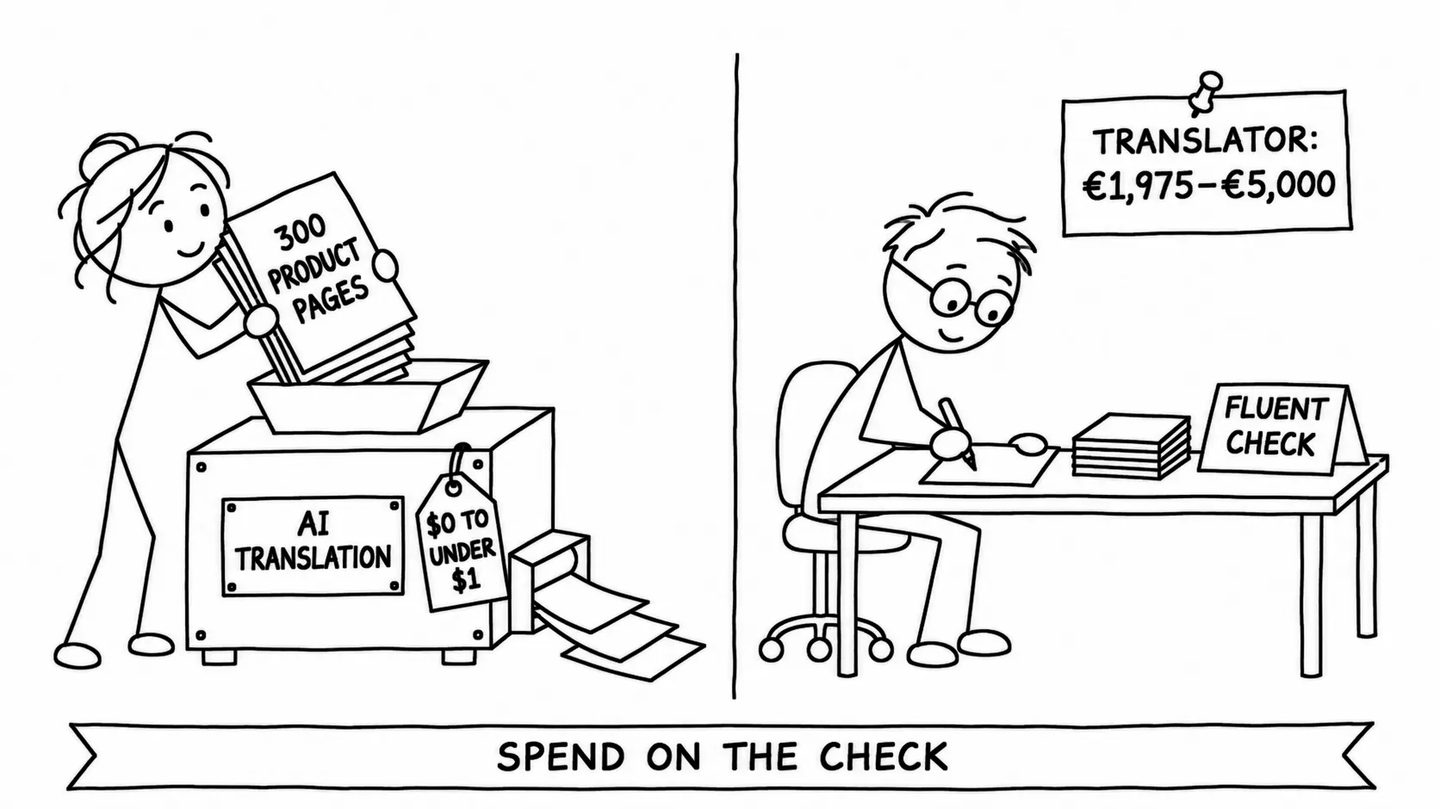
Take a shop with 300 products and a 1,500-character description each, going into German: 450,000 characters, or 250 standard pages of 1,800 characters. Through Google Cloud Translation the whole catalogue fits inside a month’s free allowance and costs $0. Through the DeepL API it fits inside the one-time Developer credit, or one month of Growth at $32.50. Through the cheapest model APIs it comes to under a dollar even if every character counted as a token. A professional translator is a different order of cost: agencies in Slovakia, where we work, publish prices of about €8 to €20 a standard page, so the same catalogue would cost €1,975 to €5,000, roughly $2,200 to $5,500 at the ECB rate of 17 November. In the US, median pay for interpreters and translators was $28.93 an hour in May 2025 (BLS, 2026).
Quality costs more than the cheapest tier, though. WMT’s organisers put the cost of translating their whole 2026 test set at “$252 for Gemini, through $83 for Google Translate, down to $4 for Tiny Aya”, a small model, and noted that the cost “scales closely with model performance”. The best large model is still cheap at the size of a small business’s catalogue. The money worth budgeting goes to the person who checks the result.
What happens to the text you paste?
Free translators and consumer chat plans, the paid ones included, may learn from what you paste; business tiers and paid developer APIs promise not to train on it. The terms, as of November 2026:
- DeepL free translator: “We process the content you upload and their translations or improvements for a limited period of time to train and improve our neural networks and algorithms.” Its users “may not use DeepL Translator / Write for the translation or improvement of texts containing personal data of any kind” (DeepL privacy policy, October 2026).
- DeepL paid plans and API Growth: texts are deleted after translation and “will not be used to improve the quality of our services”, with a data processing agreement available under the Pro terms. The free API Developer tier does not carry the “No data training” line that Growth adds.
- Google Translate (free): Google says it analyses “usage of Google Translate to improve translation quality” (Google Privacy Policy, October 2026). Cloud Translation: “Google does not use the content you send to train and improve our Google Translation features” (Google Cloud, 2026).
- ChatGPT: on Free, Plus and Pro “data sharing is enabled by default”, and you can switch it off; content from Business and Enterprise workspaces and from the API is not used for training by default (OpenAI Help Center, 2026).
- Gemini API: prompts on the free tier are “used to improve our products”; on the paid tier they are not.
For a European business this is also a GDPR question. A customer’s complaint, a CV or a contract pasted into a translator hands personal data to a processor, and Article 28 of the GDPR allows only processors “providing sufficient guarantees”, bound by a contract that sets out the processing. DeepL offers such a data processing agreement on its paid plans and OpenAI on ChatGPT Business, Enterprise and the API, while the free DeepL translator rules out personal data altogether. The same split between consumer apps and business tiers runs through the data terms of ChatGPT, Claude and Gemini.
Can you translate your website with AI without hurting SEO?
Yes, if the translated pages are made for people who read that language. Google says that “localized versions of a page are only considered duplicates if the main content of the page remains untranslated”, and that “it is usually best for you to explicitly indicate your language- or region-specific pages” with hreflang annotations (Google Search Central, 2026). It also advises against redirecting visitors automatically by language.
Google’s spam policies mention translation only as one of the “automated transformations” used to turn scraped content into “many pages … where little value is provided to users”, next to “using generative AI tools or other similar tools to generate many pages without adding value for users” (Google spam policies, August 2026). A checked translation of your own catalogue for customers in another country is what hreflang exists for. Spinning other people’s articles into twenty languages is what the policy describes.
Businesses selling to consumers in another EU country often have to provide information in their customers’ language: the Consumer Rights Directive lets member states set “language requirements regarding the contractual information” (Directive 2011/83/EU, Art. 6(7)), and product safety information must be “in a language which can be easily understood by consumers, as determined by the Member State” (GPSR, Art. 9(7)). The terms, the returns page and the safety instructions are the pages where a mistranslation costs most. If the shop runs on Shopify, our review covers what selling across borders costs there.
When do you still need a human translator?
For general text, the best machines now rival professionals under test conditions. In WMT’s 2026 scoring, translations by professional humans made the top group in only 8 of 12 language pairs, which the organisers say shows “the inherent difficulty of translation” and could also reflect the annotators’ preferences. A person is still the safer choice for:
- Legal and regulated text: a peer-reviewed comparison of an inheritance-law text translated from German into Slovak by DeepL, Google Translate, the EU’s eTranslation and ChatGPT concluded that “neural machine translation is not yet sufficiently mature for a translation in accordance with legal norms” (Gergel et al., Fachsprache, 2025). Courts and public offices usually want a certified translation anyway.
- Headlines, slogans and names: the words that carry the brand need rewriting for the market, which is closer to copywriting than to translation.
- Anything sent at scale: one wrong term in a template repeats in every order confirmation.
Machine translation can also trip AI-text detectors. A study of detection tools found that when human-written texts were machine-translated into English, the tools’ accuracy “dropped by 20%”, and that “using machine translation such as Google translate or DeepL can lead to a higher number of false positives” (Weber-Wulff et al., International Journal for Educational Integrity, 2023).
How to choose an AI translator for your business
- Sort your text by risk. Reading a supplier’s email, drafting a reply, publishing a product page and signing a contract need four different levels of care.
- Choose the tier by the data. Anything with customer or employee details goes through a tool with a data processing agreement: a paid DeepL plan, ChatGPT Business or Enterprise, or a paid API.
- Test on your own text. Take three real pieces (a product page, a customer email, a paragraph of your terms), run them through two or three tools, and have a fluent colleague mark the errors without knowing which tool produced which.
- Give the machine a brief. A glossary of product names and terms that stay fixed, formal or informal address, units and currency. DeepL takes a glossary; a language model takes the same list in the prompt.
- Spend on the check. The translation costs cents; a fluent reviewer’s hours decide whether customers trust the page.
- Build the site for languages. One URL per language, hreflang annotations, no automatic redirects, and the legal pages translated by a professional. A second language is one of the items that adds design and build time to a website.
If the translated text then needs a voice, the same questions of quality, price and rights come up in our guide to AI voice generators. If you are taking a shop into new markets and want the languages, URLs and legal pages set up to hold, that is part of our e-commerce development work, and you can tell us which markets you have in mind.