

Claude vs ChatGPT vs Gemini: Which Is Right for Your Business in 2026?
- Published —
- Updated —
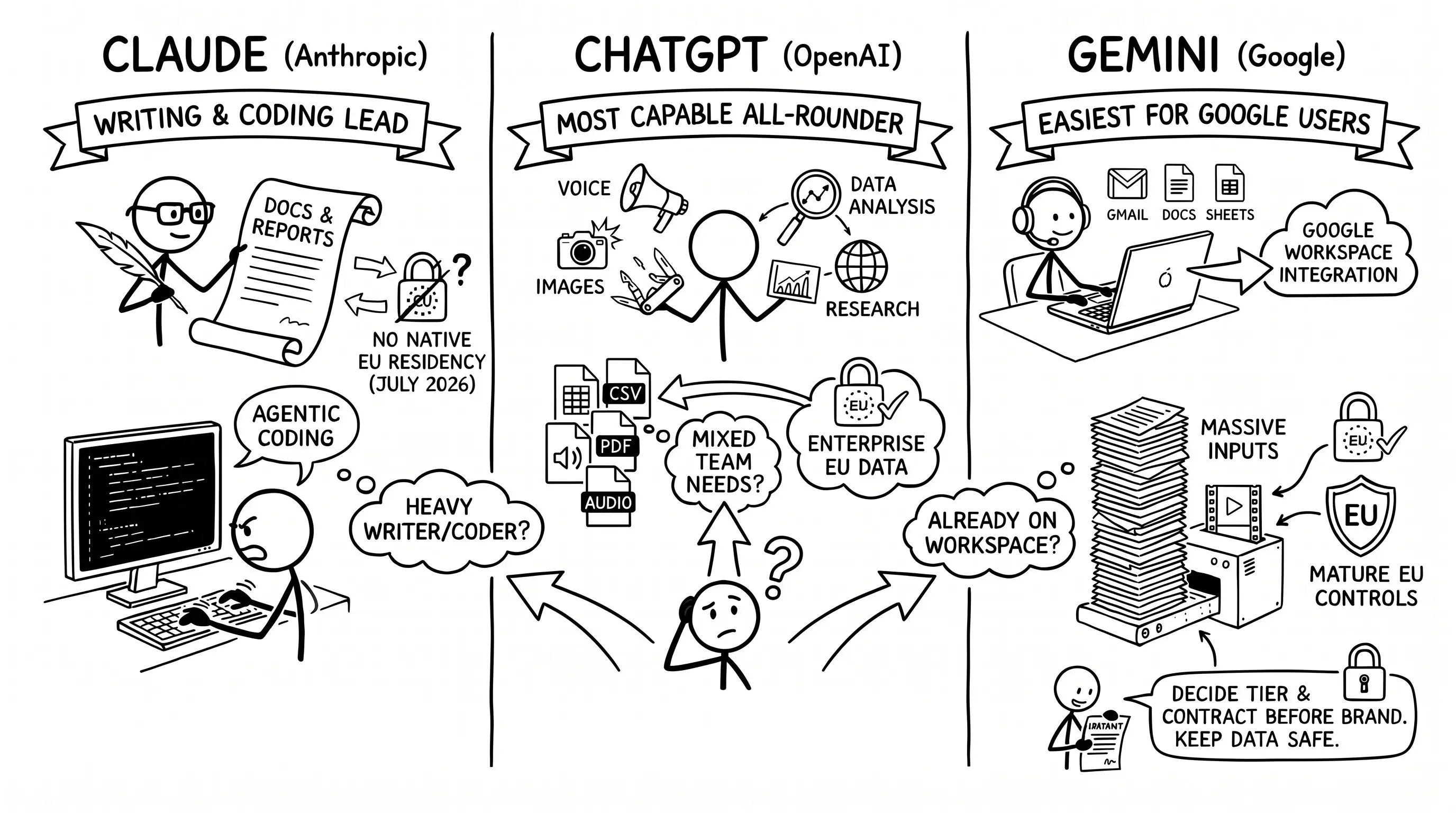
Short answer: for most businesses the three are now close enough in raw ability that the deciding factor is rarely the model. It comes down to which tools your team already works in, what you are allowed to put in front of an AI under EU data rules, and which one is strongest at the job you will hand it most often. As of July 2026, the loose consensus is that Claude leads on writing and coding, ChatGPT is the most capable all-rounder, and Gemini wins when your company already runs on Google Workspace.
Choosing an AI assistant for a business has quietly turned into a procurement decision. You are about to pay for one across a whole team, sign a contract for it, and feed it customer information, so “whichever one you happen to like” stops being a good enough answer. The useful news is that the three serious options have converged: on most everyday work, Claude, ChatGPT, and Gemini are all capable enough that the differences below matter more than the raw model does.
The three assistants, and why any winner is temporary
Claude is made by Anthropic, ChatGPT by OpenAI, and Gemini by Google. As of mid-July 2026, ChatGPT’s everyday model is GPT-5.5, with OpenAI’s new GPT-5.6 family (sold in three tiers named Sol, Terra, and Luna) rolling out to paid plans since its 9 July release (OpenAI, 2026); Claude runs on Opus 4.8 and Sonnet 5 with a higher tier called Fable 5; and Gemini defaults to 3.5 Flash, with 3.1 Pro above it and a 3.5 Pro still officially “coming soon.” A comparison written six months ago named different models, and one written six months from now will name different ones again. The churn even reaches availability: US export controls took Anthropic’s top model offline for two weeks in June 2026 before it returned worldwide in July (Anthropic, 2026). That is the first thing to accept: every verdict here is a snapshot of a fast-moving race, which is why this page carries a date and gets refreshed each quarter.
Which is best for writing and documents?
For drafting and editing, Claude has the edge, with ChatGPT close behind and more flexible. Writers tend to prefer Claude’s tone, and it has ranked at or near the top of independent creative-writing leaderboards through 2026. ChatGPT is very close and often wins on versatility, because it can research a topic, analyze a file, and generate an image in the same conversation. Gemini writes well too, and is strongest when the document already lives in Google Docs or Gmail. One honest caveat for anything fact-sensitive: a 2026 independent evaluation found the latest ChatGPT model more likely than its rivals to state wrong facts with confidence, so keep a human check on names, dates, and numbers whatever you use.
Which is best for coding and technical work?
For software work, independent coding benchmarks in mid-2026 split the lead between Claude and OpenAI’s newest models, with Gemini a step back. On the repository-scale SWE-bench Pro test, Anthropic’s Claude Fable 5 leads the field, and Claude remains the tool most developers reach for on large, messy codebases. OpenAI’s July release moved the other front: in independent runs, GPT-5.6 Sol now tops Terminal-Bench, the benchmark for agentic coding where the model writes, runs, and fixes code with light supervision (Artificial Analysis, 2026). Gemini trails on these benchmarks but handles very large inputs well and fits naturally if your team already builds on Google Cloud. Treat all of this as approximate: coding scores shift with every release and depend heavily on how each test is run, a problem we unpack in our guide to the best AI for coding.
Which is best for data, spreadsheets, and research?
For spreadsheets and file analysis, ChatGPT and Gemini lead in different ways, and Claude has closed most of the gap. ChatGPT remains the strongest general-purpose analyst: hand it a messy CSV and it will clean, chart, and explain it. Gemini is the natural choice when your data already sits in Google Sheets, and it can take enormous inputs, including long PDFs and hours of audio or video, in a single pass. Claude now ships a dedicated Excel add-in that shows its working at the cell level, which finance and audit teams like. For research, all three can browse the web and produce long “deep research” reports with sources.
One practical difference sits underneath all of this: only ChatGPT and Gemini generate images and video themselves. Claude does not, so a marketing team that wants copy and visuals out of the same tool will lean toward the other two. All three now handle voice.
What do they cost?
The consumer plans are cheap and nearly identical; the money and the real differences live in the business tiers. Each has a free tier. The standard paid plan is around €20 a month on all three (ChatGPT Plus and Claude Pro at $20, Gemini AI Pro at €21.99), and each now offers a cheaper entry option, with ChatGPT Go near $8 and Gemini AI Plus at €4.99. Business seats run €20 to €25 per user per month (ChatGPT Business and Claude Team both bill $20 to $25 a seat; Gemini comes bundled into Google Workspace or its enterprise plan). The heavy individual tiers have converged too, at $100 or $200 a month for high-volume use across all three; Google even cut its top Ultra plan from $250 to $200 in May 2026 while adding a $100 step below it. One consumer-tier note: ChatGPT’s free and Go tiers now show ads in a handful of countries (the US since February 2026, the UK since June), though not yet in the EU, and paid tiers stay ad-free; the details are in our ChatGPT ads guide. Two European notes: these prices are before VAT, which adds 23% in Slovakia, and only Google publishes a clean euro price, while the others bill in dollars with local tax added at checkout. All of it is current as of mid-July 2026 and worth re-checking before you buy.
The part most comparisons skip: EU data and GDPR
For a European business the important line is not between the three vendors. It is between their consumer apps and their business tiers.
Every consumer app trains on what you type by default and gives you no data-processing agreement. Claude’s training setting defaults to on, Gemini keeps your activity and has a sample of chats reviewed by people and stored for up to three years even after you delete them, and ChatGPT can use consumer chats to improve its models unless you opt out. The rule that follows is simple: keep client and personal data out of free consumer accounts.
The business, enterprise, and API tiers behave differently. All three stop training on your content by default, all three offer a GDPR data-processing agreement with standard contractual clauses, and all three add admin controls. Where they genuinely differ is where your data physically sits. OpenAI and Google let approved business customers keep data inside the EU: OpenAI on its Enterprise, Edu, and API plans, and Google across Vertex AI’s European regions and Workspace. Claude has no first-party EU data residency as of July 2026, and you can only get EU hosting by running Claude through Amazon’s or Google’s own EU clouds. If keeping data on EU soil is a hard requirement for you, that is a real point against Claude.
Two current events are worth knowing. An Italian regulator’s €15 million fine against OpenAI from 2024 was annulled in March 2026, but on jurisdictional grounds rather than a clean bill of health, so the underlying privacy questions were never settled. And a US court in the New York Times case has ordered OpenAI to preserve certain consumer and standard-API chat logs; OpenAI says the order conflicts with European privacy law and is contesting it, and business accounts with zero data retention are exempt. None of this is a reason to panic, but it is a reason to buy the right tier and keep sensitive data on it.
The honest bottom line on compliance: the tool does not make you compliant. You still need a lawful reason to process personal data, the right contract signed, and one plain internal rule about what staff may paste in. Get those three right and any of the business tiers can be used responsibly.
So which one should your business choose?
The decision gets easier once you stop looking for an overall winner and match the tool to your situation.
- If you already run on Google Workspace: Gemini is the path of least resistance, its EU data controls on Workspace are mature, and the integration into Gmail, Docs, and Sheets saves real time every day.
- If your work is writing- or document-heavy: Claude is the strongest single choice for proposals, reports, contracts, and code, as long as first-party EU data residency is not a hard requirement.
- If you want one tool for the widest range of jobs: ChatGPT is the most capable all-rounder for a mixed team that writes, codes, analyzes data, and needs images and voice in one place.
- If you are in a regulated or privacy-sensitive field: decide the tier and the contract before the brand. Buy a business plan, sign the data-processing agreement, and pick the vendor whose data-residency story fits your obligations.
The advice you will read online is to subscribe to all three and switch between them. That works for an individual power user, but a business is buying one bill, one admin console, and one contract, so most are better off standardizing on a single platform and revisiting the choice in a quarter, when the models will have moved again. The one thing worth ruling out is running the company on free consumer accounts with customer data inside them. If you want a sharper sense of where these tools actually pay off in your own operation, our piece on AI agents for real business work is a good next read.
Picking the tool is the easy part; wiring it into how your team already works, on a plan that keeps your data where it belongs, is the part that takes judgement, and it is a large part of what our AI and automation work involves, so if you would rather talk it through than read another comparison, tell us what eats your week.