
Best AI for Coding in 2026: How to Choose the Right Model and Tool
- Published —
- Updated —
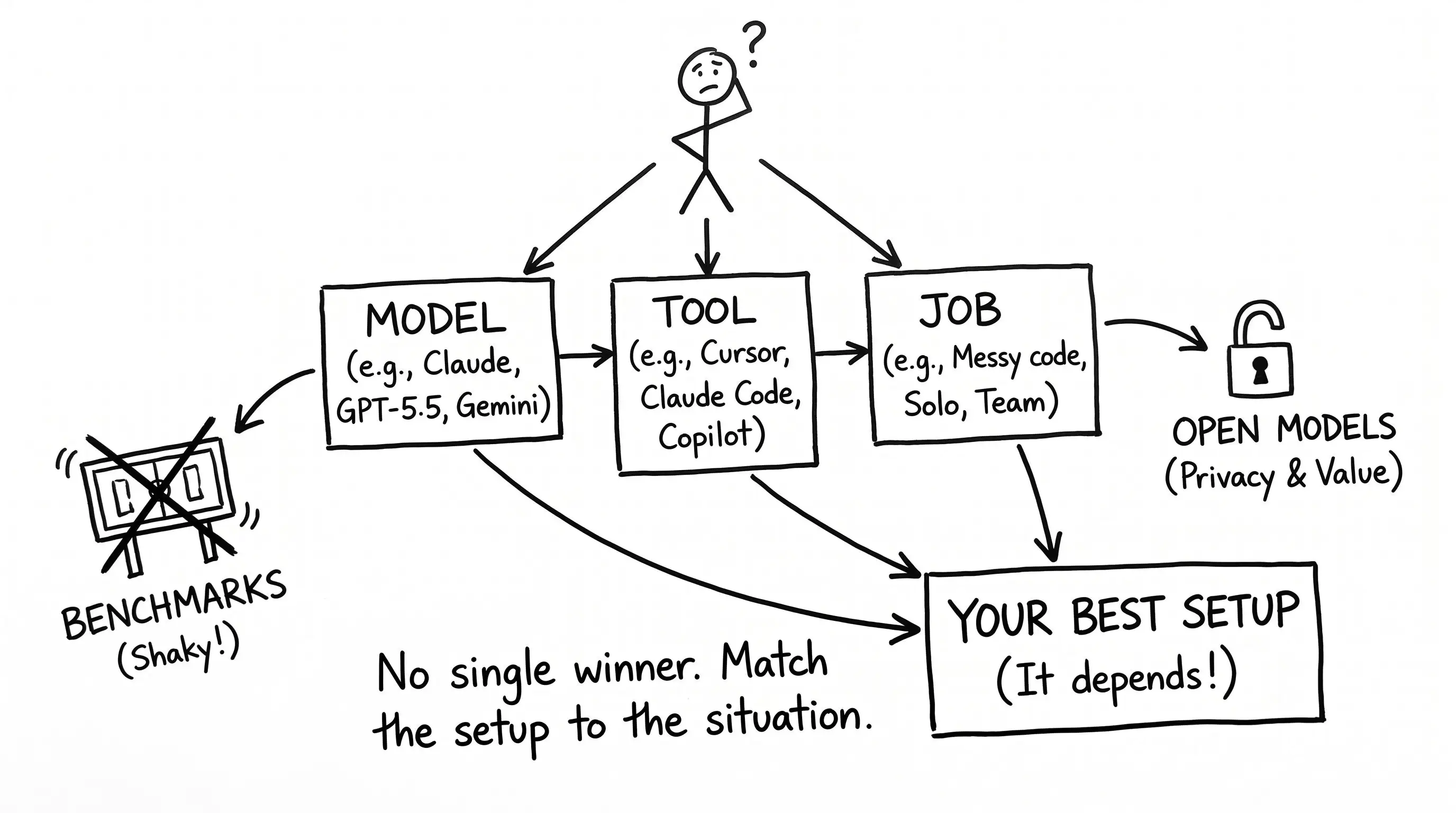
Short answer: there is no single best AI for coding, and picking one model name is the wrong way to decide. What you get depends on three things: the model, the tool you run it inside, and the job you point it at, and the tool matters as much as the model. As of mid-July 2026, Claude, OpenAI's new GPT-5.6 family, and Gemini sit close together at the top, open-weight models have nearly caught up for teams that want to self-host, and the benchmark that once settled these arguments has started to fall apart.
Ask which AI is best for coding and you will get a confident answer: a model name, usually with a benchmark score attached. The score is often SWE-bench Verified, where the leading models now sit near 88%. The awkward part is what the people who build those models say about it. In 2026 OpenAI published a note explaining why it had stopped using SWE-bench Verified: its own audit of the hardest tasks found most had broken tests, and that a model could reproduce the correct patch from the task’s identifier alone, which is memory, not skill (OpenAI, 2026).
So the scoreboard everyone quotes is unreliable, and the real question is not which model wins. It is more practical: which model, running inside which tool, for the kind of work you actually do. Get those three right and a mid-tier setup does excellent work. Get them wrong and the highest-ranked model on the internet will still frustrate you.
How the top models compare for code
At the frontier, three vendors set the pace, and as of July 2026 they are close enough that the differences below matter more than the ranking. Treat every number as a snapshot: coding scores move with each release, which is why this page carries a date.
- Claude (Anthropic) is the one most developers reach for on large, messy codebases and long agentic sessions. Its premium Fable 5 now leads the hardest public test, SWE-bench Pro, at 80.0%, with the workhorse Opus 4.8 at 69.2%; Sonnet 5 is the cheaper daily driver and Haiku 4.5 the fast, low-cost option. On blind human preference for coding, Claude sits second only to Moonshot’s new Kimi K3 (LMArena Code, July 2026).
- GPT-5.6 (OpenAI), released 9 July 2026 in three tiers named Sol, Terra, and Luna, is the strongest terminal and agentic all-rounder. In independent runs, GPT-5.6 Sol tops the Terminal-Bench 2.1 board at 89.5% (Artificial Analysis, 2026), and the mid-tier Terra roughly matches the previous flagship at half the price. GPT-5.5 stays available and reads as a fine default, but new work should start on 5.6.
- Gemini (Google) wins on scale and cost. It handles a million-token context comfortably, and in an unusual move Google still positions its cheaper Gemini 3.5 Flash above its Pro model for coding and agentic work, with a 3.5 Pro announced but unreleased as of mid-July. It is the natural fit for teams already on Google Cloud.
| Model | Best for | Context | Price, in / out per M tokens | Notable score |
|---|---|---|---|---|
| Claude Fable 5 | the hardest work, price no object | 1M | $10 / $50 | SWE-bench Pro 80.0% (top) |
| Claude Opus 4.8 | messy codebases, long agentic work | 1M | $5 / $25 | SWE-bench Pro 69.2% |
| Claude Sonnet 5 | cheaper daily driver | 1M | $2 / $10 | SWE-bench Pro 63.2% |
| GPT-5.6 Sol | terminal and agentic all-rounder | 1.05M | $5 / $30 | Terminal-Bench 2.1 89.5% (top) |
| GPT-5.6 Terra | value all-rounder | 1.05M | $2.50 / $15 | SWE-bench Pro 63.4% |
| Gemini 3.5 Flash | scale and value | 1M | $1.50 / $9 | Google’s coding-first pick |
Prices and positioning from vendor pages, mid-July 2026 (Sonnet 5 is intro pricing through August, then $3 / $15). Scores from Artificial Analysis independent Terminal-Bench runs, SWE-bench Pro aggregations, and vendor cards, 2026. The snapshot ages fast: GPT-5.6 went from preview to general availability on 9 July, and Fable 5 spent two weeks of June offline under US export controls before returning worldwide on 1 July (Anthropic, 2026).
What the benchmarks measure, and where they mislead
If a score is going to move your decision, it helps to know what it tests and how it breaks. Five are worth your attention, and they disagree with each other often enough that no single number should settle anything.
- SWE-bench Verified: resolves real GitHub issues in real Python repositories. It is the most-cited test and the most compromised. The issues and their solutions are public, so models train on them, and OpenAI’s audit found many of the hardest cases had faulty tests. Useful as a floor, not a ranking.
- SWE-bench Pro: a harder, less leakable version. It knocks about 20 to 25 points off the same models, which tells you how much of the headline figure was memorization rather than reasoning.
- Aider Polyglot: code editing across six languages, a deliberate answer to SWE-bench’s Python monoculture. Worth knowing that its official board has not been updated since November 2025, so any “leads Aider” claim about a 2026 model is not coming from Aider itself.
- LiveCodeBench: competitive problems tagged by date and scored only on ones published after a model’s training cutoff. That rolling window is built to make memorization impossible, which makes it one of the cleaner signals.
- Terminal-Bench: agentic tasks in a real command line, the closest thing to “can this run as an autonomous agent.” It also exposes the most important caveat here.
That caveat: a score is never only the model. On Terminal-Bench 2.1, the same GPT-5.5 scored 83.4% in one harness and 78.2% in another. Vendor-reported numbers are run on the vendor’s own tooling, so they do not compare cleanly across companies. When you want to know where things actually stand, the live boards are the place to look rather than a listicle.
| Benchmark | What it tests | Watch out for | Live board |
|---|---|---|---|
| SWE-bench Verified | real GitHub issues, Python | saturated, leaked, OpenAI dropped it | swebench.com |
| SWE-bench Pro | harder, un-memorized issues | ~20 to 25 points lower, more honest | Scale AI |
| Aider Polyglot | edits across six languages | official board frozen since Nov 2025 | aider.chat |
| LiveCodeBench | dated competitive problems | one of the cleaner signals | livecodebench.github.io |
| Terminal-Bench | agentic command-line tasks | the score depends on the harness | tbench.ai |
| LMArena, Code | blind human preference | taste, not correctness | arena.ai |
The tool matters as much as the model
This is the part most “best model” lists skip. The same model produces very different results depending on the software you run it inside, because the tool decides how much of your codebase the model sees, how it makes and checks its edits, and how long it can work without losing the thread.
The evidence is not subtle. When LangChain reworked only the wrapper around a fixed model, its agent climbed from 30th to 5th on a Terminal-Bench board without touching the model at all (Faros.ai, 2026). Independent developer tests report the same model swinging by more than ten points between one tool and another. The tool is a first-class decision, not an afterthought, and the leading ones fall into a few shapes:
- Cursor: a full AI-first editor, built as a fork of VS Code, that indexes your whole repository and can run several agents at once. Model-agnostic, with its own fast Composer model. From $20 a month.
- Claude Code: Anthropic’s terminal agent, the strongest hands-off option for multi-file work. It is the one major tool locked to a single vendor’s models, which is the trade for how tightly it is tuned to them. Billed through Claude subscriptions or the API.
- GitHub Copilot: the incumbent, now an editor extension, an agent, and a cloud worker that opens pull requests straight from an issue. Model-agnostic, and it moved to usage-based billing in 2026. From $10 a month.
- Devin Desktop, formerly Windsurf: an AI IDE fused with an autonomous cloud agent, rebranded in June 2026. Model-agnostic.
- Zed: a fast native editor, written in Rust, that can host external agents like Claude Code and leans on bring-your-own API keys.
- Cline: an open-source extension that runs any model you point it at, including local ones. The extension is free; you pay only for inference.
Do you need a frontier model, or will an open one do?
For a lot of work, no. Open-weight models you can download and run yourself have closed most of the gap. On SWE-bench Pro, Z.ai’s GLM-5.2 scores 62.1, ahead of GPT-5.5’s 58.6 and level with OpenAI’s brand-new budget tier GPT-5.6 Luna (62.7). The premium frontier has pulled ahead again since Fable 5, but DeepSeek, Alibaba’s Qwen, and Moonshot’s open Kimi weights sit in the same band as GLM, and Mistral’s smaller Devstral runs on a single high-end laptop.
Three reasons a business chooses open weights, none of them about bragging rights:
- Cost: hosted, they run at a fraction of frontier prices; self-hosted at volume, the per-token cost is zero.
- Data residency: the weights run entirely on your own infrastructure, so code and prompts never leave your network. Some of these models’ own hosted APIs route through servers in China, which is an argument for self-hosting them rather than against the models.
- No lock-in: you can pin a version, fine-tune it on your own code, and never be pushed through a pricing change you did not choose.
| Model | Licence | Runs on | Coding standing |
|---|---|---|---|
| DeepSeek V4-Pro | MIT | GPU server | SWE-bench Verified 80.6% |
| Qwen3-Coder-Next | Apache 2.0 | high-end laptop | strong for its small active size |
| GLM-5.2 | MIT | multi-GPU server | SWE-bench Pro 62.1, beats GPT-5.5 |
| Kimi K2.6 | open weights | multi-GPU server | SWE-bench Verified 80.2% |
| Devstral Small 2 | Apache 2.0 | single laptop or GPU | EU vendor, 68.0% Verified |
Licences from model cards; scores from those cards and LLM-Stats, 2026.
What it costs
Pricing splits three ways, and the sticker price is the least of it. The $20-a-month consumer plans (Claude Pro, ChatGPT Plus, Cursor Pro) are a real starting point, and if you reach for AI now and then they are genuinely enough. They stop being enough sooner than most people expect once the work is daily and agentic. A $20 Claude plan runs on a five-hour usage window, and developers routinely report a single large refactor spending most of it before they move up to a $100 or $200 tier (r/vibecoding, 2026). The community’s rule of thumb is blunt: use these tools to assist you and the limits are fine; use them to do the work for you and you will hit a wall. A developer who codes with them all day usually lands on $100 to $200 a month (Claude Max, Cursor Ultra) or on metered billing, where the frontier models run from roughly $1 to $30 per million output tokens and Anthropic’s own figure for a full-time coder is $150 to $250 a month (Anthropic, 2026). The cost that shows up on no price page is still the one that matters most: a model that needs three tries burns more time and tokens than a pricier model that gets it first, so cheap per token is not the same as cheap per finished task.
So what should you actually use?
Match the setup to the situation instead of hunting for an overall winner.
- Light or occasional use: a $20 Claude or ChatGPT plan is the right starting point and genuinely enough for a few prompts a day. Lean on it all day and the limits arrive fast, so budget for a $100 tier or metered usage instead.
- A team already on GitHub: Copilot is the path of least resistance, and its cloud agent earns its keep on routine pull requests.
- A large or messy codebase: Claude Opus 4.8 inside Claude Code or Cursor is the combination most professionals trust for multi-file, long-running work.
- Privacy or EU-data constraints: run an open-weight model like DeepSeek or Mistral’s Devstral on your own infrastructure, or buy a frontier vendor’s EU-resident business tier, and settle the contract before the brand.
- Tight budget or high volume: a hosted open-weight model, or Gemini 3.5 Flash, gives you most of the capability at a fraction of the price.
The habit worth dropping is loyalty to a single model name. The field moves every few weeks, the benchmarks that rank it are shakier than they look, and the tool you run it in changes the result as much as the model does. Pick for the job in front of you, keep the setup easy to swap, and revisit it a quarter from now when the names will have changed again. For a wider view across writing, data, and everyday business work rather than code, our Claude vs ChatGPT vs Gemini comparison is the companion to this one.
If you would rather hand the building to a team that already ships with these tools, that is what our web and app development and AI and automation work is for. If you would rather talk it through first, tell us what you are building.