ChatGPT Ads in 2026: What They Cost, Who Can Buy Them, and Whether They're Worth It
- Published —
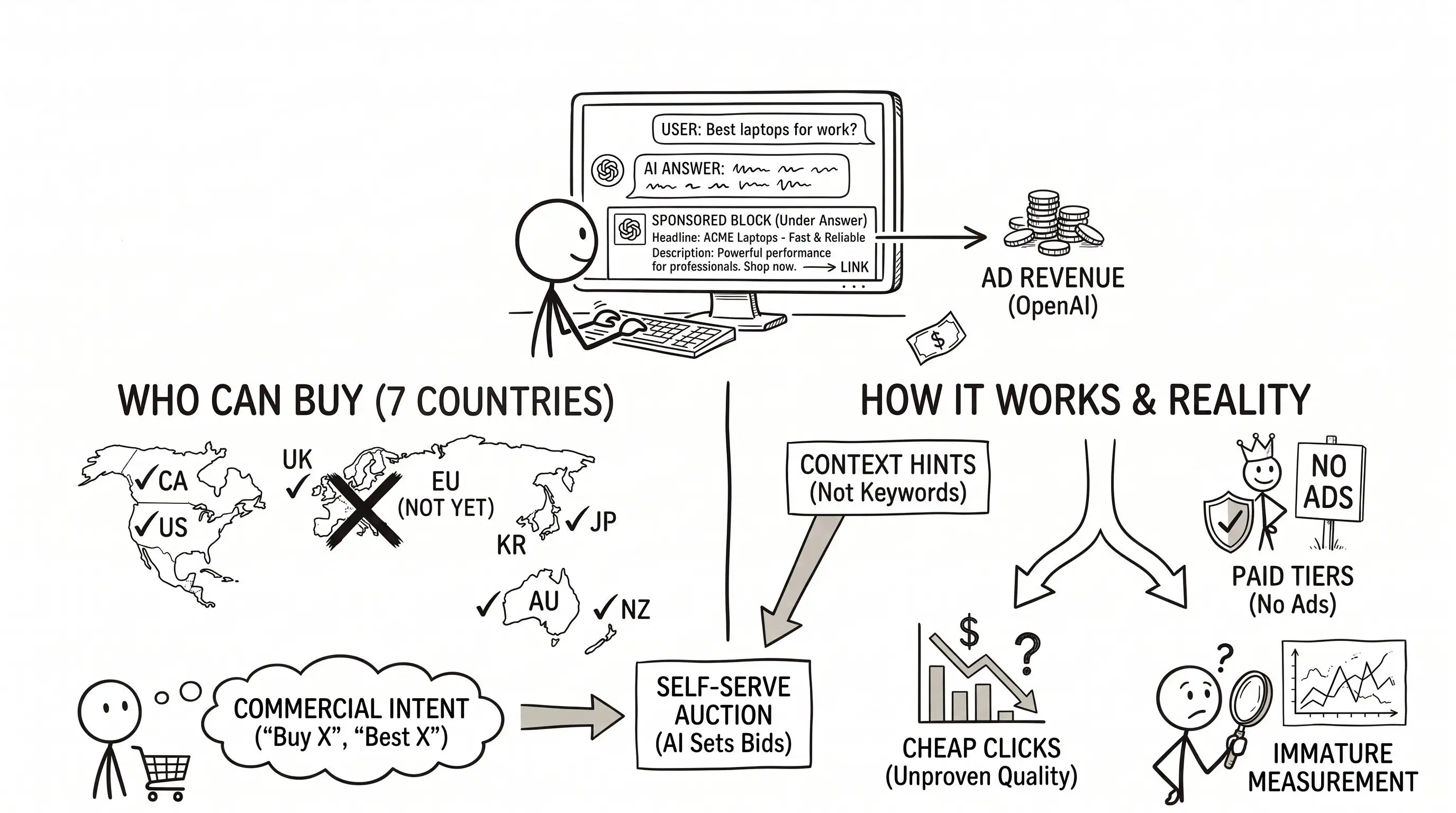
Short answer: ChatGPT ads are real, self-serve since May 2026, and open only to businesses based in seven countries. The EU is not one of them. There is no rate card beyond a recommended $3–5 cost per click, and the early public results are cheap clicks with unproven conversion quality. Most businesses should prepare rather than spend, and if your customers are in the EU, preparation is the only thing on sale.
OpenAI began testing ads inside ChatGPT on 9 February 2026. Six weeks later the pilot had passed $100 million in annualized ad revenue, according to OpenAI and CNBC (2026). By 5 May any US business could open a self-serve Ads Manager and buy placement under an answer, by early June the ads had reached the United Kingdom, and custom audience uploads arrived in the first week of July. Advertising channels do not usually move at this speed, and this one is selling something that did not exist before: space inside the AI answer itself.
It is also a public change of mind. In 2024 Sam Altman told the Lex Fridman podcast, “I kind of hate ads just as an aesthetic choice” (2024), and at a Harvard talk that spring he reportedly filed advertising under “a last resort” for OpenAI’s business model. The last resort is now a forecast: OpenAI has told investors it projects roughly $2.5 billion in ad revenue for 2026, according to Axios (2026).
Search demand followed the product. Queries for “chatgpt ads” grew roughly twentyfold year over year, according to Google keyword trend data (2026), and the questions inside that demand are practical ones: what do the ads cost, who can run them, can you buy them from Europe, and are they worth real money yet. Most of what currently ranks is OpenAI selling the placement, news desks logging each launch, or ad-tech vendors selling an alternative to it. This is the version for a business owner, checked against OpenAI’s own documentation in mid-July 2026.
What do ChatGPT ads look like, and who sees them?
A ChatGPT ad is a labeled block underneath the answer: advertiser name and logo, a headline of up to about 50 characters, a short description, an image, and a link. OpenAI’s launch announcement commits to ads being “always clearly labeled as sponsored and visually separated from the organic answer” (2026). There are no pop-ups and no banners; so far there is only this one placement.
Who sees it is tightly scoped. Ads appear for logged-in users on the Free and Go ($8 a month) plans; Plus, Pro, Business, Enterprise, and Education accounts see none, and neither does anyone under 18. Free users can even trade ads away in exchange for lower daily message limits. Exposure is a trickle by design: OpenAI said in March that fewer than 20% of eligible users see an ad on a given day (CNBC, 2026). Independent checks agree. WIRED put 500 questions to ChatGPT and saw an ad under roughly one new conversation in five (2026), while a Business Insider analysis of 66,000 placements found ads on only 1–2% of prompts overall, with 83% of ad-bearing chats showing exactly one ad (2026).
What triggers an ad is commercial intent. In an Adthena sample, “buy X” prompts drew ads about 15% of the time and “best X” about 12% (via Business Insider, 2026). Travel is the heaviest category so far: WIRED’s test saw a Booking.com unit arrive pre-filled with a hotel search for the destination being planned (2026). Conversations around health, mental health, and politics are excluded, though the policy moved in April, when medical, legal, and financial advice contexts stopped being categorically blocked by default (OpenAI ad policies, 2026). OpenAI’s own pitch, delivered at Cannes, is that ChatGPT catches people who are “super intentional” about a job to be done, with roughly a fifth of queries carrying direct commercial intent (Marketing Dive, 2026).
Who can buy ChatGPT ads today?
Businesses based in exactly seven countries can open an ads account as of July 2026: the United States, United Kingdom, Canada, Australia, New Zealand, Japan, and South Korea, per OpenAI’s availability documentation (2026). No EU country is on the list. The criterion is where your business is registered, not where your customers are: a company based outside those markets cannot buy placement at any budget, and can only file OpenAI’s advertiser interest form.
Inside the supported markets, the platform is a self-serve beta. You register the business, pass an identity check, wait in a human review queue, and pay after delivery; the account’s country and billing currency are fixed at creation (OpenAI help documentation, 2026). Current documentation lists no minimum spend, which is a recent development: the February pilot reportedly launched around a $60 CPM with a six-figure commitment, a floor that was cut and then removed entirely when self-serve opened in May, according to trade reporting (Digiday and Axios, 2026). Category rules still apply. Consumer verticals came first; finance, health, and legal advertisers are approved case by case; political, gambling, alcohol, and crypto ads are banned outright (OpenAI ad policies, 2026).
How the buying actually works
ChatGPT ads run on a relevance-weighted, second-price auction with CPM and CPC buying. You set a maximum bid per ad group and a daily or campaign-total budget, and OpenAI recommends starting CPC bids at $3–5 per click (2026).
Anyone who has run Google or Meta campaigns will find the shape familiar, with one large exception: there are no keywords. Targeting runs on “context hints,” short descriptions of the conversations where your offer belongs, which OpenAI is explicit are “broad thematic signals, not exact keyword matching” (2026). Geography goes to country level everywhere, and to state, DMA, and ZIP inside the US. Since early July, advertisers can upload hashed first-party lists as custom audiences, with a 25,000-match minimum, usable for inclusion, exclusion, or bid multipliers. Demographic targeting does not exist at all: no age, gender, or interest segments appear anywhere in the current documentation. E-commerce gets product feeds, where a template ad fills in the item and price that fit the conversation at serve time, the machinery Criteo connected to as OpenAI’s first ad-tech partner (Digiday, 2026).
Measurement is the young part. The dashboard reports impressions, clicks, CTR, average CPC and CPM, and conversions; there is a JavaScript pixel, a server-side conversions API, and UTM parameters persist on clicks (OpenAI developer docs, 2026). Practice is rougher: early buyers describe reconstructing performance by hand, and one advertiser reportedly spent 3% of a $250,000 budget over several weeks because a dashboard glitch hid the campaign data (trade reports, 2026). Wire up your own tracking before the first dollar of spend.
How much do ChatGPT ads cost?
There is no rate card. OpenAI’s only published number is the recommended $3–5 starting bid per click; everything beyond that is auction results, and in a five-month-old auction those scatter widely. The public early numbers are single cases, not benchmarks. An agency that spent $1,200 targeting advertising-service conversations paid about $13 a click and got zero conversions (Grow My Ads, 2026). An e-commerce account reported a $1.72 average CPC and a 1.49× blended return on roughly $60,000 over 15 days, with daily swings between 0.2× and 2.9× (Opascope, 2026). A B2B-focused agency saw $4–10 clicks against $15–40 and up for the same intent on Google Search, with its best cost per lead beating Google’s at about a third of the volume (North Country Growth, 2026). Independent trackers put average click-through under 1% (2026).
The honest summary: clicks cost less than Google, volume is thin, measurement is immature, and nobody has publicly shown consistent conversion quality yet. There is also a structural caveat for anyone selling to businesses: the buyers you most want may be paying for ChatGPT, and paid tiers never see ads.
Can you run ChatGPT ads in Europe?
No. As of mid-July 2026, ChatGPT shows no ads to users in the EU, EU-based businesses cannot open an ads account, and OpenAI has announced neither a date nor an official reason. What exists is visible preparation. In May, OpenAI added a consent-management mechanism to its ads pixel, and its stated plan for the EU is personalized ads only with user consent, with contextual ads based on location and conversation topic as the fallback, according to Digiday (2026).
The regulation that will shape an EU launch is the Digital Services Act, not the AI Act. OpenAI’s own disclosures report ChatGPT search at 159.1 million monthly EU users (2026), more than three times the threshold at which the European Commission designates a platform, and designation brings ad-labeling duties, targeting-parameter disclosure, and a public ads repository. The Commission has been assessing exactly that question and had not designated ChatGPT as of its July list (2026). The EU AI Act adds transparency duties for the assistant itself from 2 August 2026, but contains no advertising rules. Beyond that, OpenAI job postings point at France, Germany, and Ireland as the next markets, per industry reporting (2026), with no dates attached. Our read: the EU launch is a matter of when and under what consent flow, and nobody has committed to the when.
The rest of the AI ad market
ChatGPT is the biggest bet on ads inside AI, not the only one, and the neighbors are instructive. Google has shown ads in AI Overviews since 2024 and now serves them in twelve countries, in English only, using ads from existing Search, Shopping, and Performance Max campaigns; the EU is not among the twelve, and ads inside AI Mode remain a US-only test with new formats announced in May (Google Ads Help, 2026). If you already run Google Ads, that half of the story is its own decision, and the classic side has a current playbook of its own. Microsoft sells sponsored placements in Copilot and added native checkout in January (2026). The counterexamples matter just as much: Perplexity shut its advertising program in February, telling the Financial Times “We are in the accuracy business” (2026), and Anthropic keeps Claude ad-free as an explicit choice. Analysts still project AI-search advertising growing from under 1% to about 13.6% of US search ad spend by 2029 (eMarketer, via Axios, 2026). The market is real; its settled shape is not.
Should your business advertise on ChatGPT yet?
- Test now if your business is based in one of the seven markets (or has an entity there), your customers are there too, and you can fund a genuine experiment. Agencies spending on the platform suggest treating it as 10–15% of paid budget (2026), with the pixel, conversions API, and UTMs live before launch.
- E-commerce goes first. A product feed plus cheap CPCs plus conversation-level intent is the configuration behind the strongest early reports, and it is where OpenAI has built the most machinery.
- Wait if your customers are in the EU, where nobody sees the ads; if you sell B2B to people who live on paid tiers; or if your margins cannot absorb a learning phase on a platform whose reporting is still stabilizing.
- Prepare regardless. The EU launch will not announce itself a quarter in advance, and the preparation costs nothing you were not already supposed to be doing.
What ChatGPT ads cannot buy you
An ad buys the labeled block under the answer. It does not buy the answer. OpenAI’s first advertising principle states it directly: “Ads do not influence the answers ChatGPT gives you” (2026). Which businesses ChatGPT names when someone asks for a recommendation is decided organically, by what the model can read, verify, and trust about you across the web. That work, generative engine optimization, is open to European businesses today, costs content and discipline rather than a media budget, and compounds while the paid channel stays closed. The preparation list is short: structure your site so a model can quote it, keep your facts consistent everywhere you are mentioned, get product data into feeds, and have measurement ready for the day the ads switch on here. The step-by-step version of that work is in our guide to getting recommended by ChatGPT.
We treat paid campaigns and AI-era visibility as one budget conversation rather than two line items. If you are deciding where next quarter’s advertising money should go, talk to us.