
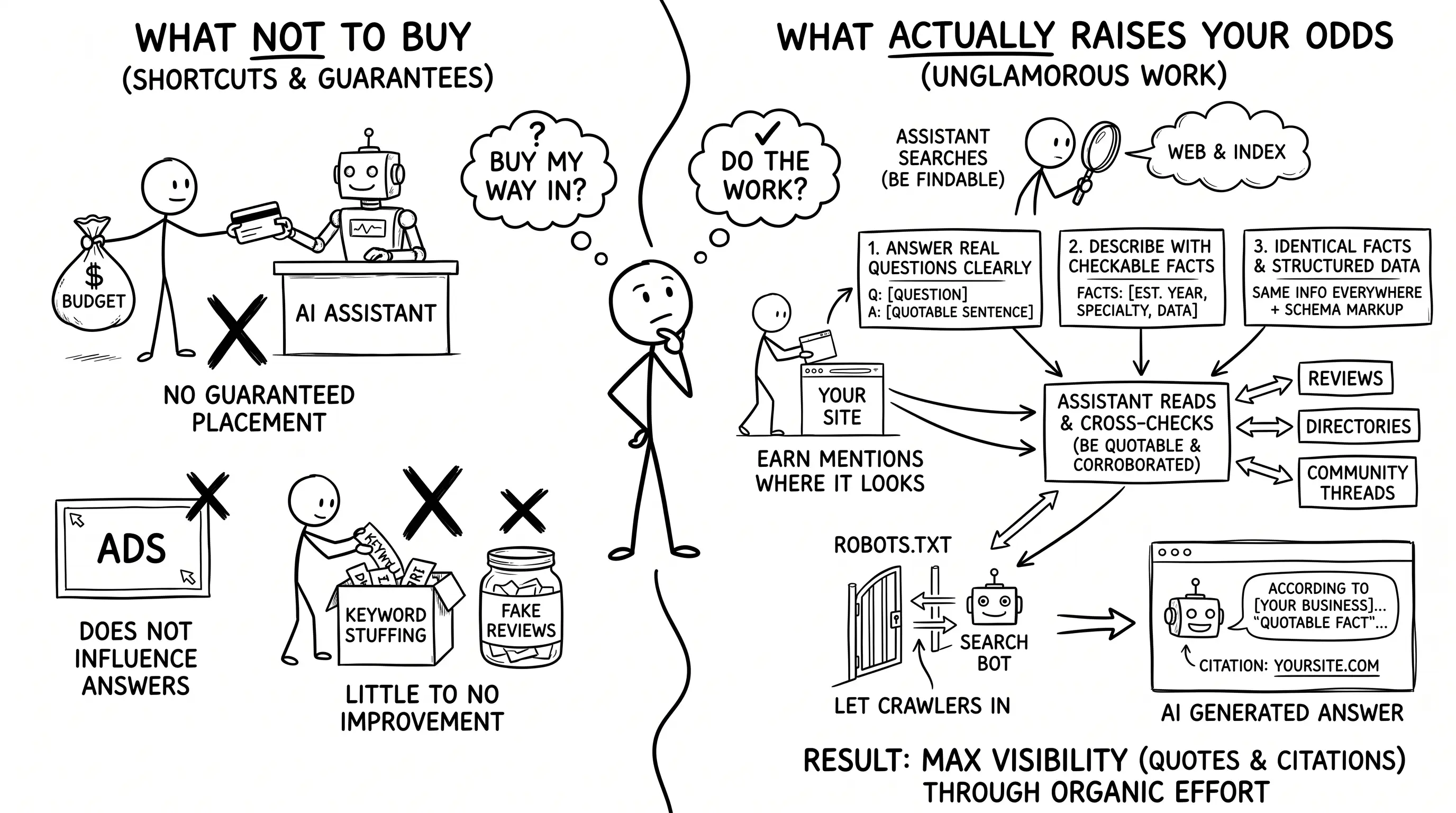
Short answer: you cannot buy your way into ChatGPT's answers, and nobody can guarantee you a place in them; OpenAI's own documentation says both. What raises your odds is unglamorous work that any business can do: a site that answers real questions in sentences a machine can quote, facts that match everywhere you are mentioned, reviews and third-party pages that corroborate you, and crawlers you have not accidentally blocked. Most of it is free.
The most visible advice on the internet for getting ChatGPT to recommend your business includes a reply on OpenAI’s own forum, posted in January 2023, that suggests hiring people to write reviews. In July 2026 it still ranks on the first page of Google, next to a Reddit thread and a Facebook group post. The question deserves better. ChatGPT reports more than 900 million weekly users and OpenAI says search usage inside it nearly tripled in a year (2026), while prompt-volume estimates show people asking ChatGPT itself how to do “SEO for ChatGPT” roughly eight times more often than a year ago (2026). When a question this valuable is answered this badly, someone will sell you a shortcut. What follows is the longer route: what OpenAI documents, what published research measured, and what we verified by testing in July 2026.
One housekeeping note, because the vocabulary is a mess. Generative engine optimization (GEO), answer engine optimization (AEO), LLM SEO, and AI SEO are four names for one practice: making your business visible and quotable in AI-generated answers. We say GEO; substitute freely.
How ChatGPT decides which businesses to name
ChatGPT composes recommendations in two modes. Without web search, it speaks from training data: patterns learned months earlier, no sources checked, and most small businesses simply absent. With search on, which is the norm for anything commercial or current, it rewrites your question into search queries, sends them to search providers and its own index, reads what comes back, and writes an answer with citations. OpenAI’s documentation says ranking in ChatGPT search “is based on a number of factors designed to help users find reliable, relevant information,” and then adds the sentence every business owner should frame: “There is no way to guarantee top placement” (OpenAI help documentation, 2026).
For products, the company is more specific: results “are selected independently by ChatGPT and are not ads,” and merchants are ranked on availability, price, quality, and whether they are the maker or primary seller of the item (OpenAI help documentation, 2026). If the user has memory enabled, their past chats tune the suggestions further.
We ran the obvious experiment on 15 July 2026: we asked ChatGPT (GPT-5.5, web search on) to recommend a web and SEO agency in Slovakia, where this studio is based. It named five real agencies, and the citation behind every one of them was that agency’s own website. Before answering, it ran its own searches for shortlist and review material, including a Slovak-language query for “best SEO agencies Slovakia Clutch”, then read the candidates’ pages and repeated what they said plainly about themselves; one agency was recommended in part because its about page states it has been building websites since 1997. A single test proves no rule, but the mechanics on display match the documentation: the assistant searches, reads, cross-checks, and quotes whoever is clearest.
Strip away the mystery and there are three levers: be findable when it searches, be quotable when it reads, and be corroborated when it cross-checks. Everything below serves one of the three.
Can you pay ChatGPT to recommend your business?
No. OpenAI has sold ads inside ChatGPT since February 2026, and its first advertising principle reads: “Ads do not influence the answers ChatGPT gives you” (OpenAI, 2026). The help center is blunter: advertisers “have no ability to shape, rank, or alter ChatGPT’s responses” (2026). An ad buys a labeled block underneath the answer, is available only to businesses based in seven countries, and the EU is not among them; the costs and mechanics are their own topic. Perplexity went further and shut its advertising program in February 2026, telling the Financial Times “We are in the accuracy business.” On every major assistant, the recommendation itself is organic. That cuts both ways: no budget can buy it, and no budget is required to compete for it.
What actually raises your odds
This question has a primary source that most of the advice industry skips. In a study accepted to KDD 2024, researchers from Princeton and IIT Delhi built a benchmark of 10,000 queries and measured which page changes made generative engines cite a source more. Visibility rose by up to 40% on their position-weighted metric, and the changes that won were adding statistics, quotable sentences, and cited sources. Keyword stuffing, the oldest reflex in SEO, produced “little to no improvement” (Aggarwal et al., 2024). Machines reward pages that read like evidence.
Converted into work, that is five jobs:
- Answer real questions in sentences a machine can lift. An assistant assembling an answer takes self-contained statements: a first sentence that defines, a number with a year attached, a heading phrased the way people ask. Google’s guidance for its own AI features says the quiet part out loud: there are “no additional requirements” and no special files or markup, just indexable pages and the usual fundamentals (Google Search Central, 2025). Put a direct answer at the top of each page and you have done most of what “AEO content” courses charge for.
- Describe your business in checkable facts. “We help clients grow with innovative solutions” gives a model nothing to verify or repeat. “Accounting firm in Bratislava, specialized in small companies and e-shops, payroll and VAT included, since 2011” gives it everything. In our July test the assistant echoed the agencies’ self-descriptions almost verbatim, down to a founding year. Write your about page for a careful stranger who quotes you literally.
- Keep the facts identical everywhere, and mark them up. The same name, services, and numbers should appear on your site, your Google Business Profile, directories, and social profiles, because an assistant that cross-checks and finds agreement cites with more confidence. Structured data helps the parsing: Microsoft’s Bing team has confirmed schema markup helps its LLMs understand content (via Search Engine Land, 2025), while Google says no markup beyond the standard kind is needed for its AI features (2025). LocalBusiness, Service, and FAQPage schema is an afternoon of developer time.
- Earn mentions where assistants actually look. Citation studies keep finding the same shape: assistants lean on aggregation and review layers. Wikipedia was ChatGPT’s most-cited domain at 7.8% of citations in one nine-month sample, with Reddit, Forbes, and the review platform G2 close behind, while Reddit led citations in both Google’s AI Overviews and Perplexity (Profound, 2025). The favorites move fast; Semrush measured Reddit and Wikipedia citation rates in ChatGPT collapsing by more than half after model updates in late 2025. So chase the pattern, not a single domain: review platforms, comparison and roundup pages, community threads, industry directories. Finding your niche’s version takes five minutes: ask the assistant for a recommendation in your category and read which pages it cites. That list is your PR target list. The same mechanics also decide which people get named; we cover the individual version in how to build a personal brand.
- Let the crawlers in. Sites that opt out of OpenAI’s search crawler “will not be shown in ChatGPT search answers,” per OpenAI’s crawler documentation (2026). The bot that matters for visibility is OAI-SearchBot; it is separate from GPTBot, the training crawler, and either can be blocked by accident in a firewall or CDN bot rule, so check your robots.txt and server logs rather than assuming. Perplexity and Anthropic publish the same kind of allowlist guidance for their search bots. While you are in there, keep dates on your pages: Bing’s team notes generative AI values fresh content partly as a reference check against its training data (2025).
How to check what AI says about you today
Ask the assistants the questions your customers would ask, in two or three phrasings, ideally in a fresh session with memory off so you see the neutral answer. Note who gets named, and read the citations to see which sources put them there. Then measure arrivals on your side: ChatGPT tags outbound clicks with utm_source=chatgpt.com, so filtering on that source in GA4 shows exactly which pages earn visits from answers (OpenAI help documentation, 2026). Google Search Console counts AI Overviews clicks inside the ordinary “Web” totals without breaking them out (Google, 2025). Repeat the round monthly, because answers shift with model updates, and ask new customers how they found you; “ChatGPT recommended you” already happens, and analytics never sees the people who did not click. Where AI answers fit among referrals, reviews, and search is the subject of how to get clients. And because a growing share of these readers get their answer without ever arriving, the visits you do earn are worth converting into a contact you keep: an email list is the one audience no model update reassigns.
Do you need llms.txt?
Probably not yet, and certainly not as a paid service. llms.txt is a 2024 proposal, “adding a /llms.txt markdown file to websites to provide LLM-friendly content” (llmstxt.org, 2024), that no major AI provider has committed to reading. Google’s John Mueller compared it to the old keywords meta tag in 2025 and called its value “purely speculative for now” as recently as June 2026 (via Search Engine Journal). The measurements agree: adoption grew almost ninefold in a year, yet 97% of llms.txt files received zero requests from AI bots in May 2026 (Originality.ai via PPC Land, 2026). Adding one costs an hour and might age well; that is the honest ceiling. If someone charges you monthly to maintain it, you are the product.
What not to buy
- Guaranteed placement: OpenAI states there is no way to guarantee it. Anyone selling you the top spot in ChatGPT is selling a promise they cannot keep.
- Enterprise monitoring before basics: AI-visibility tracking platforms are real products and make sense at scale, but a small business gets most of the value from a half hour of manual prompts each month, at a cost of zero.
- Panic, in either direction: the week we researched this, one feed declared SEO dead while another ran a video titled “The AEO Panic Has Turned Into Regret.” The data is calmer than both. Only 12% of URLs cited by AI assistants ranked in Google’s top 10 for the original prompt (Ahrefs, 2025), and pages ChatGPT cites sit at position 21 or deeper almost 90% of the time for related queries (Semrush, 2025). Read that again as a small site: AI answers reach far past the top of the SERP, which means you can be cited without first winning rankings you cannot yet win. Rankings still matter; they are simply no longer the whole game.
Is this AEO, GEO, or just SEO with new letters?
It is one discipline with a wider finish line. The substrate is still search: assistants find you through indexes, and Google’s own advice for AI features is that “all existing SEO fundamentals continue to be worthwhile” (2025). What is genuinely new sits in two places: writing so a machine can quote you, and building the third-party record it checks you against. If you want the budget-level comparison of the two surfaces, we wrote GEO vs SEO for exactly that decision. The name will settle eventually. The work is available now, and it compounds while your competitors argue about the acronym.
Getting named in AI answers is the organic half of a pair; the paid half is not for sale in the EU yet, which makes this the half worth doing first. It is part of how we approach digital marketing, and if you would rather have someone measure where you stand than run the prompts yourself, talk to us.