

Short answer: a personal brand is your reputation made visible and checkable. One narrow claim about what you do, public evidence that you actually do it, repeated in the places your buyers look. You do not need to dance on camera, post daily, or become a creator. In a feed where half the content is machine-generated, proof that a real person does real work is the scarcest marketing asset you own.
Somewhere around November 2024, machines started publishing as many articles as people. That is not a figure of speech: Graphite, which tracks a large sample of the open web, measured the crossover then, and its May 2026 update finds the split holding at roughly half AI, half human ever since (Graphite, 2026). Content stopped being scarce. What became scarce is the thing content used to prove: that a competent person stands behind the words. Search demand reflects it — interest in building a personal brand runs at roughly five times its long-term average in 2026, by our read of search-demand data.
Most advice on this question is written by people whose personal brand is their entire business: full-time creators selling courses about becoming a full-time creator. If that is your goal, their playbooks are fine. This guide is for everyone else: the founder, the freelancer, the specialist who wants the reputation without the performance. It runs on published research, and it will not ask you to film yourself.
Why personal brands suddenly matter more
When anyone can generate competent-sounding text in seconds, competent-sounding text stops being evidence of competence. Readers have adjusted. Merriam-Webster’s word of the year for 2025 was “slop,” defined as low-quality digital content “produced usually in quantity by means of artificial intelligence” (Merriam-Webster, 2025). In a Gartner survey of 1,539 US consumers, 50% said they would prefer to give their business to brands that avoid using generative AI in consumer-facing content, and 68% said they frequently wonder whether the content they see is real at all (Gartner, 2026).
The flood is real, but so is its limit, and the limit is the interesting part. Ahrefs found that 74.2% of newly published pages contain at least some AI-generated text, yet only 2.5% are purely AI (Ahrefs, 2025). Meanwhile Originality.ai’s long-running study of what actually ranks put AI-generated pages at about 17% of Google’s top twenty results as of late 2025 (Originality.ai, 2025). Graphite’s own hypothesis for why the flood plateaued at parity: “primarily AI-generated articles do not perform well in search.” Machines flooded publishing; humans still dominate what gets read, ranked, and cited.
Trust has moved the same direction, toward identifiable people. The 2026 Edelman Trust Barometer, surveying nearly 34,000 people across 28 countries, found trust concentrating in the near and the known: scientists (76%) and teachers (73%) top the list, “my employer” is the most trusted institution at 78%, and the biggest year-over-year gains went to neighbors and coworkers (Edelman, 2026). People trust people they can verify. A personal brand is how a stranger verifies you.
What a personal brand actually is (and isn’t)
A personal brand is what people can find out about you, plus what they conclude from it: your reputation, made visible and checkable by someone who has never met you. The term goes back to Tom Peters’ essay “The Brand Called You” (Fast Company, 1997), but the 2026 version has a harder edge, because the person checking is now often assisted by a machine that reads everything.
Three things it is not. It is not an aesthetic: a color palette and a professional headshot are packaging, not the product. It is not a posting schedule: frequency without substance reads as noise, and readers now assume noise is machine-made. And it is not reach: an audience of ten thousand strangers is worth less than being the person thirty of your actual buyers think of first.
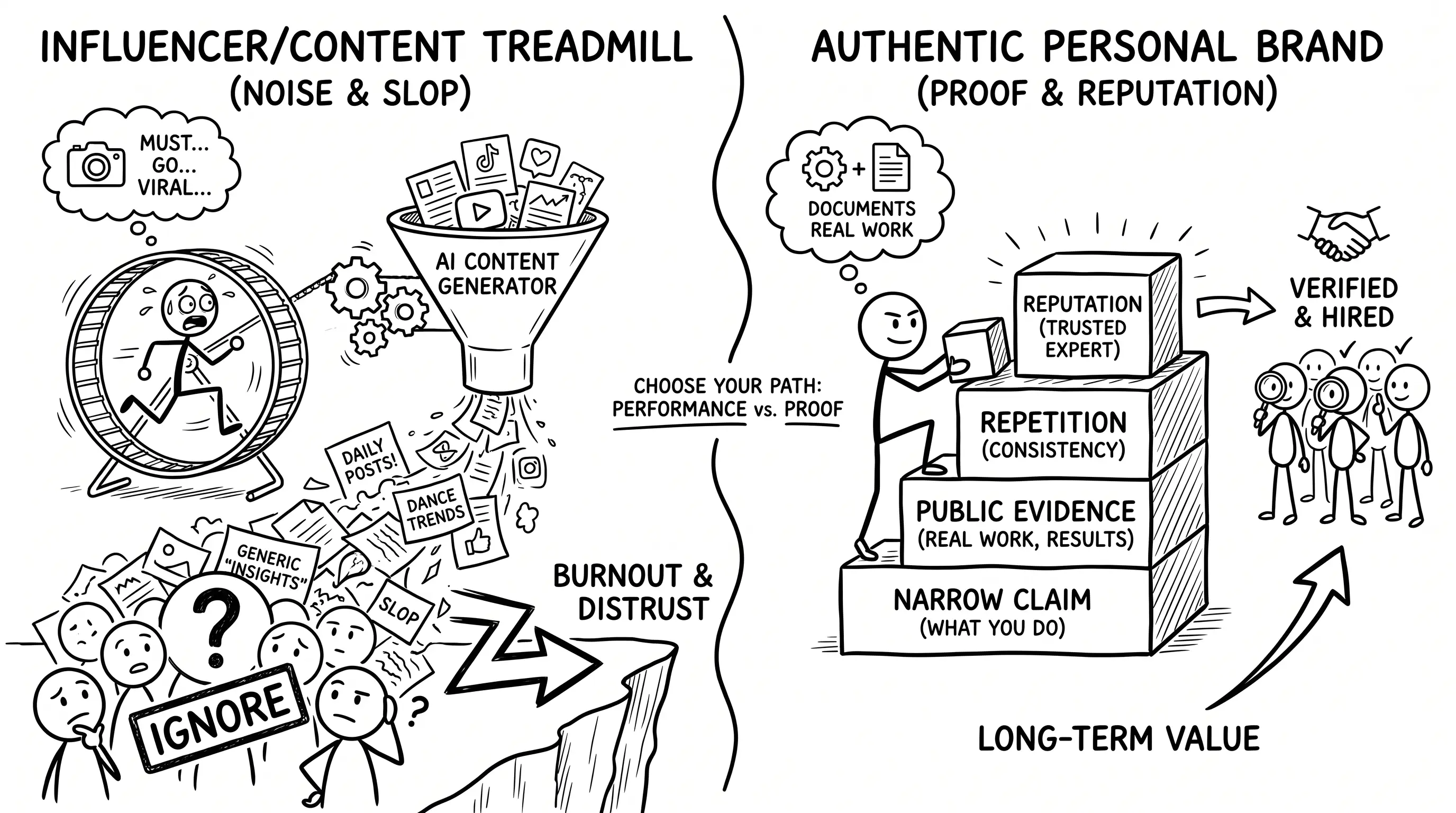
For a working professional, a personal brand reduces to three components: a clear claim (what you are for), public evidence (work, results, reasoning people can inspect), and repetition (the claim and evidence showing up consistently where your buyers look). Everything in the system below feeds one of those three.
One more honest note: you already have a personal brand. Search your name, or ask an AI assistant about you. Whatever comes back is the current version. The only choice is whether you shape it.
Does it actually pay? What buyers say
The best data on whether visible expertise wins business comes from Edelman and LinkedIn’s annual study of business decision-makers, and the numbers are unambiguous. In the 2025 edition, which surveyed 1,934 executives, 71% of decision-makers said strong thought leadership is more effective than conventional marketing at demonstrating what a vendor is worth, and 95% said it makes them more receptive to outreach (Edelman–LinkedIn, 2025). The 2024 edition, fielded across seven markets, found 60% willing to pay a premium to work with an organization or individual that produces valuable thought leadership (Edelman–LinkedIn, 2024).
For a small firm, one finding matters more than the rest: 53% of decision-makers agree that if the thought leadership is high quality, brand recognition matters less (Edelman–LinkedIn, 2025). Visible expertise is the one marketing channel where a two-person studio can genuinely outrank a corporation, because the unit of trust is the person, not the logo. And the bar is low: in the 2024 study, only 15% of decision-makers rated the thought leadership they read as very good or excellent. Most of what your competitors publish is mediocre, which is precisely the opening.
One distinction keeps the whole topic honest. Ipsos’ global trustworthiness index puts doctors, scientists, and teachers at the top of the most-trusted professions, while social media influencers sit at the bottom, level with politicians at 15% (Ipsos, 2024). The public does not distrust visible experts; it distrusts professional visibility. Build the expert’s brand, not the influencer’s.
The system: five moves, no performance
- Claim one narrow thing you can prove. A personal brand is a territory: one intersection of what you do and who you do it for, specific enough that evidence can back it. “Marketing consultant” is not a claim. “I help Slovak e-shops fix the checkout step where they lose a third of their orders” is: it names the buyer, the problem, and implies the proof. The test for the right scope is uncomfortable but simple: can you attach real work to the sentence? If not, narrow it until you can.
- Pick one platform where your buyers think, and own your home base. For most B2B and service businesses that platform is LinkedIn; for a visual trade it may be Instagram; for a developer it may be GitHub and a blog. One is enough, chosen by where your buyers actually evaluate people. Separately, put a page on the open web that you own: your name, your claim, your work, in plain sentences. Feeds change their rules without asking; your own page is the one surface that cannot be taken away, and, as the next section shows, it is what machines read when someone asks about you.
- Document work instead of manufacturing content. The sustainable source of material is the work you already do: the decision you made this week and why, the mistake that cost you, the number that surprised you, the before-and-after with the reasoning attached. Documentation carries built-in proof; manufactured opinion does not, and readers can tell. This is the same system we laid out in what to post when you have run out of ideas: pillars derived from real customer questions, one production session, a sustainable cadence. Evidence first, opinions second, and opinions always with the reasoning shown.
- Write the one-sentence statement. Every profile needs a line that says who you help, with what, and why you can. A formula that works: I help [specific buyer] [specific outcome], [evidence hook]. “I help construction firms win public tenders; 40+ submitted, €18M awarded.” “I design packaging for food brands; my redesigns sit in two supermarket chains.” “Accountant for freelancers; I answer the tax questions you are afraid to ask.” Plain beats clever, numbers beat adjectives, and the statement should read the same on every platform where you appear.
- Show up less often than you fear, for longer than you would like. Jakob Nielsen’s participation-inequality research found that in most online communities roughly 90% of users only read, 9% contribute occasionally, and 1% produce most of the content (Nielsen Norman Group, 2006). That ratio has softened but not flipped: LinkedIn reported original posts up 14% year over year in April 2026, on a network of 1.3 billion members (LinkedIn, 2026), which still leaves the regular contributors a small minority. Posting thoughtfully once or twice a week puts you ahead of nearly everyone in your field, and consistency over quarters is what compounds. The people who quit after three weeks of daily posting lose to the person who showed up weekly for two years.
Will AI assistants recommend you?
They already recommend people the way they recommend businesses: by assembling answers from what they can read and corroborate. When we tested how ChatGPT recommends companies in July 2026, the pattern was blunt: for every business it named, the source it cited most was the company’s own website, quoting the site’s own plain-language claims back as reasons. The full breakdown is in how to get ChatGPT to recommend your business, and every mechanism in it applies to a person: consistent naming everywhere, a page that states who you are in quotable sentences, mentions on sources the models already read.
The practical checklist for a person is short. Use the same name, title, and claim across your site, LinkedIn, directories, and anywhere you are written about. Publish under a byline, on a page that pairs your name with your subject. Say the checkable things: “since 2015,” “120 projects,” “works with X” (our testing suggests assistants lift exactly these self-descriptions). And earn third-party mentions: a podcast appearance, an industry roundup, a conference page, a client’s case study all become machine-readable references that corroborate your claim.
This matters more each quarter because the first impression is increasingly the answer layer, not your homepage. Similarweb puts zero-click searches at 68% of all Google searches in 2026 (Similarweb, 2026), and Pew found users click a result roughly half as often when an AI summary appears (Pew Research Center, 2025). Even LinkedIn’s feed now runs on large language models that surface posts to non-followers by understanding what the post is about; LinkedIn’s engineering team describes the goal as content “timely, relevant to their professional goals, and grounded in trust” (LinkedIn Engineering, 2026). Expertise-dense writing travels beyond your network; generic motivational filler does not.
Founder brand or company brand?
For a small business, the founder’s face usually outperforms the logo, and the data supports leading with it. In Sprout Social’s mid-2026 survey, 40% of social media users said they discover products through employee-generated content at least monthly, rising to 61% among Gen Z, with Sprout’s own summary of the mood: people “are tired of AI slop and want to see real people talking about subjects that matter to them” (Sprout Social, 2026). LinkedIn’s employee-advocacy guide reports click-through roughly 2x higher when a person shares content than when a company page does (LinkedIn, undated guide; treat as directional).
The honest caveat is key-person risk. A company that is only its founder’s feed is harder to staff, scale, or sell, and clients who bought the person can resent being handed to a team. The division of labor that works: the founder’s brand opens the door; the company’s own proof keeps it open, the same two-door machine we map in how to get clients. That second half is ordinary brand-building: casework, a coherent identity, a site that holds up without the founder in the room. We wrote about what that costs, and when it is worth paying for, in how much branding costs.
What not to spend money on
The personal branding industry grew alongside the demand, and much of what it sells replaces nothing above.
- Courses that teach “the algorithm”: most $500–$5,000 personal branding courses repackage the system in this article: niche, platform, consistency, proof. Platform mechanics change quarterly; evidence does not. If you want to spend money, spend it on making the work worth documenting.
- Engagement pods: groups that like and comment on each other’s posts to game reach. Platforms classify this as inauthentic activity, buyers can smell the same twelve people applauding, and the reach it buys is reach among other pod members, not customers.
- Bought followers: an audience number without buyers in it. The count impresses nobody who matters, and it poisons the one metric that predicts revenue, the share of your audience that could actually hire you.
- AI-ghostwritten thought leadership: paying a tool or agency to generate “insights” in your name joins the slop pile that half of consumers already hold against brands (Gartner, 2026). Using AI to edit, structure, or research your own thinking is sensible; publishing machine-generated opinions under a human byline is exactly the signal readers have learned to discount.
The folk frameworks deserve one honest paragraph. The “7 pillars of personal branding,” the “5 A’s,” the “4 C’s” (clarity, consistency, content, communication, in the version Berkeley’s executive-education blog popularized), and the “3-7-27 rule” circulate in every course and carry no canonical source or research base we could find. As memory aids they are harmless. As paid curriculum they are a table of contents sold as a book.
A personal brand is slow marketing: one narrow claim, evidence in public, repeated until strangers repeat it back. If you want the company-side foundations under it done properly, that is what our branding and content production work is for, and if you would rather talk it through with a person first, get in touch.