

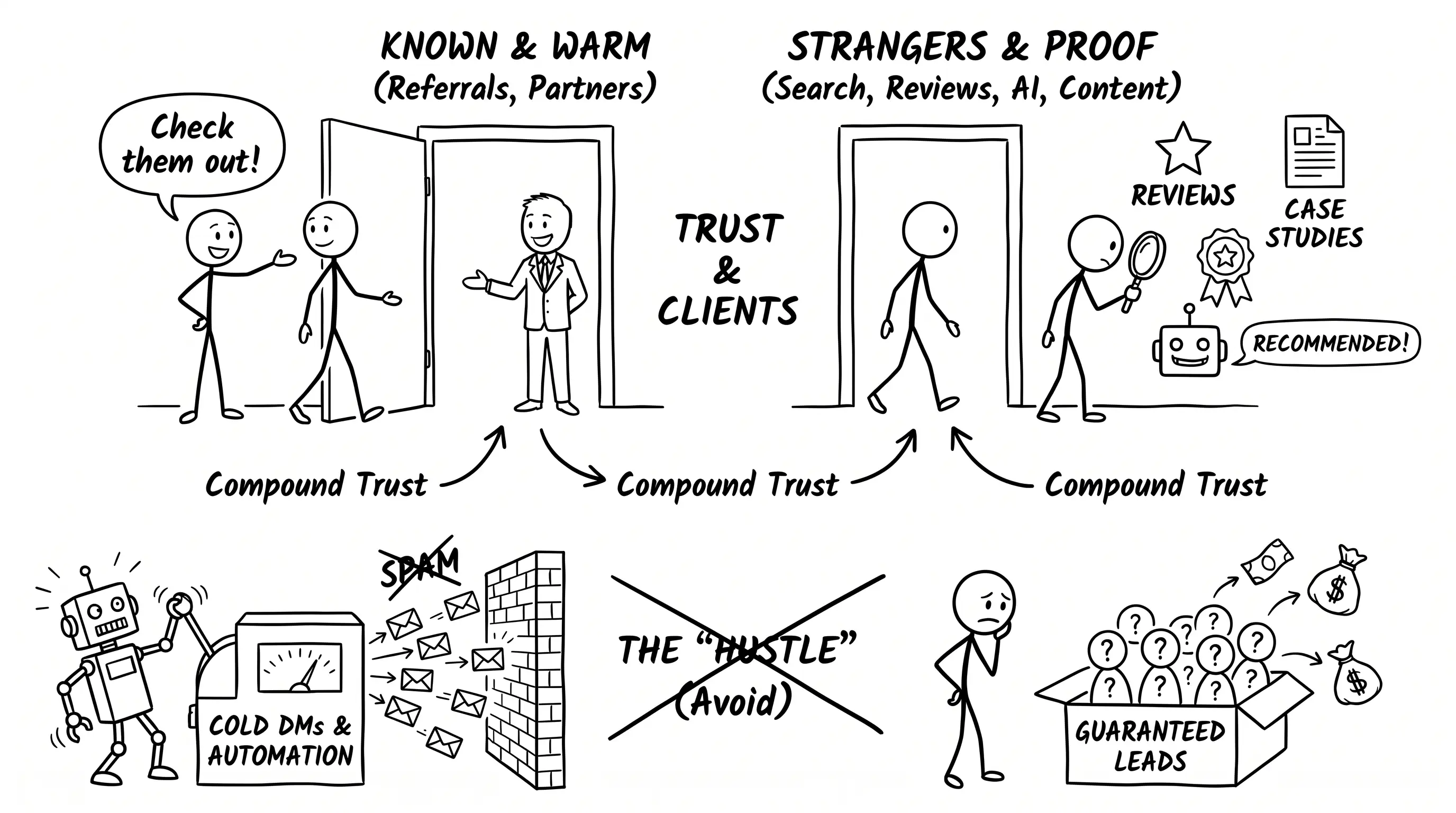
Clients come through two doors: people who already know your work, and strangers who find proof of it while deciding whom to trust. Everything that reliably wins clients (referrals you actually ask for, reviews and case studies a buyer can verify, showing up where people search, which now includes AI assistants) is one of those two doors, made deliberate. The cold-DM grind the internet keeps selling you is neither, and it shows in the results.
Search interest in how to get clients is at a five-year high and still climbing: in the search-demand data we pulled this July, the question roughly doubled over the past year, and the wider cluster around it (“how to get customers”, “how to find clients”) is put to AI assistants tens of thousands of times a month in the US alone. The market answering it has a curious shape. The top results are career coaches with a course to sell, marketplaces that earn fees when you stay dependent on them, a Reddit thread, and a US government listicle published in April 2017. Almost everyone ranking for the question earns money from a specific answer to it.
We run a service business ourselves, so the question is not academic for us. The honest answer is duller than the hustle content suggests: clients come from a few unglamorous mechanisms that compound, and almost none of them involve messaging strangers. Here is the system, the research behind each part, and what not to spend money on.
Where do new clients actually come from?
New clients come through two doors: people who already know your work, and strangers who find proof of it while deciding whom to trust. Referrals, repeat business, and partner recommendations walk through the first door. Search results, reviews, case studies, content, and now AI recommendations open the second. Client acquisition is the work of widening both doors on purpose instead of waiting for either to open by itself.
The first door carries most small firms. In a 2025 LocaliQ survey of more than 730 US small businesses, 65% named referrals their best source of new customers, rising to 75% among businesses with ten or fewer employees. The pattern is old and stable: Nielsen’s most recent global Trust in Advertising study (2021, roughly 40,000 respondents in 56 countries) found 88% of people trust recommendations from someone they know more than any other channel, and the 2026 Edelman Trust Barometer recorded trust shifting further toward personal circles, with “my neighbors, family and friends” and “my coworkers” among the year’s biggest gainers.
The mistake is treating the doors as separate strategies. Hinge Research Institute, which studies how professional-services buyers behave, found in a 2015 study that practitioners still cite that about half of referred buyers rule a firm out before ever speaking to it, and that the place they go to decide is overwhelmingly the firm’s website. A recommendation opens the door; your proof decides whether the buyer walks through. Referrals and proof are one machine, and the sections below are its parts.
Make referrals deliberate, not accidental
A referral system is nothing more exotic than doing referable work, then removing friction and awkwardness from the moment of recommendation.
Referrals are worth engineering because referred customers are measurably better customers. The cleanest evidence is a Journal of Marketing study that tracked roughly 10,000 customers of a large German bank for 33 months: customers who arrived through its ordinary refer-a-friend program were at least 16% more valuable over their lifetime, around 25% once cheaper acquisition is counted, and about 18% less likely to leave; the loyalty gap persisted even as the profitability gap slowly faded (Schmitt, Skiera & Van den Bulte, 2011). That program paid about €25 per referral, and the customers it brought were better, not worse. A modest thank-you does not poison the well. Paying strangers to recommend you to other strangers does; that is advertising in a costume.
What making referrals deliberate looks like in practice:
- Ask at the moment of delivered value. The day you hand over the finished work, fix the problem, or ship the result is the day a recommendation costs your client the least effort. Months later it becomes a favor; in the moment it is a natural sentence.
- Say what a good referral looks like. “Someone opening an e-shop” gets remembered; “anyone who needs a website” does not. Specific asks travel.
- Build partner routes. Adjacent providers who serve your clients before or after you (the accountant and the business lawyer, the car mechanic and the tire shop) refer without competing. In Hinge’s referral research, 81.5% of firms had received a referral from someone who was never a client: reputation travels farther than your client list.
- Close the loop. Report back and thank the referrer, whatever the outcome. People repeat what visibly worked.
Build proof a stranger can check
Every referral, search result, and AI mention ends at the same place: a stranger checking whether you look real. Hinge’s buyer research puts numbers on it: 82% of professional-services buyers evaluate a firm through its website, and around nine in ten rule firms out before any conversation happens.
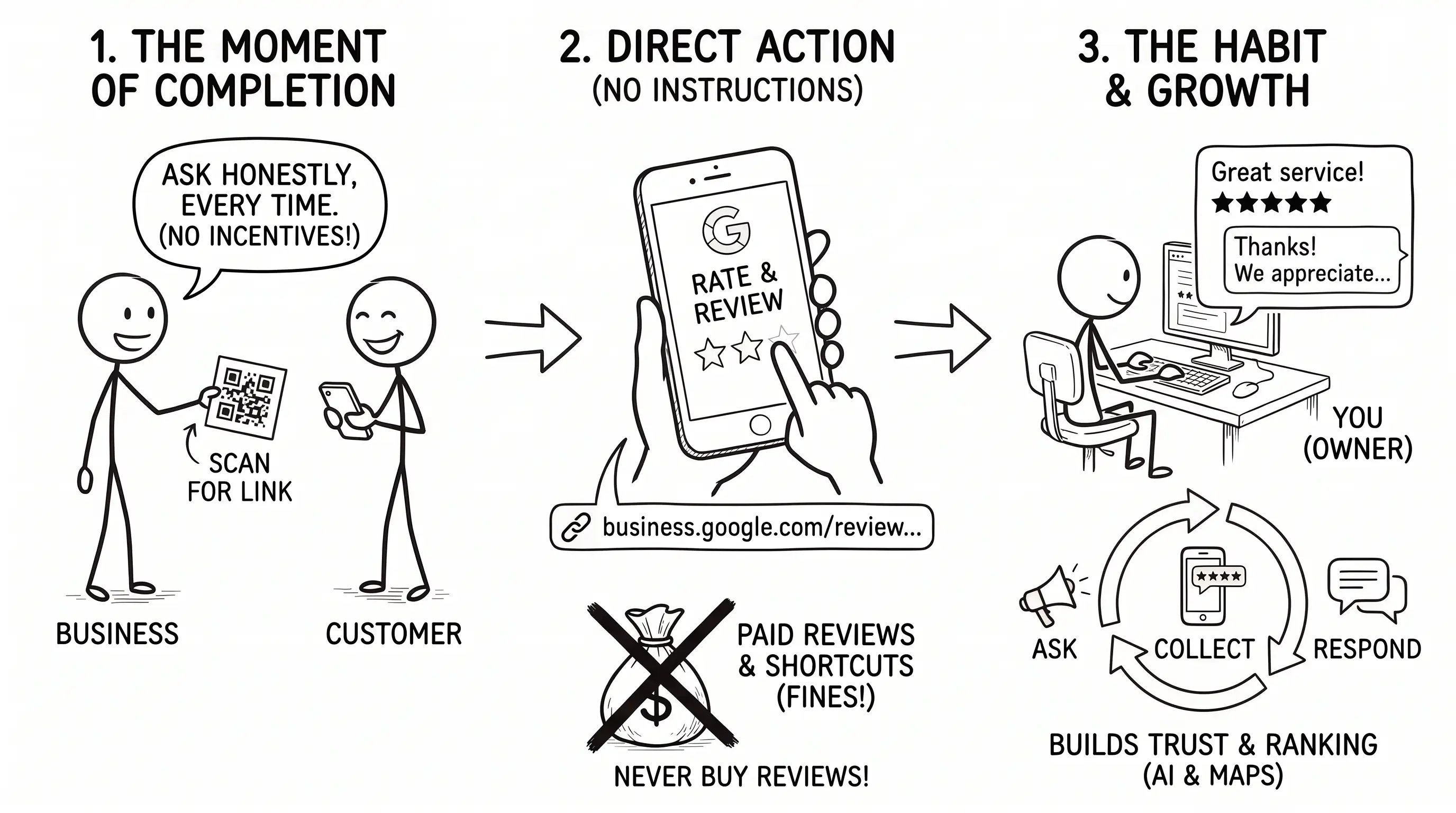
Reviews are the most-checked form of proof. In BrightLocal’s 2026 Local Consumer Review Survey (about 1,000 US consumers, a vendor study worth hedging), 97% read reviews for local businesses, 49% trust them as much as personal recommendations, and recency matters: 74% look for reviews written in the last three months. The operational consequence is a habit, not a campaign: ask every satisfied client for a review at handover, reply to all of them, and never let the stream stop. Do not pay for reviews or trade discounts for them; besides the platform rules, one exposed fake costs more trust than fifty real ones bought.
Beyond reviews, proof means case studies with real numbers, prices you are willing to publish (setting them well is its own discipline), and pages that answer the questions buyers actually ask before they trust a provider, including what things cost (the reason our own website pricing breakdown exists). For founders and freelancers, the strongest proof asset is often personal: people trust people, which is why a personal brand works as an evidence trail rather than a performance.
Google’s own consumer research explains why proof punches above its weight. Its Decoding Decisions report (2020) describes buyers looping “between exploring and evaluating” in the messy middle between trigger and purchase, and tested six biases that settle the loop, social proof among them. In its experiment with 31,000 UK shoppers, a fictional brand nobody had ever heard of pulled large shares of preference away from established favorites once its offer carried those trust signals, though Google is honest that it took a far superior proposition to do it. For a small firm, that is the encouraging reading: at the evaluation moment, checkable proof can outweigh size.
Be findable where clients look now
The second door has moved twice in a decade: from directories to Google, and now from Google alone to AI assistants. The basics still pay first: a complete Google Business Profile with fresh photos and services listed, service pages that answer one query well each, and the classic search layer we covered in GEO vs SEO. What changed is who does the reading. In the same BrightLocal 2026 survey, 45% of consumers had used AI tools to find or vet local businesses, up from 6% a year earlier, with ChatGPT the most used; 42% said they trust those answers as much as reviews.
We test this the direct way. In July 2026 we asked a current assistant how a small accounting practice should win clients: it searched the web and assembled its advice from a handful of citable sources, a professional journal, a review-research firm, an industry benchmark report. When we had earlier asked one to recommend specific providers, it named real firms and cited, in every case, the firm’s own website. Both are single test runs, illustration rather than measurement, but the mechanism they show is consistent: assistants recommend whoever they can verify. Machine-readable proof is the same proof as the previous section, published where crawlers can reach it. The step-by-step version is its own guide: how to get ChatGPT to recommend your business.
Pick one channel and run it like a system
Visibility work fails by scattering, not by choosing the wrong channel. One channel your buyers actually use, run consistently for a year, beats five channels attempted for six weeks each.
Start with the warm layer, because it is free and honest: one message to the people who already know you (former colleagues, past clients, the local businesses you already deal with) saying what you do now and for whom. No follow-up sequence, no pitch. Most first clients in a new business come from exactly this, which is the one thing the coach content gets right. From there, pick the single public channel where your buyers spend attention and feed it from real customer questions; the sustainable version of that machine is the subject of what to post on social media. Consistency beats volume everywhere we have measured it.
How do you get clients fast?
The only fast lever is people who already know you. Past clients with a concrete reason to return, quotes that went quiet, referrers you have not updated in a year: these convert in days because the trust already exists. Everything aimed at strangers (search, reviews, content, AI visibility) compounds over months, which is the argument for starting it now rather than in the next slow season.
A first month that works:
- Week 1: Fix the proof. Make the website answer who you help, what it costs, and why to believe you; ask your five most recent happy clients for a review.
- Week 2: Send the warm-layer message. One honest paragraph, no pitch, to everyone who knows your work.
- Week 3: Reactivate. Write to past clients with one specific, useful reason to talk; follow up every quote that never answered.
- Week 4: Choose the one public channel and schedule the recurring habits: the review ask at every handover, the referral ask at every delivered result.
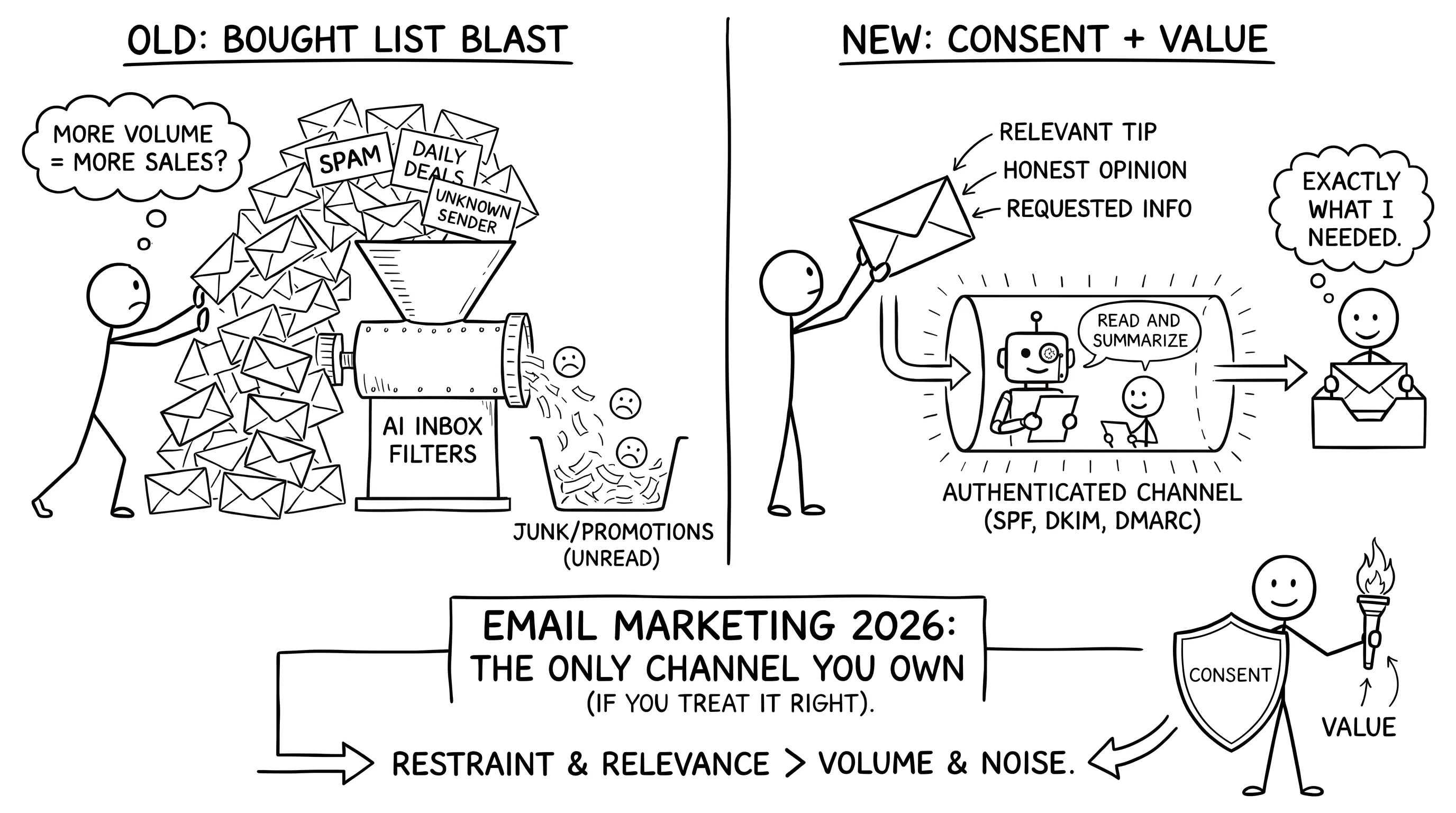
Reactivation stops being a scramble once it runs on a list instead of memory, which is the argument for keeping an email list of your own: the same warm layer, contacted on a calendar rather than in the month the pipeline empties.
What not to buy
The money saved on bad acquisition spending funds everything above.
- Guaranteed leads. Lead vendors sell the same contact to several firms and the “guarantee” measures deliveries, not clients. If the leads were as good as advertised, the vendor would serve them itself.
- Cold-outreach automation. AI made cold messages nearly free to send, which is precisely why they stopped working; when everyone can send a thousand personalized messages, nobody reads any of them. The scarce asset is trust, and automation cannot manufacture it.
- Client-getting courses. Note that the seller’s own acquisition system is selling courses about acquisition. The mechanics that work are in front of you, free, in this article and its sources.
- Marketplace dependency. Upwork and similar platforms are a legitimate first step: real demand, borrowed trust, fast feedback. They are a poor permanent home, because you rent the client relationship and compete mostly on price. Use them to build proof, then graduate the proof to surfaces you own.
The folk rules, briefly
Search this topic and you will meet numbered rules. The “3-3-3 rule of marketing” has no traceable origin and circulates in several contradictory versions, so treat any confident definition as invented. “70-20-10” began life as a budgeting split (70% proven channels, 20% promising, 10% experimental), which is a reasonable planning heuristic and nothing more. The “3 C’s” (company, customers, competitors) is the one with a real source, Kenichi Ohmae’s strategy triangle from The Mind of the Strategist (1982), and it survives translation into one sentence: sell what you are genuinely good at, to people who want it, where competitors are weak.
Most of this system is work you can do yourself, which is the point of it. When a piece is worth handing over, building the proof and the visibility is what we do all day in digital marketing and content production, and if you would rather talk it through with a person than a search box, talk to us.