

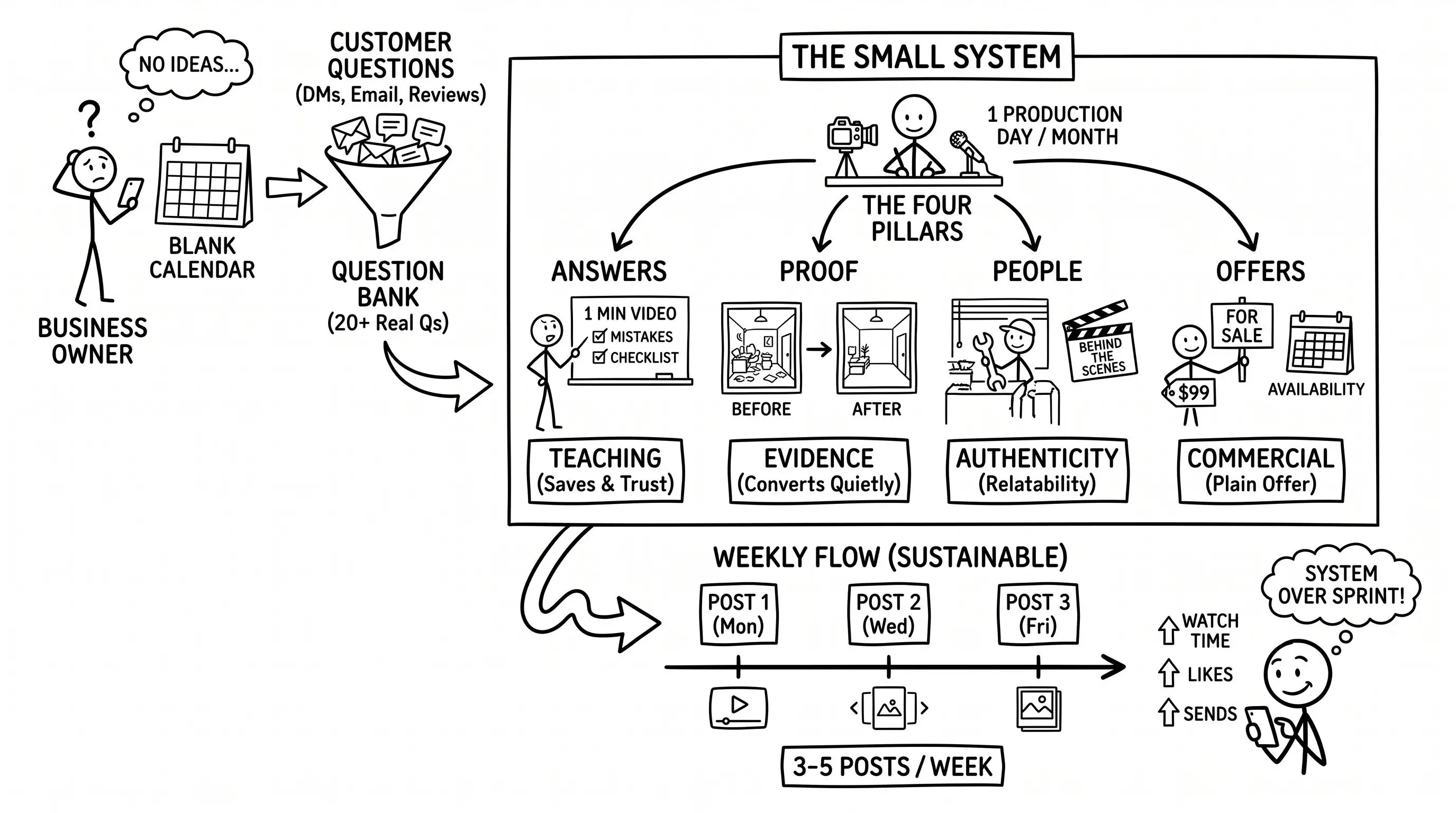
Short answer: stop hunting for ideas and build a small system. Post answers to the questions customers already ask you, proof that your work delivers, the people behind it, and the occasional plain offer. Three to five posts a week you can sustain beat a daily sprint you abandon in March, and one production session can feed a whole month. The data behind each of those claims is below.
“What should I post?” has quietly become one of the most common questions business owners ask an AI assistant. Search-demand data puts that question cluster around fifteen thousand prompts a month in the United States alone, and the underlying Google search has been climbing for five straight years. The internet’s standing reply is a list: 27 post ideas, 38 post ideas, 100 killer post ideas. If lists solved this, the question would be shrinking by now.
Why you keep running out of ideas
A blank content calendar is rarely an inspiration problem. It is what happens when every post is a one-off: you invent something on Monday, publish it, and by Thursday you are back at zero. Nobody has an infinite supply of one-off ideas. The businesses that post without visible effort are not more creative; they draw from a system that produces posts on demand.
Borrowed ideas have also started aging badly. As of April 2026, Instagram no longer recommends accounts that primarily repost other people’s photos, carousels or reels, and reports that 75% of what it recommends in the US is now original content (Instagram, 2026). Consumers pull in the same direction: about half say original content is what makes their favorite brands stand out, and a third say brands jumping on viral trends is embarrassing (Sprout Social Index, 2025). A post assembled from the same listicle everyone else read competes in exactly the category that platforms and people now value least.
Start with the questions customers already ask you
The most reliable content plan a small business can have is the list of questions its customers already ask it. Open your inbox, your DMs, your reviews, and the notes from your last few sales conversations, and write down fifteen or twenty real ones. What does it cost. How long does it take. Is the cheap version good enough. What happens if it breaks. Why did you do it that way. Every one of those is a post, and most are several: the same answer works as a short video, a step-by-step carousel, and a written caption. Content built this way is also the public half of how a service business wins clients: the same questions, answered where strangers can find them.
This works for three reasons. First, it is original by definition; nobody else has your answers, your examples, or your pricing logic, which is precisely what the originality policies above reward. Second, social platforms have become search engines: roughly two-thirds of US consumers have used social apps to search, and Google began indexing public Instagram posts in mid-2025 (Hootsuite Social Media Trends, 2026). The question your customer asks in person is the phrase their neighbor types into TikTok, and the same logic that gets a business cited by AI search applies on social. Third, platforms say outright that they reward it: LinkedIn has prioritized knowledge and advice content since 2023, with its product lead reporting that 98% of professional-knowledge posts were rated valuable by members (LinkedIn, 2023).
Four pillars cover everything else
Sort what you make into four piles. The first three give; only the last one asks.
Answers. Teaching posts built from the question list. The pillar that earns search traffic, saves, and trust.
- One customer question answered on camera, in under a minute
- The five mistakes you see clients make most often
- What things cost and why quotes differ
- A before-you-buy checklist for your product or service
- A myth in your industry, corrected plainly
Proof. Evidence that what you sell works. Proof posts convert quietly while teaching posts build the audience.
- A before and after, with one sentence on what changed
- One project or order walked through from start to finish
- A customer review, plus the story behind that job
- Real numbers from real work, where you can share them
- Customer photos of your product, reposted with permission
People. The part corporate accounts skip and small businesses win on. Authenticity and relatability are the two traits consumers say they value most in brand content (Sprout Social Index, 2025). If the face in these posts is usually yours, that is the start of a personal brand, and it compounds.
- How it is actually made, start to finish
- The person behind tomorrow’s delivery or Friday’s haircut
- A day on site, in the kitchen, at the workshop
- Why you refuse to do something competitors do
- The thing that went wrong this week and how you fixed it
Offers. The plain commercial post. It belongs in the mix; it just cannot be the mix.
- The product or service, stated simply, with a price
- Availability: “two installation slots left in August”
- Seasonal and holiday offers tied to a real date
- Something new in stock, one photo, one line
- A single clear call to action, not three
How often should you post?
Less often than the panic suggests. Across 18 industries, the median brand posts to Instagram 3.7 times a week, to Facebook 3 times, and to TikTok twice (Rival IQ Social Media Industry Benchmark Report, 2026). Buffer’s analysis of 2.1 million Instagram posts found that accounts posting 3 to 5 times a week grew followers roughly twice as fast as those posting once or twice, with gains past that point shrinking at every step; its own conclusion was that 3 to 5 is the sweet spot (Buffer, 2025). Instagram’s head Adam Mosseri has put the floor lower still: two feed posts a week and a couple of stories a day, as reported from Creator Week (Social Media Today, 2021).
The real penalty is stopping. In Buffer’s 2026 dataset of 52 million posts, accounts that skipped a week consistently underperformed their own baseline growth afterwards (Buffer, 2026). So the honest answer to “how often” is: the highest frequency you can hold for a year. Three posts a week still going in November beat seven a week abandoned in March. It is worth noticing who publishes most of the advice here: scheduling-tool vendors earn more when you post more, and even their own data says the median brand posts three times a week.
What the platforms say they reward
You do not have to guess what the algorithm wants; the platforms publish it. In his January 2025 ranking explainer, Mosseri named the three signals that matter most on Instagram: watch time, likes, and sends, advising creators to track “average watch time, likes per reach, and sends per reach” (Instagram, 2025, as transcribed by Social Media Today). That gives you a practical test to run before publishing anything: would one of your customers send this to a friend? A post that answers a real question passes far more often than a post that fills a calendar slot.
The other platforms are just as explicit. TikTok’s own creative guidance says to introduce your point in the first 3 seconds and secure the hook within 6, and recommends “a DIY or not overly polished style” over produced gloss (TikTok, 2025). Instagram says reels must be under three minutes to be recommended and that visibly watermarked reposts are deprioritized (Instagram, 2023). LinkedIn rebuilt its feed in 2026 around content that is “timely, relevant to their professional goals, and grounded in trust” (LinkedIn Engineering, 2026).
One production day, one month of content
The pillars tell you what to make. Batching decides when you make it, and it is the difference between a plan and a plan that survives. Set one production session a month: an afternoon with a phone, decent light, and the question list. Film yourself answering four questions in 30 to 60 seconds each. Shoot one process video for a how-it-is-made reel. Photograph recent work or products for two carousels and a handful of single images. That is 12 to 15 posts, a month of material at the median frequency, from one afternoon.
Format the output according to what the data says each format does. In Metricool’s 2026 study of 24 million Instagram posts, reels drew more than four times the interactions of single images and carousels earned nine times the saves, while single-image posts lost nearly half their engagement year over year (Metricool, 2026). Buffer’s numbers agree: carousels take the highest engagement per reach on Instagram while reels deliver about 1.36 times the reach (Buffer, 2026). Video reaches new people, carousels teach and get saved, single images carry the offers.
We work this way ourselves. When FUTBALIC’s production for its Czech team reveal fell through days before deadline, one Saturday shoot produced seven videos that carried the entire reveal and brought in hundreds of thousands of views. One day of cameras, weeks of content. The same arithmetic scales down to a phone and a quiet Tuesday. And topics repeat better than you think: only a fraction of your followers sees any given post, so the question you answered in March can honestly be answered again in September, in a different format. One of those formats is not social at all: the same four answers, written out, are a month of newsletter material, delivered to people no algorithm can put out of reach.
The 5-3-2 rule and the rest of the folklore
Ask Google how to divide your posts and it offers arithmetic: the 5-3-2 rule (five shared posts, three of your own, two personal, per ten; commonly attributed to T.A. McCann of Gist), the rule of thirds (promotion, curation, conversation), 4-1-1, the 80/20 rule (Pareto’s name borrowed for a ratio he never wrote), and the 5-5-5 rule, which circulates with at least two contradictory definitions. None of these is research. No platform uses them. They are mnemonics, and they all encode the same single instruction: mostly give, rarely ask.
Take the instruction and skip the arithmetic. Worth noting: the curation-heavy rules were coined in an era when sharing other people’s content was neutral. Under the originality policies above, a feed built on curation is now measurably worse advice than when it was written.
What a normal result looks like
Most businesses quit because they measure themselves against the wrong number. The median engagement rate on Instagram across industries is 0.30% per follower; on TikTok it is 2.01% (Rival IQ, 2026), and a separate 70-million-post benchmark lands in the same range (Socialinsider, 2026). The single-digit “engagement rates” in screenshots are usually calculated per reach, a different denominator. An account with 800 followers where a post collects a dozen likes, two saves and a send is not failing; it is at the median, and the saves and sends are the signals worth growing. Those standout posts are also the only ones worth putting ad budget behind, if you ever do; promoting a proven winner is the one boost that rarely goes to waste.
A few things to leave out of the plan: reposted content with someone else’s watermark (officially deprioritized), trends that have nothing to do with your business (the embarrassment stat above), and feeds that are one long sales pitch (the folk rules exist because the failure mode is that common). And treat replies as content: 73% of consumers say they will buy from a competitor if a brand ignores them on social (Sprout Social Index, 2025), and replying to comments measurably lifts engagement (Buffer, 2026).
The system fits in one sentence: twenty real customer questions, four pillars, three to five posts a week, one production day a month. If you would rather keep the system and hand off the production, that is the work we do in content production and social media management, or you can simply ask us the first question.