

Short answer: most SEO providers in the US charge $2,000 a month or less on retainer, and the most common band is $500 to $1,000; agencies alone sit higher, with about half at $1,500 to $5,000 a month. Consultants bill $50 to $150 an hour, and one-off projects most often cost $2,500 to $5,000. Whether any of it pays is a sum you can do before signing: divide a year of fees by the profit on one new customer. For a renovation firm that can mean eight extra jobs a year; for a café it means thousands of extra orders. Google's own advice adds that a small local business can probably do much of the work itself, with free tools.
Google keeps a page for business owners who are deciding whether to hire an SEO. It lists the services worth paying for, eight questions to put to any candidate, and a sentence that none of the price guides ranking for this question repeats: “If you run a small local business, you can probably do much of the work yourself” (Google Search Central, updated June 2026). The same page warns that “no one can guarantee a #1 ranking on Google.”
The guides that rank for “how much does SEO cost” are almost all written by companies that sell SEO, and the survey two of the top ten quote as current was run in November 2022. Whether a retainer earns its money back depends on figures only the buyer has: the profit on one new customer and how many of them search can bring.
How much does SEO cost in 2026?
SEO is sold in four ways: a one-off audit or project, a monthly retainer, hourly consulting, or a person on your payroll. Three surveys of providers give the prices, and they disagree.
Ahrefs’ poll of SEO providers (agencies, freelancers and consultants, collected in November 2022) found the most common retainer at $501 to $1,000 a month, chosen by 20.4% of respondents, with 68.8% charging $2,000 a month or less. GoodFirms’ 2026 survey, which asked more than 300 agency professionals in April and May 2026, puts 48% of agencies at $1,500 to $5,000 a month, 43.3% under $1,500 and 5.5% above $5,000. SE Ranking’s study with Duda (260 agencies, December 2024) found 64% of retainers below $1,000 and 30% below $500. All three are vendor data, and their samples differ: Ahrefs polled freelancers and consultants as well as agencies, while GoodFirms and SE Ranking asked agencies.
| How you buy it | What it costs | Source |
|---|---|---|
| One-off audit or project | $2,501 to $5,000 is the most common project fee (21.2% of providers) | Ahrefs, November 2022 |
| Monthly retainer, all providers | $501 to $1,000 most common; 68.8% charge $2,000 or less | Ahrefs, November 2022 |
| Monthly retainer, agencies | $1,500 to $5,000 for 48%; under $1,500 for 43.3% | GoodFirms, 2026 |
| Hourly consulting | $75 to $100 most common (24%), $111 average | Ahrefs, November 2022 |
| Freelance marketplace | $15 to $35 an hour, median of past contracts worldwide | Upwork |
| In-house specialist | $78,760 a year, median wage | BLS, May 2025 |
| Tools, if you do it yourself | $99 to $139 a month for entry paid plans; free tiers exist | Ahrefs, Semrush, Moz |
The marketplace figure comes from Upwork’s own rate page, which describes it as typical rates on historical contracts worldwide. The salary is the Bureau of Labor Statistics median for market research analysts and marketing specialists, the group O*NET uses for search marketing strategists; it comes to about $6,560 a month before payroll costs. The tool prices are the makers’ list prices in November 2026: Ahrefs Lite at $129 a month, Semrush’s SEO plan at $139 and Moz Pro Standard at $99, and each offers a free tier with limited access.
How old are the numbers in SEO price guides?
The most quoted SEO prices come from a poll taken in November 2022. The Ahrefs page now carries the headline “439 People Polled” and an “updated” date of August 2024, and two of the top ten results for “how much does SEO cost” quote its figures as current. An archived copy of the page from January 2023 gives the poll date and says 89 of the 439 submissions were removed as duplicates or spam, which leaves about 350 answers. Its widely repeated average of $2,917 a month assumes every provider charges the top of its price band. GoodFirms’ US pricing page reuses the same Ahrefs figures and calls them a 2026 survey.
Prices move with wages, so a 2022 figure needs restating. US consumer prices rose by a factor of 1.13 between November 2022 and October 2026 (BLS CPI-U), which turns Ahrefs’ $501 to $1,000 band into roughly $570 to $1,130 in today’s money and its $1,557 local-SEO average into about $1,760.
What does an SEO retainer buy?
An SEO retainer buys a monthly block of hours, and at the $111 average hourly rate in the Ahrefs poll, $1,500 buys about 13 of them. Google’s list of what SEOs legitimately sell is a fair menu for those hours: a review of your site’s content and structure, technical advice on hosting, redirects and error pages, content development, keyword research, training, market expertise and “optimizing for generative AI.”
Forbes Advisor’s guide, which Google’s AI Overview quoted on 18 November 2026, prices link building at $100 to $1,500 per link. Google’s spam policies define link spam as links made “primarily for the purpose of manipulating search rankings” and list “Buying or selling links for ranking purposes,” including “Exchanging money for links, or posts that contain links.” A paid article is within the rules only when its links carry a rel="sponsored" or rel="nofollow" attribute. An offer that bills links per piece should say how they will be labelled, because a paid link without the label is what Google’s policy calls link spam.
Is SEO worth it for a small business?
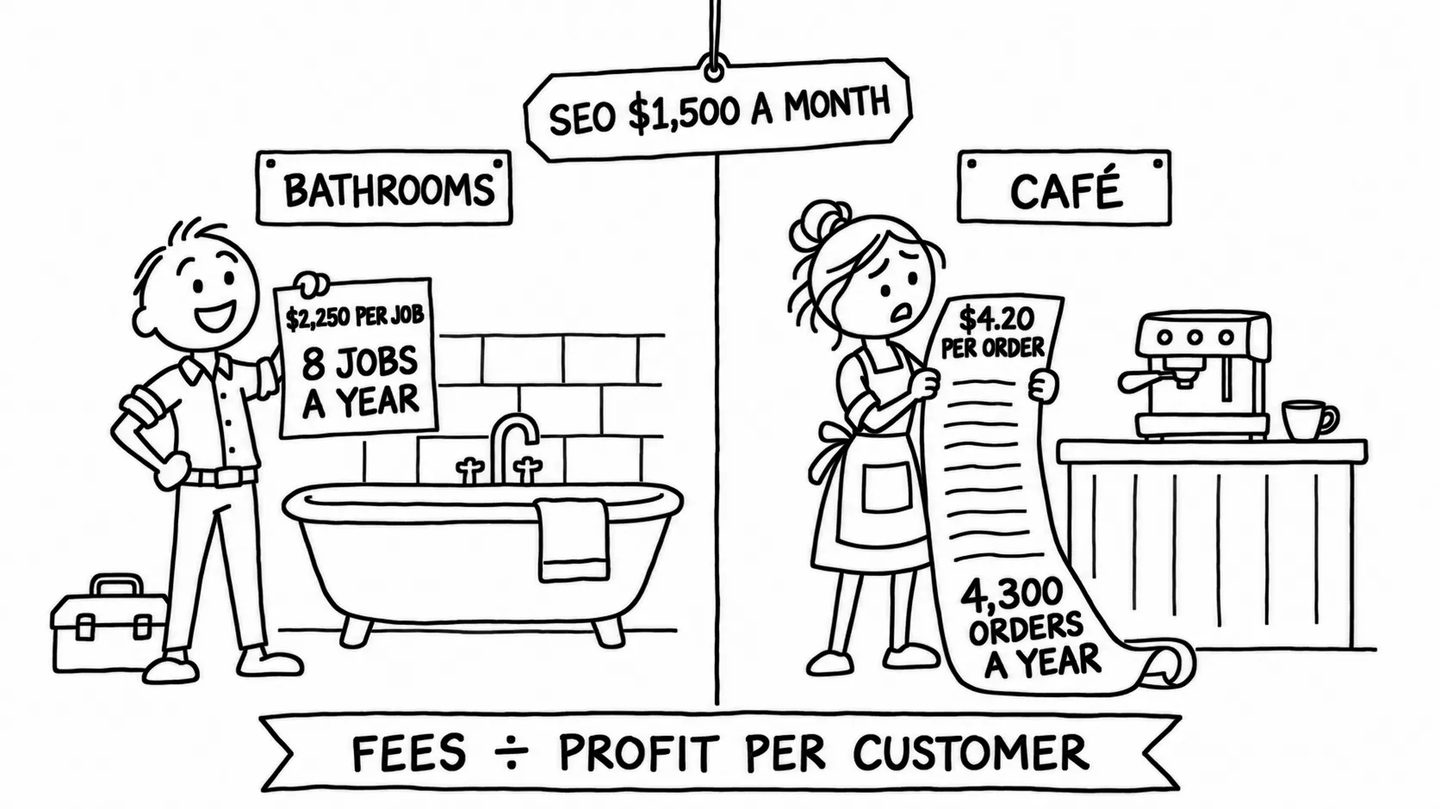
It is worth it when the profit on the customers it brings exceeds the fees, and you can test that before you sign. Take a year of fees and divide it by the gross profit on one new customer. The result is the number of extra customers search has to deliver in that year.
The figures in these two examples are assumptions; replace them with your own.
- A bathroom renovation firm: the average job is $9,000 and the firm keeps 25% after materials and labour, so one job is worth $2,250. A $1,500 retainer (about €1,365 at the ECB’s reference rate of $1.0989 on 17 November 2026) costs $18,000 a year. The break-even is eight extra jobs a year, fewer than one a month. If one enquiry in four becomes a job, that is 32 enquiries a year, or about three a month.
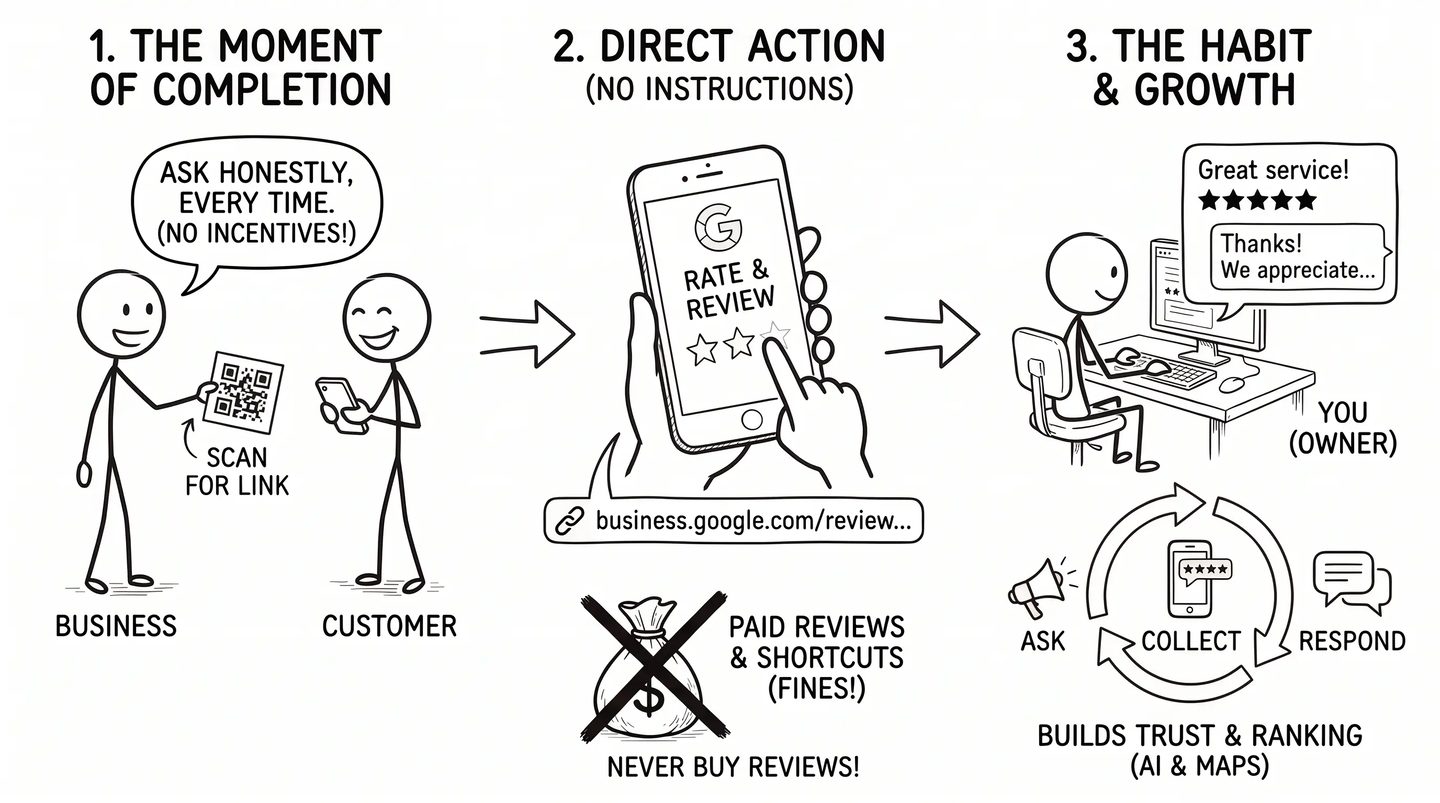
- A café: the average order is $14 and the café keeps 30%, so one order is worth $4.20. The same $18,000 needs about 4,300 extra orders a year, close to 360 a month, from people who found the café through search and would not have come anyway. A café is better served by its free Business Profile and its reviews, and the policy-safe way to collect Google reviews costs nothing.
Google gives no timeline beyond the one in its SEO Starter Guide: “some changes might take effect in a few hours, others could take several months,” with a suggestion to wait “a few weeks” before judging any single change. Budget for the first months as cost with little return. Ads bring visitors from the first day and stop the day you stop paying, and before choosing between the two, set the SEO fee against what a first Google Ads campaign costs. The break-even sum works for either, and a page that turns more of its visitors into enquiries cuts the traffic needed to reach it, whichever channel brings them; what a good website conversion rate is covers that side.
What did AI Overviews change?
AI Overviews cut the number of clicks a ranking brings on the searches where they appear. Pew Research Center tracked the browsing of 900 US adults in March 2025: when Google showed an AI summary, they clicked a traditional result in 8% of visits, against 15% when it did not, and clicked a link inside the summary in 1%. About 18% of the searches in the study produced a summary. Ahrefs’ own study of 300,000 keywords found the top-ranking page’s click-through rate 58% lower on keywords with an AI Overview, comparing December 2025 with December 2023. Google’s head of Search, Liz Reid, wrote in August 2025 that total organic clicks from Google to websites had been “relatively stable year-over-year,” a claim about the whole web that says nothing about any one site’s share.
For the break-even, that means counting on fewer visitors per ranking than a 2022 price guide would assume, especially on question-style searches. The work that gets a business named inside AI answers overlaps with SEO: clear pages, consistent details everywhere and other sites mentioning you, and the difference between GEO and SEO sets out where the two part ways. One of Google’s “People also ask” boxes for this search asks whether SEO is dead in 2026. These studies give a narrower answer: a ranking is worth fewer clicks where an AI summary appears, and the fees have to be judged against that smaller number.
Can you do SEO yourself?
A small local business can do most of its own SEO, and Google says so. The tools that matter most are free: Search Console shows which searches you appear for and where you rank, and a Business Profile puts you on the map at no charge. Ahrefs and Semrush both offer free tiers for checking a small site. The Starter Guide covers the rest in plain language: titles that describe each page, pages that answer what customers ask, and a site Google can crawl.
ChatGPT and other assistants can draft page titles, suggest the questions a page should answer and check a page against the Starter Guide. They cannot see your Search Console data unless you paste it in, and they do not know which of your services earns the most. The judgment about what to fix first stays with whoever knows the business. If you want to see what the assistants already say about you, getting your business recommended by ChatGPT has a method that costs nothing.
Hiring help makes sense once the site is large, the market is competitive, or the hours you would spend are worth more than the fee. Google’s own wording: “Short on time or not feeling adventurous? You might consider hiring a professional.”
How do you judge an SEO offer?
Google publishes the questions to ask an SEO before hiring one. They include examples of previous work, whether the provider follows Google Search Essentials, “What kind of results do you expect to see, and in what timeframe? How do you measure your success?”, experience in your industry and your city, and whether they will share every change they make with the reasoning behind it. It also asks whether they cite official Google documentation for their recommendations.
Then the warning signs, also from Google:
- Guarantees: “If they guarantee you that their changes will give you first place in search results, find someone else.”
- Cold emails: “Be wary of SEO firms and web consultants or agencies that email you out of the blue.”
- Secrecy: “Be careful if a company is secretive or won’t clearly explain what they intend to do.”
- Links by the piece: a price list that sells links per unit, which Google’s spam policies treat as link spam unless the links are labelled.
The contract should name the deliverables for each month (pages written, fixes made, hours spent), the report you will get and how often, and the notice period. Your Search Console, analytics and Business Profile should be registered to you, with the provider added as a user, so the history stays with the business when the contract ends. The content they write for your site should be yours too, which is worth a line in the agreement.
If you would rather hand the work over, SEO and GEO are part of how we run digital marketing, an audit of where you stand is the usual first step, and you can ask us for a quote to test against the questions above.