

How to Write a Creative Brief: Nine Questions, One Page and a Filled-In Example
- Published —
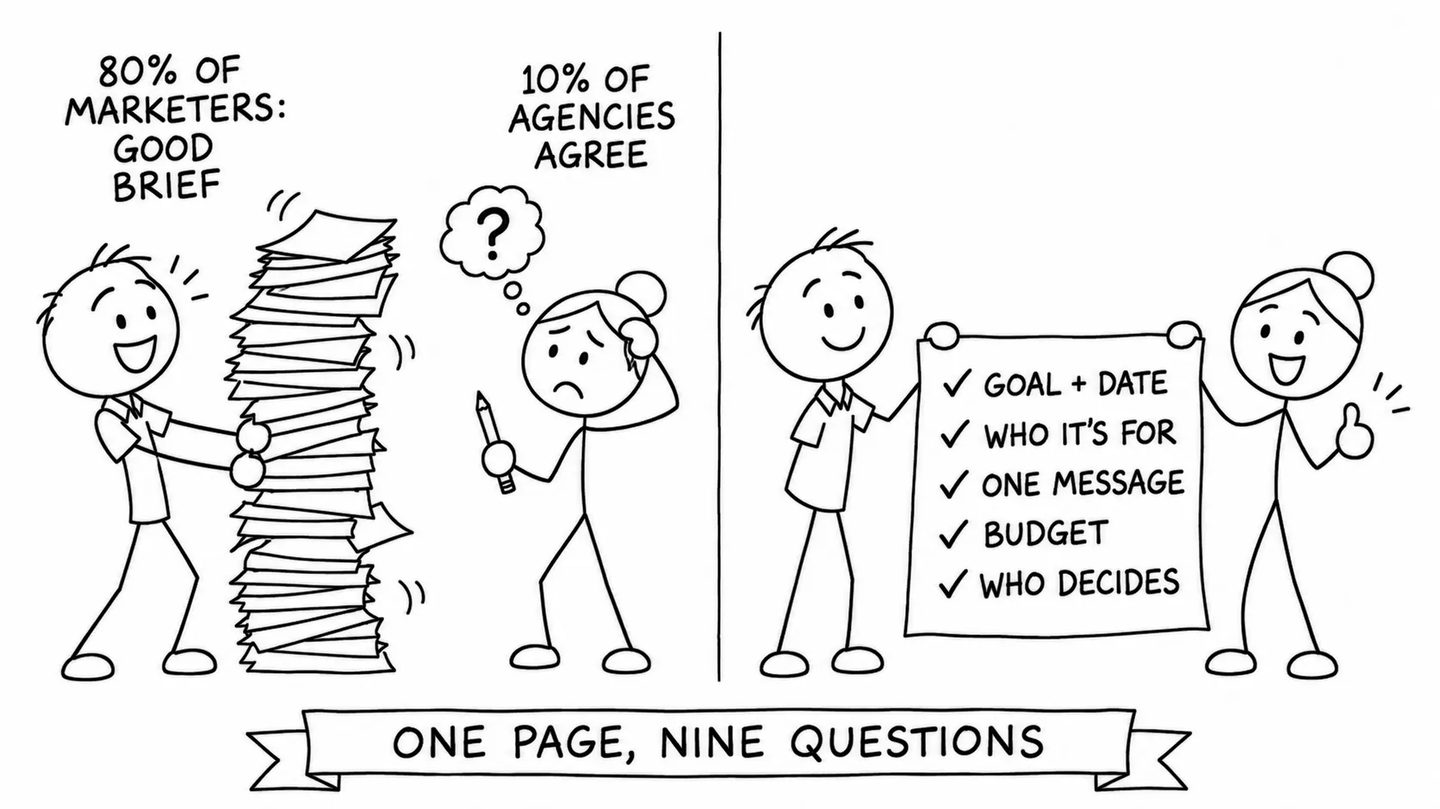
Short answer: a creative brief is the page a business gives an agency, a designer or a freelancer before the work starts. It answers nine questions: why the project is needed now, what success looks like and by when, who the work is for, the one thing it should say and the proof behind it, what must be delivered, what is fixed and what is off limits, the budget and the deadline, who approves the work, and what you need to own at the end. One page is usually enough. In the BetterBriefs research, 54% of agencies said the briefs they receive are too long, and objectives were the part clients defined worst. Put the budget in, name one person who decides, and judge the work against the objective the brief sets.
In 2021 the BetterBriefs Project surveyed more than 1,700 marketers and agency staff in over 70 countries about the briefs that pass between them. 80% of the marketers said they write good briefs. Among the creative agencies that receive those briefs, 10% agreed. On direction the gap was wider still: 78% of marketers said their briefs give clear strategic direction, and 5% of agencies said the same (IPA, 2021).
Respondents estimated that a third of the marketing budget goes to waste on poor briefs and the misdirected work they produce. The figure is their own estimate, and a UK follow-up with 508 marketers and agency staff the next year put it at 26% (IPA, 2022). The templates that rank for “creative brief” come mostly from companies selling project-management and design software. They list headings and leave out the parts that cost a small business money: the budget, who decides, how many agencies to ask and who owns the result.
What is a creative brief?
A creative brief is a short document a client writes before creative work starts, telling the people who will do it what the work must achieve, for whom, within which limits and by when. AIGA, the US professional association for design, defines the design version as “a written explanation given by the client to the designer at the outset of a project” and puts the duty on the client: “the ultimate responsibility for defining goals and objectives and identifying audience and context lies with the client” (AIGA, Design Business + Ethics).
- The client brief: the page you write and send. Depending on the job it is called a marketing brief, a design brief or a project brief, and the questions barely change.
- The agency’s creative brief: the agency’s internal rewrite of yours for its designers and writers. The UK advertisers’ and agencies’ guide to briefing draws the line: “An agency’s internal creative brief usually serves the fundamentally different purpose of inspiring their own creative people. A client marketing communications brief needs to inspire the whole agency team” (ISBA and IPA, Briefing an Agency, 2011).
- The design brief: a client brief for a logo, packaging or a website, heavier on formats, files and technical limits.
The agency’s version dates from London in 1968, when JWT and BMP set up the first account planning departments. BMP’s co-founder Stanley Pollitt “was concerned at the enormity of discretion given to account management in the writing of the creative brief” (Account Planning Group). A small business rarely has a planner on either side, so its brief usually goes straight to the person who will do the work.
Why do most briefs fail?
In the BetterBriefs data, 54% of agencies said the briefs they receive are too long, 32% too short and 14% succinct. Objectives, which 61% of marketers and 71% of agencies ranked as the most important part of a brief, were the part most poorly defined (BetterBriefs and Mark Ritson, The best way for a client to brief an agency, 2022). Both sides said rebriefs happen too often: 69% of marketers and 73% of agencies.
A brief works as a set of constraints, and research on constraints suggests they help creative work up to a point. In two experiments, people asked to build a two-line rhyme around a given word wrote more creative rhymes than people with no such limit (Haught-Tromp, Psychology of Aesthetics, Creativity, and the Arts, 2017); the samples were small, 64 and 48 students. A review of the research across management, psychology and engineering proposes an inverted U, in which creativity rises with constraints and falls once there are too many (Acar, Tarakci and van Knippenberg, Journal of Management, 2019). The advertising trade attributes the same idea to David Ogilvy, “give me the freedom of a tight brief”, though nobody has found where he wrote it.
What should a creative brief include?
The ISBA and IPA guide builds a brief on five questions: “Where are we now? / Where do we want to be? / What are we doing to get there? / Who do we need to talk to? / How will we know when we have arrived?” The nine questions below cover the same ground and add what a small business also has to settle on the same page: the budget and timeline, who approves, and what it will own.
- Why now? What changed, or what is not working, that makes the project worth paying for this year. “Our site shows a PDF menu and every cake order comes by phone” tells a studio more than “we need a modern website”.
- What counts as success, and by when? A number and a date: 100 online cake orders a month by June, a fifth more enquiries from a new landing page, a logo ready before the packaging goes to print in March. Without one the agency guesses, and you end up judging the result on taste.
- Who is it for? The people you want to reach, what they believe about you now and what you want them to believe afterwards. Use the words customers use in reviews and emails; ten customer conversations give you most of them.
- What is the one thing it should say, and why should anyone believe it? One sentence, then the proof: a guarantee, a number, a review, an award. The BetterBriefs guide puts it plainly: “A single-minded brief contains only one key message.”
- What exactly do you need delivered? Pages, formats, sizes, lengths, languages, the files you will receive and the systems they must work in (Shopify, Canva, a print shop’s specification).
- What must it include, and what must it avoid? Your brand guidelines, legal wording, product names that cannot change, competitors you do not want to resemble, and what you have already tried.
- What is the budget and the timeline? The amount or a range, the final deadline and the dates of the decisions in between.
- Who decides, and how will feedback work? One named person who approves, how many rounds of changes the budget covers, and how quickly you will answer.
- What will you own at the end? The uses you need (website, print, packaging, a trademark filing), the source files you expect and the licences for fonts, photos and music that come with them.
The BetterBriefs guide calls the objectives, the target audience and the budget the “backbone” of a brief. When the page runs long, cut background before you touch any of the three.
A filled-in creative brief example
A hypothetical bakery with two shops wants a website that takes cake orders. Its brief fits on one page:
| Question | The bakery’s answer |
|---|---|
| Why now | About 40 cake orders a month arrive by phone during the busiest hour of the morning. The site shows the menu as a PDF and takes no orders. |
| Success, and by when | 100 cake orders a month through the site by 30 June 2027, and fewer than 10 by phone. |
| Who it is for | People ordering a birthday or office cake two to seven days ahead, mostly on a phone. Reviews describe us as “always ready on time”. |
| One message, and the proof | “Order by 2 pm, collect tomorrow.” Proof: next-day pickup since 2012, and the reviews say so. |
| What to deliver | Six pages (home, cakes, order, about, shops, contact), an order form with pickup slots and card payment, on a platform our staff can edit. Photos from our own shoot in January. |
| Must include, must avoid | The logo and colours in our brand guidelines; allergen information on every cake. No stock photos of cakes we do not bake, no pop-ups. |
| Budget and timeline | $9,000 for design and build, $150 a month for hosting and care. First designs by 15 January, live by 1 March 2027. |
| Who decides | Maria, the owner, approves every stage. Two rounds of changes per stage; our feedback within three working days. |
| What we will own | Design, texts and photos transferred to us in writing; the domain and admin accounts in our name; a list of every font, plugin and photo licence. |
Three studios quoting against this page are pricing the same six pages, the same order form and the same deadline, so their numbers can be set side by side, and each quote should repeat that scope in its own words. Without the budget line they would be pricing three different websites.
Should you put the budget in the brief?
Yes. The guide UK advertisers and agencies published jointly in 2003 says: “Ideally, you will know the budget from the outset, in which case it should be clearly stated” (IPA, ISBA, MCCA and PRCA, The Client Brief, reprinted by the Association of Canadian Advertisers in 2006). AIGA’s guide for clients gives the reason: “it’s as risky to design in a budgetary vacuum as it is to design without a goal.”
A request for “a new website” fits a $3,000 brochure site and a $35,000 custom build alike, and the range a website can cost is wide enough for three quotes to differ tenfold. Logos spread even further, from a freelancer’s few hundred dollars to a studio’s identity programme, as what branding costs at each level shows. If you do not know the figure, give a range and say what it must cover: design, build, photography, the first year of hosting. A studio that finds the range too low for the brief can then tell you which part to drop.
How many agencies should you brief, and should you pay for the pitch?
Three is the usual number. The guidance published with the Pitch Positive Pledge, which the IPA and ISBA launched in 2022, says “Industry practice suggests 3 to 4 with 3 agencies being most common”, and advertisers who sign the pledge commit to “write a clear brief to pitch against, approved by key stakeholders” (Pitch Positive Pledge).
Pitching is expensive for agencies. A 2023 study by the US associations of advertisers and agencies put an agency’s cost of taking part in a review at $204,461 when it did not already hold the account, and the total cost of a review with three finalists at about $1 million (ANA and 4A’s, Cost of the Pitch, 2023). In Europe, 412 agency leaders surveyed in 2025 put the average new-business pitch at €43,804 (EACA, Cost of Pitching). Those are large accounts. A small studio pitching for a website spends days, and it weighs them against its chance of winning.
The design trade calls unpaid pitch work “spec”: “work done for free, in hopes of getting paid for it”, in AIGA’s words, and AIGA asks designers to understand the risks before they agree to it (AIGA). For a small project, ask each studio for relevant past work, how it would approach your brief, a timeline and a fee estimate. If you want to see ideas drawn for your brief before you choose, pay each shortlisted studio a fixed fee for them and state the fee in the brief.
Who owns the work the brief pays for?
Name the uses in the brief, then put them in the contract. In the United States a logo or a website design made for you does not become yours because you paid for it. Work by someone who is not your employee counts as a “work made for hire” only if it falls into one of nine categories of commissioned work, such as a translation or a contribution to a collective work, and both sides sign an agreement saying so (US Copyright Office, Circular 30). Everything else passes to you only through a signed written transfer, which brand guidelines that record who owns the logo explain statute by statute.
AIGA’s standard agreement for design services offers four arrangements for the rights: a limited licence, an exclusive licence, an assignment of the rights, or work made for hire (AIGA Standard Form of Agreement for Design Services). Saying in the brief which one you need lets every studio price the same thing.
What happens after you send the brief?
- Brief in person as well as in writing: walk the studio through the page and ask it to explain back what it understood. If the agency writes its own creative brief, ask to see it: it shows which of your sentences survived.
- Leave room for the agency to question the brief: in a study of 1,011 advertising campaigns, agency staff reported that “merely having strategy in client briefs has little effect on creativity, but the client’s willingness to explore new strategic ideas with the agency does have a substantial impact” (Koslow, Sasser and Riordan, Journal of Advertising, 2006). Only agency staff were asked.
- Judge the work against the brief: does it carry the one message from question 4 to the people in question 3, in the formats from question 5?
- Send one list of feedback per round: collect comments from everyone first, let the person named in the brief decide between them, and answer within the time you promised.
- Treat a new objective as a new brief: across all kinds of projects, PMI’s 2024 survey found scope creep on 30% of projects on average (PMI, Pulse of the Profession 2024). A changed goal usually means a changed quote, so put the new goal in writing and ask for one.
Can AI write your creative brief?
An AI assistant can turn rough notes into the nine headings and list the questions you left blank. It cannot supply the answers that decide the work: the budget, who approves, what customers say about you and what you have tried before. Once written, the same page also works as a prompt, and testing image generators on your own brief tells you more about them than a leaderboard does.
If you want a brief checked before it goes out, or a studio to answer one, we do both in branding, graphic design and web development; send it to us.