

Short answer: email is the one marketing channel where no algorithm sits between you and a person who asked to hear from you, and that is why businesses are relearning it in 2026. The skill has changed, though. It now starts with authentication records and complaint thresholds, runs through an inbox that summarizes your message before anyone opens it, and ends with restraint: fewer, better emails to people who would miss them.
By the time a marketing email reaches a person in 2026, at least three machines have read it first. Gmail’s filters have checked whether the sending domain can prove it is who it claims to be. Apple Mail has filed the message under Promotions and told the sender nothing about whether it was ever seen. And increasingly, an AI has compressed it into a one-line summary before anyone reads the subject line the sender spent an hour polishing.
It would be reasonable to conclude from this that email is a bad bet. The opposite is happening. In the search-demand data we pulled this July, US interest in email marketing stepped up several-fold this spring, the fastest-rising queries around it are small-business phrasings like “email marketing for small business”, and the same wave appears in Slovak data a few months behind. The reason is not nostalgia. Every rented channel got worse at roughly the same time, and email is the one channel where the list of people you can reach belongs to you.
This is the version of the guide without a platform to sell: the rules that decide whether your emails arrive, the machines that now read them first, the arithmetic, and the advice that the tool vendors who write most of the content on this topic cannot say out loud.
Why everyone is relearning email in 2026
Three things broke at once, and none of them were email.
- Search stopped sending the click. Similarweb’s June 2026 analysis puts 68% of Google searches ending without a click on any result, and Pew Research measured in 2025 that when an AI summary appears, users click a traditional result in 8% of visits versus 15% without one. Content you publish increasingly informs an answer instead of earning a visit; GEO vs SEO covers what that shift means for visibility, and getting named by the assistants is the other half of the response to it.
- Paid reach reprices upward every quarter. Meta’s own earnings show the average price per ad rising 10%, 6%, and 12% year over year across the last three reported quarters, and the median Google Ads cost per click sits at $5.42 in LocaliQ’s 2026 benchmark. Meta ads and Google Ads remain worth doing well, but they are a place to buy attention, not a place to keep an audience.
- Organic social reach keeps shrinking for business pages, which is why our own social media playbook treats platforms as discovery rather than as a relationship.
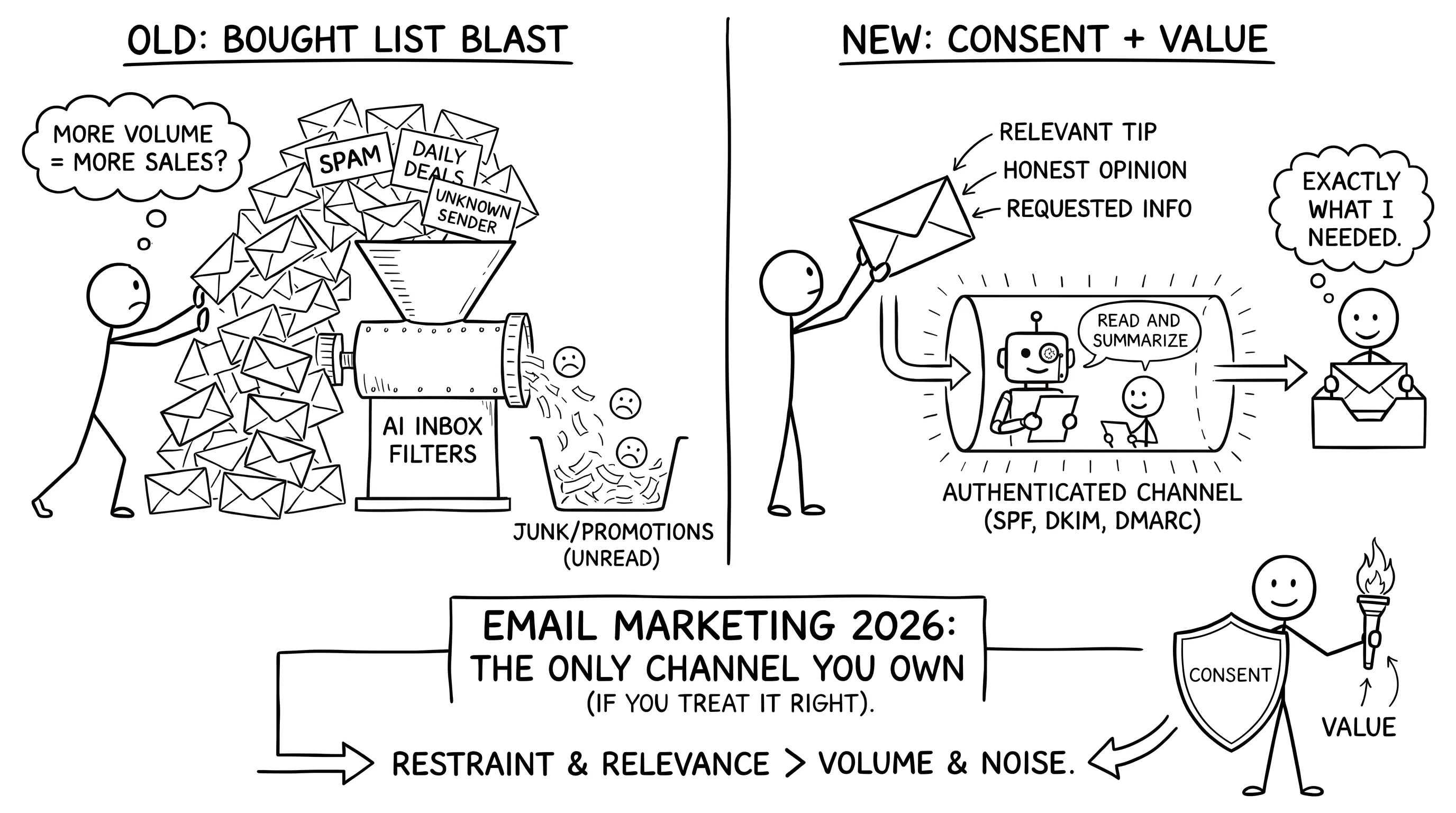
A subscriber list sits on the other side of that ledger: portable across tools, priced at nearly zero per send, and immune to feed changes. So is email marketing dead in 2026? No. What died is the version where sending had no consequences: the blast to a bought list, the daily discount nobody requested. Inbox providers now filter that sender out mechanically, which leaves better economics for everyone still standing.
What email marketing is (and what it is not)
Email marketing is sending commercial messages to people who agreed to receive them. The agreement is the load-bearing part. It separates a newsletter from spam, it is written into EU law, and since 2024 the inbox providers enforce it themselves through complaint thresholds, whatever the law says where you sell.
Two distinctions save a lot of confusion:
- A newsletter and a promotion are both email marketing. Consent, deliverability, and measurement work identically; only the content mix differs.
- Cold email is a different activity with different rules. Unsolicited outreach to strangers is prospecting, legal in the EU only in narrow business-to-business forms and expensive in sender reputation when done at volume. The influencer version of it, with view-counted titles about sending twenty-four million cold emails, is a numbers game played with other people’s attention. If your pipeline depends on strangers, a system built on referrals and proof converts better and costs less.
Everything below is about the consent-based kind.
The list: the asset everything else depends on
A useful list starts closer to home than most advice admits: past clients, current clients, the people who inquired and never bought, partners who refer you. Those contacts already trust you, and in most jurisdictions the customer relationship gives you a lawful basis to stay in touch about similar services, provided every message carries an easy opt-out.
From there, growth is a signup form and a reason. The reason does not need to be a bribe. “One practical email a month about X” outperforms a generic “subscribe to our newsletter” because it makes a specific promise a person can hold you to. Put the form where the proof lives: next to your case studies, at the end of articles, on the website pages people actually read.
Never buy a list. In the EU, emailing bought addresses violates the consent requirement outright; in Slovakia, where we work, fines run from €200 up to 5% of turnover. Deliverability punishes it faster than any regulator: purchased addresses are precisely the ones that hit spam traps and generate the complaints that push a domain over Google’s threshold, covered below. A bought list is a liability with your name on the sender line.
The arithmetic of a small list is better than it looks. Assume a 1,500-person list you built honestly and email monthly. Across the big 2024 to 2026 benchmark datasets, campaign click rates land between roughly 1.7% and 3.3% (Klaviyo, GetResponse, Mailchimp), so each send brings 25 to 50 interested visits. Buying those same visits at the $5.42 median CPC would cost $135 to $270, and you would pay it again every single month. The list you built once keeps delivering, and the only meaningful cost is writing something worth opening. One caveat cuts the other way: most platforms price by list size, so dead addresses cost you twice, once on the invoice and once in engagement metrics that now decide your placement.
What to send, so people would miss it if you stopped
The test for every email is blunt: would anyone notice if it stopped arriving? A message that survives that test usually does one specific job. Formats that consistently earn their place:
- The practical tip: one problem your customers actually have, solved in ten sentences, no gate, no teaser.
- The worked example: a short case walk-through with a number in it, which builds more trust than any adjective.
- The seasonal reminder: service businesses have calendars built in; the pre-season checkup email fills quiet weeks.
- The honest opinion: what you would and would not pay for in your own field reads as expertise because it is.
You do not need new material for most of this. The pillar system you use for social content repurposes directly: one substantial piece becomes a newsletter section, three posts, and an answer to a client question.
Send less than you think. Since September 2025, Gmail’s Promotions tab can sort by relevance, surfacing, in Google’s words, senders “you engage with the most”. Since July 2025, Gmail also shows a single Manage-subscriptions screen listing every sender by frequency, one tap from unsubscribe. Your cadence is now a visible, sortable number next to your name. A monthly email people read beats a weekly email they archive, and the inbox itself now does that bookkeeping.
Why your emails go to spam: the deliverability floor
Most advice treats deliverability as a footnote. In 2026 it is the entry fee, and it has hard numbers attached.
Three DNS records authenticate your mail, and all three are checkable in an afternoon:
- SPF (RFC 7208) lists which servers may send for your domain.
- DKIM (RFC 6376) signs each message so recipients can verify nothing changed in transit.
- DMARC (RFC 7489, whose successor standard RFC 9989 landed in 2026) tells receivers what to do when the first two fail, and sends you reports about who is sending as you.
Since February 2024, Google and Yahoo require authentication from everyone and add three duties for bulk senders, which Google defines as roughly 5,000 or more messages to Gmail in a day: all three records aligned, one-click unsubscribe honored within two days (RFC 8058 headers, mandatory since June 2024), and a user-reported spam rate kept “below 0.10%”, never reaching 0.3%. Microsoft joined in May 2025 for senders above the same volume to Outlook consumer addresses, and it skipped the warning phase: non-authenticated bulk mail is rejected outright with error 550 5.7.515. Gmail’s own FAQ added in late 2025 that non-compliant traffic faces “temporary and permanent rejections”. The rules grew teeth within the last year, which is part of why so many businesses are relearning this channel now.
The complaint threshold deserves arithmetic, because it is smaller than it sounds. At a 2,000-recipient send, 0.3% is six people tapping “report spam”. Six annoyed people is not a spam operation; it is one stale segment, one list imported from a trade fair three years ago. This is why list hygiene is a deliverability strategy rather than tidiness: remove people who have ignored a year of emails before they remove you.
If your emails already land in spam, work the checklist in order: authentication records missing or unaligned, a complaint rate creeping toward the threshold, a sudden volume spike after months of silence, old or purchased addresses, image-only messages with no real text, a broken or hidden unsubscribe. Google’s free Postmaster Tools, rebuilt in 2025 with a compliance dashboard, shows your spam rate and authentication status directly. One folklore warning: paid “inbox warm-up” networks that simulate opens and replies sit somewhere between placebo and policy violation. The durable fix is boring: real recipients, steady volume, mail people asked for.
The AI inbox: what changed between you and the reader
The inbox stopped being a chronological list while nobody was watching. A short timeline of what now stands between your send button and a human:
- 2021: Apple’s Mail Privacy Protection begins preloading messages and masking IPs, in Apple’s words to “prevent senders from knowing when they open an email”. Open tracking has been unreliable ever since.
- 2024: Apple Intelligence adds automatic email summaries and a Priority section (October), then Mail categorization (December), which files marketing into a Promotions tab on every iPhone running iOS 18.2, with or without the AI branding. A promotion only surfaces in the Primary list when it is genuinely time-sensitive.
- 2025: Gmail ships the Manage-subscriptions screen (July) and relevance-sorted Promotions (September). Litmus telemetry puts Apple Mail at about 65% of tracked opens and Gmail at 24%, so these two inboxes effectively are your audience.
- 2026: Gmail enters what Google calls its Gemini era in January: automatic AI thread summaries for all users, free, on by default, with an AI-organized inbox rolling out through the first half of the year.
The practical consequences are simpler than the feature list. Write the first sentence as if it will be the only sentence read, because for a growing share of readers the AI summary built from it is exactly that. Make subject lines describe what is actually inside; summarization exposes bait faster than any spam filter did. Give each email one job, in real text rather than one big image, because parsers and screen readers see the same thing. And treat engagement as placement: inboxes that sort by relevance quietly bury senders people ignore, which is one more reason pruning your list beats growing it carelessly.
Metrics that still tell the truth
Open rate is the number everyone quotes and the least reliable one on the dashboard. Apple’s preloading fires opens no human made, and the vendors say so themselves: Klaviyo’s 2026 benchmark notes that Apple “opens” each email for MPP users “whether or not they actually open the email”. Treat opens as directional at best.
What still means something:
- Clicks: the honest engagement floor. Recent cross-vendor benchmarks put campaign click rates around 1.7% to 3.3%; automated flows run far higher.
- Replies: for a service business, the single best signal, and a deliverability asset, since replies tell providers your mail is wanted.
- Unsubscribes and complaint rate: watched in Postmaster Tools against that 0.1% comfort line.
- Revenue per email for e-commerce, with the caveat that platform attribution flatters itself; merchants on email-first platforms typically see around a quarter to a third of tracked revenue attributed to email, by the platforms’ own counting.
About the famous ROI figure: the “$36 to $42 for every $1” line that decorates most email articles traces to marketer surveys, chiefly a 2019 UK study where 197 marketers self-reported an average of £42.24, a pound figure that circulates in dollars with the symbol quietly swapped. The newest edition of that same tracker (DMA Marketer Email Tracker, March 2026) lands near £41, still self-reported. The honest claim is smaller and still sufficient: sending costs almost nothing, so even a mediocre response rate beats most paid alternatives on unit economics. Budget on your own click and reply numbers, not on survey folklore.
Tools: what you actually need at each size
The tool matters less than every tool’s marketing insists. What changes with scale:
- Up to a few hundred contacts: you barely need a platform. The newsletter signup on this site is a form, a captcha, a database table, and a transactional email API; it costs us approximately nothing per month. Plain, personal emails from a real address are not a compromise at this size, they are the best-performing format there is.
- Hundreds to a few thousand: free tiers end sooner than their landing pages suggest. Mailchimp’s free plan now stops at 250 contacts and 500 sends a month, with entry paid tiers around €12; Kit, Brevo, and MailerLite compete in the same range. Pick for deliverability reputation and simplicity, ignore feature checklists, and mind that pricing scales with list size.
- E-commerce at volume: a flow-capable platform (Klaviyo and its class) earns its higher cost through automation, which is where the actual money is, per the next section.
One reading tip for vendor content, which is most content about this topic: when a platform argues that ordinary email tools are “not compliant” and you therefore need its category of software, that is marketing. Compliance lives in your consent records and sending practices, not in a subscription tier.
Automation that earns its keep
Automation advice usually arrives as a twelve-step lifecycle diagram. Three automations cover most of the value:
- The welcome email: sent on signup, states what you will send and how often, delivers the promised thing. It arrives at peak attention and sets the engagement pattern the algorithmic inboxes learn from.
- E-commerce flows: abandoned checkout, post-purchase, back-in-stock. Klaviyo’s 2026 benchmarks make the case bluntly: automated flows click at 5.58% versus 1.69% for campaigns and convert at thirteen times the rate. The boring automations outperform the clever campaigns by an order of magnitude.
- Service reminders: the annual checkup, the seasonal prep, the renewal. This is the follow-up machinery from how to get clients running on a calendar instead of memory.
Everything past those three is optional until they run reliably.
What not to buy
The channel’s comeback has revived its bad merchandise. Skip bought or “rented” lists, whatever legitimacy the seller claims. Skip inbox-warming networks and engagement simulators. Skip the AI email SaaS whose feature list duplicates what your sending platform and a general-purpose assistant already do. Skip the $2,000 course teaching cold-email volume tactics under an email-marketing label. The entire working system fits in this article: consent, authentication, a list you treat with respect, something worth sending, and the discipline to send less of it.
Frequently asked questions
How often should you send marketing emails?
As often as you can be genuinely useful and no more. For most small businesses that is monthly, plus automated reminders and flows. Consistency beats frequency; the inbox now displays your cadence to your subscribers.
Is email marketing dead in 2026?
The lazy version is: bought lists, daily blasts, and open-rate theater all stopped working, visibly. Consent-based email to an engaged list is performing better than it has in years, partly because the filters removed the noise around it.
Does B2B email marketing work differently?
The mechanics are identical; the cadence is slower and the content is expertise rather than offers. EU rules leave more room for contacting published business addresses, but reputation math does not care about the legal category: irrelevant mail generates complaints either way.
Do you need email if you are active on social media?
They do different jobs. Social reaches strangers; email keeps the people who already chose you. The follower count is rented, the list is yours, and only one of them survives an algorithm change.
If you would rather have help building the system than another subscription, that is what our digital marketing and content production work covers, and talking to us costs exactly one email.