
AI Max vs Performance Max in 2026: Which Google Ads Setup Should Your Business Actually Run?
- Published —
- Updated —
AI Max and Performance Max are not rival campaigns, and they are not the same bet. Performance Max reaches across Google's whole network and lets its AI make most of the calls; AI Max for Search keeps you inside Search with far more control and reporting. Most businesses need one of them running well rather than both running blind, and if you used broad match or run Dynamic Search Ads, Google has already made part of that call for you or will in February 2027.
Log into Google Ads and, depending on how your campaigns were built, some of them may already have upgraded themselves to something called AI Max for Search. You did not ask for it: Google began switching eligible campaigns over in September 2026, and Dynamic Search Ads follow in February 2027. If you are like most business owners, you are also not sure what AI Max is, how it differs from the Performance Max campaign your agency spun up two years ago, or whether the change will raise your costs.
That confusion is the demand. Searches for “what is AI Max” are up +256% year over year, and comparison searches for the two setups have doubled quarter over quarter, according to Google keyword trend data (2026). Yet almost every comparison article ranking today was written before the 2026 changes, describing a product that has already moved. This page tracks the current version, with nothing to sell you: what each setup does, which one fits your business, and which parts of the decision Google has already made for you.
What is the difference between AI Max and Performance Max?
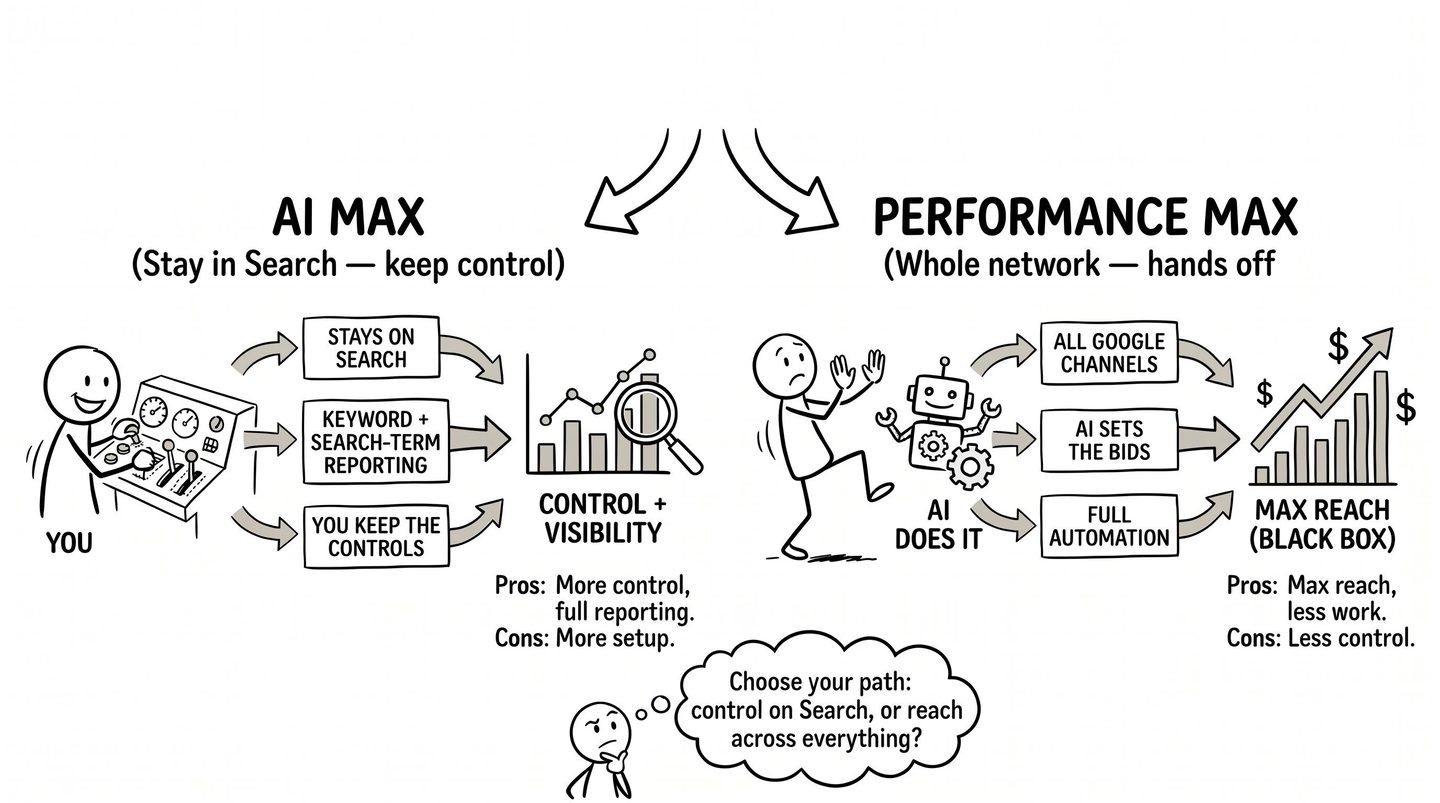
The short version: Performance Max runs everywhere Google shows ads, while AI Max stays inside Search. One is a whole-network campaign type; the other is a set of AI features you switch on inside the Search campaigns you already run.
- Performance Max is a single campaign that shows across every Google surface: Search, Shopping, YouTube, Display, Gmail, Maps, and Discover. You hand Google your budget, your goal, and a pile of assets, and its AI decides who sees which ad, where, and at what bid. It suits advertisers who want volume across the whole network, and it is the engine behind most Google Shopping today.
- AI Max for Search is not a new campaign type at all. It is a bundle of AI features you enable inside a standard Search campaign: search-term matching that finds relevant queries beyond your keyword list, automatic text customization, and final-URL expansion that routes clicks to your most relevant page. It stays on Search, exposing keyword-level reporting and controls that Performance Max, which runs without keywords, cannot offer.
Put plainly, Performance Max is Google’s “trust the machine with everything” product. AI Max is its answer to every advertiser who wanted that automation without giving up the transparency of a Search campaign. Interest in Performance Max has gone fully mainstream in the process: Google Trends shows search interest climbing from an index of 8 in July 2025 to a peak of 100 by mid-2026, according to Google Trends (2026).
The forced upgrade that landed in September 2026
This is where theory became a calendar problem. On 15 April 2026, Google announced that AI Max was leaving beta and that eligible Search campaigns would be upgraded to it automatically. The announcement offered no opt-out, only the advice to upgrade early and keep control of the setup (Google Ads & Commerce Blog, 2026).
Then the timeline split, and this is where the stale articles get it wrong. On 11 June, after advertiser feedback, Google moved the automatic migration of Dynamic Search Ads to February 2027 (Google Ads Developer Blog, June 2026). The reprieve was narrower than it sounded: campaigns using the campaign-level broad match setting or automatically created assets stayed on the original September 2026 schedule. Google’s schedule started the in-place upgrades on 1 September and spread them across the month; broad match campaigns came across with search term matching on and the other two features off, while campaigns with automatically created assets also got text customization. Since 3 August, neither legacy setting can be set up in any campaign (Google’s migration notice for developers, August 2026). Classic Dynamic Search Ads got extra time; broad match did not.
If any of your Search campaigns ran campaign-level broad match or automatically created assets, Google’s schedule moved them to AI Max in September, whether or not anyone on your team approved it. If you rely on Dynamic Search Ads, you have until February 2027 before Google moves for you. Either way the direction is one-way: the old settings cannot be recreated, and new Search campaigns now start with AI Max switched on by default (Google’s AI Max setup guide). This is the paid-search half of a bigger move: the same AI that is rewriting how organic search works is now rewriting how you buy your way onto the page.
Should I switch from DSA to AI Max?
If you run Dynamic Search Ads, the useful question is not whether to switch. It is whether you switch on your own terms before early 2027, or let the automatic migration do it to you.
When the upgrade runs, your dynamic ad groups convert to standard ad groups with the AI Max features turned on, according to Google (2026). Migrating early changes nothing about the destination, but it changes who is holding the controls when you get there. Do it deliberately and you set your negative keywords, add brand and URL exclusions, and watch a week of search-term data before you trust the expansion. Let it happen automatically and you are reading that data after the spend, not before it.
For most businesses the sensible move is a controlled early migration: one campaign first, the full feature suite on, negatives and exclusions in place, and a close eye on the search terms it starts matching. That is a very different experience from waking up to a migrated account you never configured.
What you keep control over with AI Max
Do you lose control with AI Max? Less than the Performance Max horror stories would suggest, and far more stays visible than in a Performance Max campaign.
Performance Max was close to a black box for years, and it reports far more than it used to. It still blends Search, Shopping, YouTube, and Display into one campaign, but it now has a channel performance report showing what each channel delivers, a full search terms report, and room for up to 10,000 negative keywords per campaign, up from 100 (Google Ads Help, April 2025). Your say over where the budget lands is newer: channel priority and spending caps only began rolling out to Performance Max in October 2026 (Google’s channel prioritization announcement, 2026). AI Max keeps you on Search and hands back the levers that matter: keyword-level and search-term reporting, negative keywords, brand controls, and URL exclusions (How AI Max works). You are still trusting Google’s matching to widen your reach, but you can see what it matched and rein it in.
Google’s own figure puts AI Max at an average of 7% more conversions or conversion value at a similar cost per action, when advertisers use the full feature suite rather than search-term matching alone, measured on non-retail advertisers, according to Google (2026). Read it the way you would read any vendor’s number about its own product: directional, measured on Google’s terms, and real only if you actually configure the thing well.
Will my Google Ads get more expensive in 2026?
Not automatically. But AI Max changes the shape of where your money can go, and that is where costs drift.
The features that make AI Max useful, search-term matching and final-URL expansion, also widen the net. Left ungoverned, your ads can start showing on looser queries and sending clicks to pages you never meant to promote. You do not pay more per campaign by default; you pay more when the expansion matches traffic you would never have bought on purpose.
This is an expensive corner of Google to begin with. Queries around PPC management and Google Ads help carry costs per click of roughly $40 to $130, according to keyword cost data (2026), which tells you how much competition is already priced into the space. The lever you hold is governance, not surrender: negative keyword lists, brand exclusions, and disciplined URL controls keep AI Max spending on the traffic you actually want.
Which setup your business should actually run
Strip away the branding and the choice comes down to where your customers are and how much you need to see. Match it to your situation.
- If you sell products from a feed: Performance Max still earns its place. For an e-commerce brand, one PMax campaign across Shopping, YouTube, and Display does work a Search-only setup cannot, and it is where Google has concentrated most of its Shopping intelligence. Keep it, but do not let it swallow everything: run your Search campaigns separately and add AI Max there, where you can watch the queries. This is exactly the balance we build for e-shops running live product feeds.
- If you sell a service or generate leads on Search: AI Max is usually the better fit. Your buyers are typing intent into a search box, not scrolling YouTube, and you need to see the search terms you are paying for. AI Max keeps you on that surface with the reporting to defend your budget.
- If you run Dynamic Search Ads or used campaign-level broad match: the decision is partly made for you. Broad match campaigns moved to AI Max in September, so check which features they now run; treat the February 2027 DSA migration as scheduled maintenance you control, not a surprise you absorb after it lands.
- If you do not know what you are running: that is the real exposure. The automatic upgrade does not wait for you to understand it, and “we will look at it later” is how an account gets reshaped without anyone deciding.
For most businesses the answer is not one or the other. Performance Max and AI Max solve different problems: broad-network reach on one side, controllable Search on the other. The mistake is collapsing everything into whichever one Google nudges hardest and calling that a strategy.
Where to start
The first step is an audit: log into your account, check which Search campaigns now run AI Max and which of its features are switched on, and find out whether any campaign still runs Dynamic Search Ads. That tells you how much of this calendar still applies to you. And if you are building an account from zero rather than migrating one, start with how to run Google Ads in 2026 and come back here for the campaign-type decision.
From there it is ordinary, careful work: migrate the campaigns that are moving anyway on your own schedule, set the controls before the spend, and keep Performance Max pointed at the jobs it does well. That is the core of how we approach paid search and Google Ads for the businesses we work with. If you would rather have someone check what the upgrade changed in your account, or move your Dynamic Search Ads before February does it for you, talk to us.