

The EU AI Act From 2 August 2026: What Actually Applies to Your Business
- Published —
- Updated —
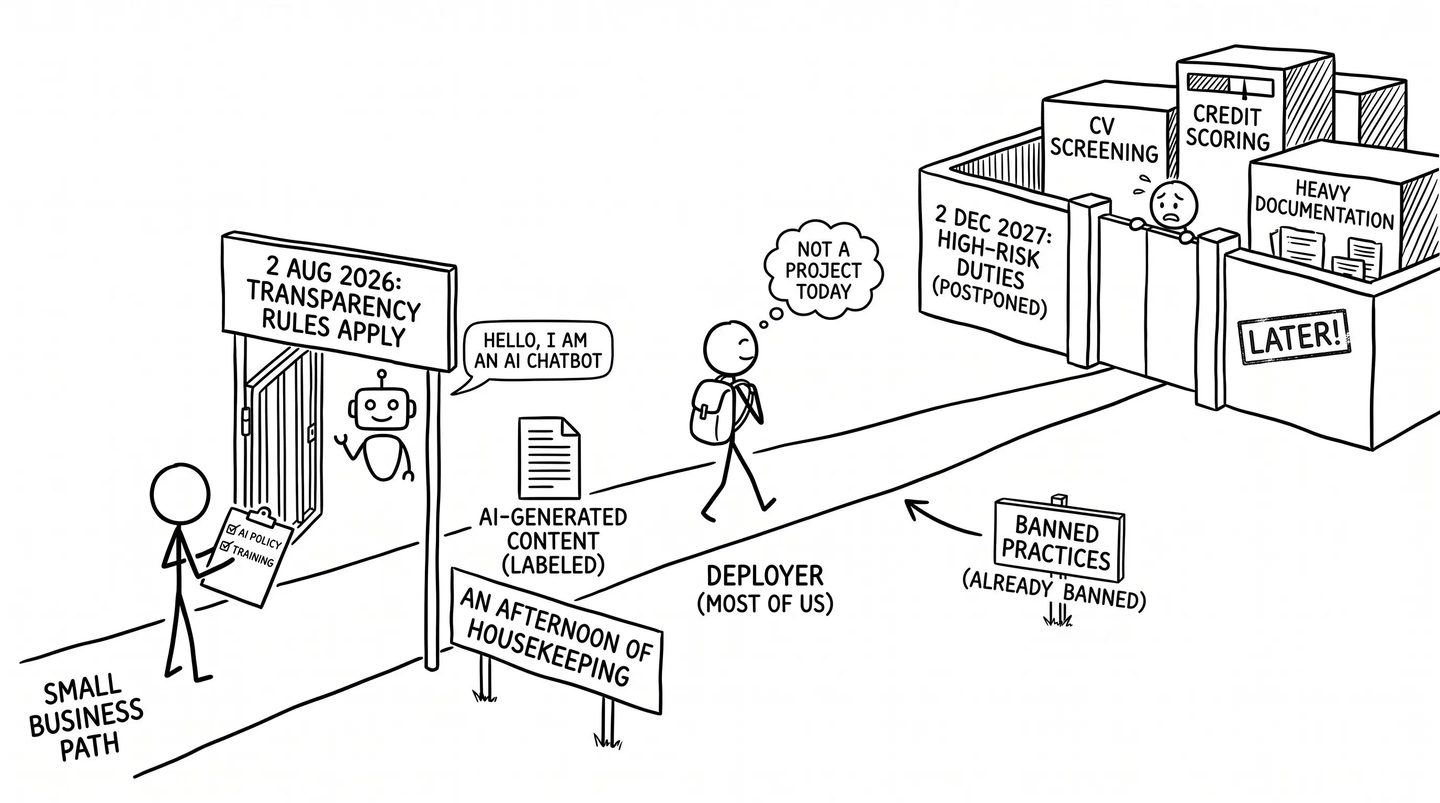
Short answer: from 2 August 2026 the AI Act's transparency rules apply. A chatbot has to say it is AI, AI-generated content has to be identifiable, and enforcement is switched on. The feared high-risk regime was postponed to December 2027 by an amendment adopted in June 2026, and the duties that already applied, staff AI literacy and the banned practices, stay in force. For most small businesses, compliance is an afternoon of housekeeping, not a project.
For two years, 2 August 2026 has been printed in every AI Act guide as the day the regulation becomes “fully applicable.” Then, five weeks before the deadline, the EU moved a large part of it. On 29 June 2026 the Council gave final approval to an amending regulation, the Digital Omnibus on AI, that pushes the strictest obligations out to the end of 2027 (Council of the EU, 2026). The transparency rules were not moved. They arrived on schedule.
That late change means most of what you can read about the deadline is now wrong in one of two directions. Guides written before May 2026 tell you the high-risk obligations start in August; they no longer do. Posts written after the deal often claim the whole Act was delayed; it was not. In July 2026 even the European Commission’s overview page still carried the old “fully applicable on 2 August 2026” line a few paragraphs away from the new 2027 dates; the page has since been corrected (European Commission, 2026). Everything below is checked against the adopted texts and written for a business that uses AI rather than builds it.
What the AI Act is, and what just changed
The AI Act (Regulation (EU) 2024/1689) is the EU’s rulebook for artificial intelligence. It sorts AI uses into risk categories and attaches duties to each: outright bans at the top, heavy documentation for high-risk systems, disclosure duties for AI that talks to people or generates content, and nothing new for the rest. It is a regulation, not a directive, so it applies in every member state directly, with no national law needed to activate it. That makes it faster machinery than the European Accessibility Act, which each country had to transpose itself.
The June amendment changes the schedule, not the design. Adopted by the European Parliament on 16 June and by the Council on 29 June 2026 and signed on 8 July, it was published in the EU’s Official Journal on 24 July as Regulation (EU) 2026/1744 and entered into force on 27 July 2026, six days before the old deadline.
What already applies to your business
Two sets of rules have applied since 2 February 2025, and the amendment keeps both.
- Banned practices (Article 5): AI that infers employees’ emotions at the workplace (medical and safety uses excepted), social scoring that punishes people in unrelated contexts, systems that manipulate or exploit vulnerable people into significant harm, and untargeted scraping of faces to build recognition databases. The workplace emotion-recognition ban is the one a normal company can trip over, typically as an “engagement monitoring” feature inside HR or call-centre software, and it binds you as the user even if the vendor’s brochure says otherwise (European Commission guidelines on prohibited practices, 2025).
- AI literacy (Article 4): anyone providing or deploying AI professionally must take measures so the people working with it understand what it is and where it fails. The Commission’s own Q&A says there is no mandated course and no certificate; training proportionate to the role plus a clear internal policy is the practical vehicle (European Commission, 2025). No direct fine is attached to Article 4, and since 27 July the wording is softer: the duty is to “take measures to support the development of AI literacy”, and it “does not require providers or deployers to guarantee any specific level of AI literacy”. National authorities have been responsible for supervising it since August 2026, so “we never told anyone anything about AI” is not a plan.
What has applied since 2 August 2026
Since 2 August 2026 the transparency rules in Article 50 have applied, and the enforcement machinery has been running. In plain terms:
- Chatbots must say they are AI. Any system that interacts directly with people, an AI receptionist on your phone line included, has to be built so users know they are talking to a machine, unless that is already obvious to a reasonably attentive person. The design duty sits with the provider, and if the assistant runs on your website under your own name, that provider can be you. If it is a vendor’s widget, check that the disclosure actually shows up in your installation.
- AI-generated content must be technically identifiable. Generative tools have to mark their output in a machine-readable way. That duty belongs to the tool’s maker, not to you, but it is worth an email to your vendors; systems already on the market before August have until 2 December 2026 to comply (Article 111(4), added by Regulation 2026/1744). Claude already marks the output of its newer models and of several earlier ones; how the invisible marks work and what they prove is covered in our AI watermarking guide.
- You must label deepfakes and unedited AI news. As a user, you disclose when you publish AI-generated or manipulated images, audio or video of real people and events, and when you publish AI-written text that informs the public on matters of public interest. The exemption is the useful part: text that went through human review, with a person taking editorial responsibility, needs no label. Your team-edited blog post is fine. An auto-publishing AI news feed is not. The definition of a deep fake also covers realistic objects and places, so a lifelike AI product ad can need a label too; the advertising examples in the Commission’s Article 50 guidelines of 20 July 2026 are walked through in our guide to AI video generators for business.
On the same date the Commission gained its fining powers over general-purpose model providers, national market surveillance began, and the SME support measures became due: priority access to regulatory sandboxes, reduced conformity fees, and plain-language guidance (Article 62). For providers, a voluntary Code of Practice on marking AI-generated content, published on 10 June 2026, offers a ready-made route to compliance (European Commission, 2026); by 16 November 2026 it had 266 signatories (Commission signatory list, 2026).
What was postponed, and until when
| Date | What applies |
|---|---|
| 2 Feb 2025 | Banned practices; AI literacy duty (already in force) |
| 2 Aug 2025 | Rules for general-purpose model providers; governance; penalty framework (already in force) |
| 2 Aug 2026 | Transparency rules (Article 50); enforcement powers; SME support measures |
| 2 Dec 2026 | Marking deadline for pre-August generative systems; new ban on “nudifier” apps |
| 2 Aug 2027 | National AI regulatory sandboxes (previously 2026) |
| 2 Dec 2027 | High-risk duties for standalone systems: CV screening, credit scoring and similar (previously 2 Aug 2026) |
| 2 Aug 2028 | High-risk duties for AI embedded in regulated products (previously 2027) |
The postponement answers a real problem rather than industry lobbying alone: the harmonised technical standards that high-risk systems were supposed to be certified against were not finished; the first of them, EN 18286 on quality management, reached the Official Journal only in October 2026 (European Commission, 2026). Parliament and Council rejected the Commission’s idea of a floating, standards-dependent start and set the fixed dates above instead (European Parliament, 2026).
Does the AI Act apply to your business?
Yes. It is directly binding law, not guidance. The real question is which bucket you are in, and for most companies the answer is the lightest one: the Commission’s own framing is that the vast majority of AI systems used in the EU are minimal-risk and face no new obligations (European Commission, 2026).
- You use AI tools (ChatGPT, Copilot, Claude and similar for text, code or analysis): you are a deployer. Your duties are the literacy measures, staying clear of the banned uses, and the disclosure rules above where they trigger. Using an American or any non-EU tool is fine; the Act binds by market, not by nationality.
- You run AI under your own name (say, a custom support bot on your site): for that system you are effectively its provider, which is where the chatbot-disclosure design duty lands.
- You use AI to evaluate people (screening job applications, scoring creditworthiness, deciding school admissions): that is the high-risk bucket, and its deployer duties, human oversight, logging, informing affected staff, following the vendor’s instructions, now start on 2 December 2027.
Using ChatGPT internally does not make you a “general-purpose AI provider”; that happens only if you substantially modify a model or place one on the market under your own brand (European Commission GPAI guidance, 2025). If you want a definitive answer for your setup, the Commission runs an official Compliance Checker, and the independent AI Act tracker publishes a good small-business guide (Future of Life Institute, 2026).
How big are the fines, really?
The headline numbers are real: up to €35 million or 7% of worldwide turnover for banned practices, €15 million or 3% for most other breaches including the transparency rules, and €7.5 million or 1% for giving authorities false information (Article 99, Regulation 2024/1689). Two provisions soften them. For SMEs and startups each cap applies at whichever amount is lower, the reverse of the usual rule (since July 2026 this also covers small mid-cap companies, except for banned practices), and regulators are required to weigh proportionality and a small firm’s economic viability. Enforcement capacity is also still being assembled: the Commission’s list of national contact points, last updated on 9 November 2026, named no market surveillance authority for three member states and marked eleven more as still awaiting final national adoption (European Commission, 2026). Expect a slow ramp-up, not raids. The duties bind from the dates in the table regardless; the fines are simply why a calm, documented effort is enough.
What to do now
For a business that uses AI rather than builds it, the preparation is short:
- List where AI actually runs in your company, including the unofficial uses nobody wrote down. You cannot disclose, train for, or switch off what you have not mapped.
- Write a one-page AI policy and run one training. Which tools are allowed, for what, what never gets pasted into them, who answers questions. Kept current, that is Article 4 in practice.
- Check your public surfaces. Does your chatbot introduce itself as AI? Are AI-generated visuals of real people labeled? Does AI-drafted public-facing text get human editorial review? Ask your tool vendors how they handle machine-readable marking.
- If you touch high-risk uses like CV screening or credit scoring, run the official checker to confirm your bucket and put December 2027 in the calendar now; those duties are postponed, not cancelled.
This article is orientation, not legal advice; if you operate anything close to the high-risk or banned categories, have a lawyer read your specific setup.
Most of the AI Act’s weight falls on the people who build AI systems, which is the work we do daily in AI & automation, with these rules designed in from the start; if you are working out where AI already runs in your business, or what it could usefully do next, talk to us.