Best AI Video Generator for Business in 2026: Cost per Second, Rights and the EU Label
- Published —
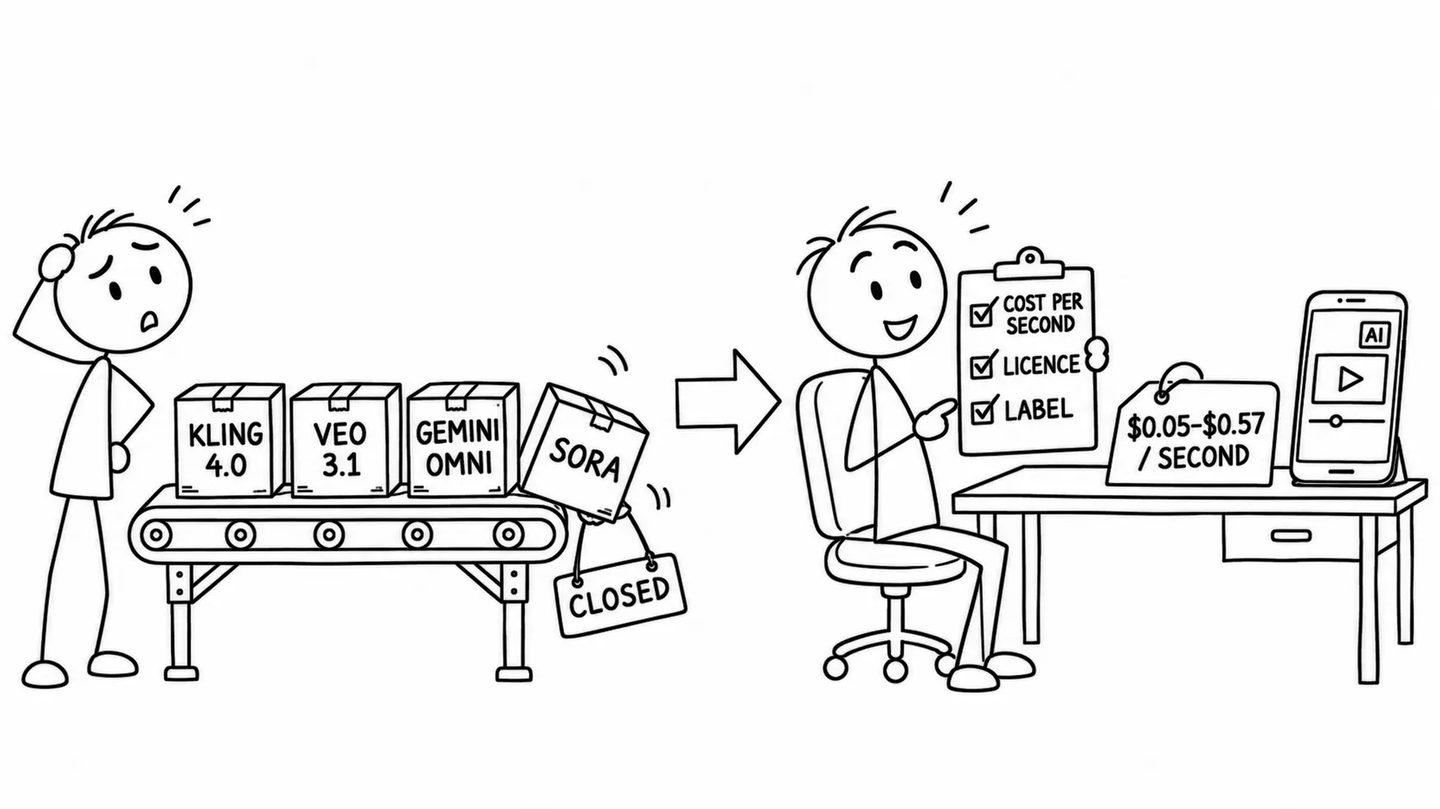
Short answer: for ads and product videos in November 2026, the models worth testing are Google's Gemini Omni and Veo 3.1, Kuaishou's Kling 4.0, ByteDance's Seedance 2.5, MiniMax H3 and Runway Gen-4.5, either from each maker directly or through a platform that resells several of them, such as Higgsfield, Adobe Firefly or Runway itself. On the makers' own price lists a generated second costs from about $0.05 to $0.57 at 720p to 1080p, so the compute for a 30-second ad comes to $10 to $85 even if you throw away four takes in five. OpenAI's Sora, still on many of the lists that rank for this question, was shut down in 2026. The plan and the place you publish matter more than the model: several free tiers forbid commercial use, and in the EU a clip realistic enough to pass for real footage of a person, a product or a place has needed a visible label since 2 August 2026.
OpenAI switched off the Sora API on 24 September 2026, five months after it closed the Sora app and website. Its help center now explains how to export your clips before the final window closes, after which OpenAI will “permanently delete any data associated with your use of Sora” (OpenAI Help Center, 2026). The Sora 2 app never launched in any EU country. Most of the lists that rank on Google for the best AI video generator still recommend it.
Sora is the extreme case of a market that changes every few weeks. Google shut down the Veo 3.1 preview models in its Gemini API on 22 October 2026 and points developers to a newer model, Gemini Omni Flash (Google AI for Developers, 2026). Kuaishou released Kling 4.0 on 15 October. Runway launched Gen-4.5 in December 2025 as the number one model on the Artificial Analysis leaderboard; in November 2026 the same board ranks it 28th of 36. For a business the model is the part of this decision most likely to change by spring, while the price per second, the licence attached to the plan and the label the law asks for decide whether an AI clip can run as an ad at all.
Which AI video generators can a business use in November 2026?
- Google (Gemini Omni and Veo 3.1): Gemini Omni 1.2 Flash, released on 5 November 2026, is the model behind video in the Gemini app, in Google’s Flow studio and in the Gemini API, with clips up to 15 seconds and native sound. With Sora closed, Gemini is now the only one of the three big assistants that makes video; how the three compare on everything else is in our comparison of Claude, ChatGPT and Gemini. Veo 3.1 continues on Google Cloud’s Gemini Enterprise Agent Platform (the new name for Vertex AI) in 4, 6 or 8-second clips up to 4K. Flow retires its Veo 3.1 Fast and Quality options on 5 December 2026 (Flow Help, 2026). Google Ads also offers Veo inside Asset Studio, turning up to three images into a clip of up to 10 seconds.
- Kling 4.0 (Kuaishou): launched 15 October 2026, generates up to 30 seconds with stereo sound and synchronised dialogue, at 720p or 1080p through the API.
- Seedance 2.5 (ByteDance): released 31 July 2026, 4 to 30 seconds up to 1080p, sold to developers through BytePlus and to consumers through Dreamina and CapCut. Its predecessor drew cease-and-desist letters from Disney and a public demand from the Motion Picture Association in February 2026 over copyrighted characters, and ByteDance paused the global rollout of Seedance 2.0 a month later (MPA, CNBC and Caixin, 2026).
- MiniMax H3: released 31 July 2026, up to 15 seconds at 2K. Disney, Universal and Warner Bros. are suing MiniMax for copyright infringement, and a federal judge in California let the case proceed in May 2026 (Bloomberg Law, 2026).
- Runway Gen-4.5 and Aleph 2.0: Gen-4.5 makes 2 to 10-second clips at 720p; Aleph 2.0 edits existing footage up to 30 seconds at 1080p.
- Luma Ray3.2 and the Adobe Firefly Video Model: Luma sells by credits and by API; Adobe describes its own model as safe for commercial use.
Around the makers sits a layer of platforms that resell several models behind one subscription. Higgsfield, a name US searchers now type about 165,000 times a month on Google Ads estimates (2026), offers Seedance 2.5, Kling 4.0, Veo 3.1, Wan and Grok Imagine next to its own tools, and its terms state that “certain features and models available through the Service are provided by third-party model providers” (Higgsfield, 2026). The company says it passed $1 billion in annualised revenue in September 2026, counted as its latest four weeks multiplied by 13. Runway now resells Kling, Seedance and Veo alongside its own models, and Adobe Firefly offers Veo, Kling, Runway, Luma and Seedance inside Adobe’s apps. A platform saves you five accounts, sets its own credit prices and applies its own terms to the output, and on Adobe’s own wording the partner models do not inherit Adobe’s commercial-safety promise.
Which one is best? The two leaderboards disagree
Two public leaderboards rank video models by blind votes, and in November 2026 they do not agree on the winner. On Artificial Analysis, the text-to-video board with sound is led by Alibaba’s Wan 3.0, followed by Utopai X, MiniMax H3, FLUX 3 Max and Seedance 2.5, with Veo 3.1 in 22nd place; the silent board is led by HeyGen Video 1, and Runway Gen-4.5 sits 28th of 36 (Artificial Analysis, November 2026). On arena.ai, the board formerly known as LMArena, the snapshot of 5 November 2026 puts Google’s Gemini Omni 1.2 Flash first on 887,494 votes, with Seedance 2.0 and 2.5 sixth and seventh, Wan 3.0 eighth, Veo 3.1 14th and Runway Gen-4.5 29th (arena.ai, 2026).
Runway’s own launch post for Gen-4.5 still quotes its first place on Artificial Analysis with 1,247 points as of 30 November 2025. The board has been re-scaled since, so the old and new scores cannot be compared, but the ranks can: eleven months took the model from first to the bottom third. Both boards also test on their own prompts, and Artificial Analysis notes that Runway’s API accepts only prompts of up to 1,000 characters, so Gen-4.5 was scored on 61% of the test set.
A leaderboard narrows the field to a handful of models worth a trial. Generating the same shot from the same starting image on two or three of the top models costs a few dollars and shows which best depicts your product, shop or typical customer.
How much does AI video cost per second?
Every maker in this table publishes a per-second or per-clip price for developers, which is the cleanest way to compare them. Prices are in US dollars, as listed on 6 November 2026.
| Model | Price per generated second (API) | Clip length | Source |
|---|---|---|---|
| Gemini Omni 1.2 Flash | About $0.07 at 720p; $0.104 at 1080p (upsampled) | Up to 15 s | Gemini API pricing, November 2026 |
| Veo 3.1 (Google Cloud) | $0.40 at 720p or 1080p with sound; $0.20 without; $0.60 in 4K | 4, 6 or 8 s | Google Cloud pricing, November 2026 |
| Veo 3.1 Fast | $0.10 at 720p, $0.12 at 1080p with sound | 4, 6 or 8 s | Google Cloud pricing, November 2026 |
| Veo 3.1 Lite (preview) | $0.05 at 720p, $0.08 at 1080p with sound | 4, 6 or 8 s | Google Cloud pricing, November 2026 |
| Kling 4.0 | $0.157 at 720p, $0.235 at 1080p | Up to 30 s | Kling API pricing, November 2026 |
| Seedance 2.5 | $1.156 per 5 s at 720p (about $0.23), $2.843 per 5 s at 1080p (about $0.57) | 4 to 30 s | BytePlus ModelArk, 23 October 2026 |
| MiniMax H3 | $0.08 at 768p, $0.13 at 2K | Up to 15 s | MiniMax API pricing, November 2026 |
| Runway Gen-4.5 | $0.12 at 720p (12 credits at $0.01) | 2 to 10 s | Runway API pricing, November 2026 |
| Luma Ray3.2 | $0.06 at 720p, $0.24 at 1080p | 5 or 10 s | Luma API pricing, November 2026 |
The consumer plans price the same models in credits. Google AI Pro costs $19.99 a month in the US and includes 1,000 Flow credits, where Gemini Omni at 720p uses 3 credits per second, plus 50 free credits a day for any account (Google, 2026). Runway’s Standard plan is $15 a month for 625 credits, which Runway itself translates into 52 seconds of Gen-4.5. Higgsfield’s Starter plan is $15 a month for 200 credits, and its own price guide puts a 5-second Seedance 2.5 clip at 720p at 35 credits (Higgsfield, 24 October 2026), so the plan buys a little under 30 seconds of that model. Adobe Firefly Standard is $9.99 a month for 2,000 credits, and Adobe’s own video model uses 100 credits per second at 1080p.
A worked example. Take a 30-second ad built from three 10-second shots, and assume you keep one take in five, so you generate 150 seconds to keep 30. At the list prices above, converted at the European Central Bank’s rate of $1.1224 per euro on 5 November 2026:
- Gemini Omni 1.2 Flash, 720p: $10.50 (€9.35)
- Veo 3.1 Fast, 1080p with sound: $18.00 (€16.04)
- Runway Gen-4.5, 720p: $18.00 (€16.04)
- MiniMax H3, 2K: $19.50 (€17.37)
- Kling 4.0, 1080p: $35.25 (€31.41)
- Veo 3.1, 1080p with sound: $60.00 (€53.46)
- Seedance 2.5, 1080p: $85.29 (€75.99)
Veo makes at most 8 seconds per clip, so the same ad takes four shots instead of three (32 seconds kept instead of 30). None of these figures include the script, the voice-over, the music, the edit or the hours spent choosing between takes. What a synthetic voice-over costs per minute, and whose voice it may use, is covered in our guide to AI voice generators for business.
Can you use AI-generated video in an ad?
Usually, on a paid plan, and often not on a free one. The free tiers that rank for “free AI video generator, no watermark” often come with a licence that rules out the ad you had in mind:
- Kling: the free Basic plan does not include commercial use or watermark removal, and non-members must label generated content “with the brand and logo” of Kling. Paid members’ commercial use “is not restricted” (Kling AI, October 2026).
- Dreamina (Seedance): the consumer terms say the services “are generally provided for private, non-commercial use,” and every user grants Dreamina “and other users” a perpetual, irrevocable, sub-licensable licence to their content (CapCut, January 2026).
- Runway: free-plan videos carry a Runway watermark. On paid plans Runway claims no ownership and does not restrict commercial use, but “Inputs and Outputs may be used by the Company to train and improve its AI models” (Runway terms, October 2026).
- Higgsfield: its terms claim no ownership and no restriction on commercial use, and reserve the right to train on outputs; its own pricing table lists commercial use as not included on the free plan.
- Luma: commercial use only for outputs “produced during an active Subscription Term” on a paid plan that allows it (Luma terms, 2026).
- Google: both the Gemini API terms and Google’s consumer terms say “Google won’t claim ownership over that content.”
Legal cover for the output is rarer still. Google’s indemnity for generative AI covers generally available Veo models used through its Gemini Enterprise Agent Platform; it does not list Gemini Omni, the Gemini app or Flow (Google Cloud, July 2026). Adobe calls the output of its own Firefly models “safe for commercial use,” says of partner models “you’re responsible for determining whether content generated by partner models is appropriate for your project,” and offers its IP indemnity only to customers whose contract links to its terms, capped at US$10,000 on the teams tier (Adobe, 2026). The two studio disputes above point at the practical risk: a prompt that names a film, a character or a celebrity is where a clip starts to infringe someone else’s rights.
Who owns an AI-generated video?
Often no one, in the copyright sense. The US Copyright Office concluded in January 2025 that “copyright does not extend to purely AI-generated material,” and that “prompts do not alone provide sufficient control” over the result (US Copyright Office, 2025). The D.C. Circuit held in Thaler v. Perlmutter that the Copyright Act requires a work “to be authored in the first instance by a human being” (2025), and the Supreme Court declined to hear the appeal on 2 March 2026. In the EU the answer runs the same way: a Prague court ruled in 2023 that an image made by AI is not a copyright work because it is not the unique result of a natural person’s creative activity, and that a prompt is at most the idea of a work (Municipal Court in Prague, 10 C 13/2023).
Terms that say you “own” the output bind you and the tool; they give you no rights against anyone else. A competitor can copy a purely generated clip. The parts you can protect are the ones a person made: the script, the edit, the voice-over, real footage of your premises and, above all, your trademark.
Do you have to label AI video in an ad?
In the EU, if it could pass for real. Since 2 August 2026, Article 50(4) of the AI Act requires a business that uses AI to generate or manipulate a deep fake to “disclose that the content has been artificially generated or manipulated.” The definition is broader than faces: a deep fake is AI content “that resembles existing persons, objects, places, entities or events and would falsely appear to a person to be authentic or truthful” (Regulation 2024/1689, Article 3(60)). A realistic shot of your product in a kitchen that never existed can qualify. The background on these duties, and what else applies from that date, is in our guide to the EU AI Act for businesses.
The Commission’s guidelines on Article 50 work through advertising cases (European Commission, 2026). Their examples of deep fakes include “an AI-generated depiction of a celebrity influencer in an advertising or promotional context,” a “realistic synthetic influencer testing out a sponsored real product,” and “an AI-generated image of a product in advertisement or packaging that can affect the audience’s perception and mislead as to the actual product appearance.” Their examples of what is not a deep fake include “AI-generated video of mice arguing in human language over the best type of cheese as part of an advertisement campaign,” and a real car shown against an AI-generated background as long as the ad is not likely to mislead. Colour correction, background extensions and re-scaling in product ads are “likely to have only a minor impact.”
The guidelines also set out how the label works. It has to be perceivable by people, “e.g. with visible or audible labels,” and the invisible watermark the tool embeds does not count: “deployers cannot rely on the machine-readable marking embedded in the content by the provider.” For video, first exposure means at the start of the video, and a disclosure buried in terms of use fails. The EU’s voluntary Code of Practice offers a ready-made “AI” icon, placed for example in the top right corner. A company that only commissions an agency, without deciding whether and how the agency uses AI, is not a deployer under the guidelines. Content made before 2 August 2026 needs no retroactive label. The fine ceiling for breaches of Article 50 is €15 million or 3% of worldwide turnover, and for small and medium-sized firms the lower of the two applies. How the invisible marks themselves work is covered in our explainer on AI watermarking.
The platforms add disclosure rules of their own:
- YouTube: creators must disclose realistic altered or synthetic content, and YouTube’s own example is “AI generated extra footage of a real place, like a video of a surfer in Maui for a promotional travel video.”
- TikTok: creators must label realistic AI-generated scenes or people, and for ads, “if we identify AI-generated content that has not been disclosed, your ad will be rejected or restricted.”
- Meta: advertisers must disclose AI in ads about social issues, elections or politics; for other ads Meta shows its own “AI info” label in “About this ad” when the ad was made with its tools or with third-party AI tools it detects.
- Google Ads: synthetic content must be disclosed in election ads; Google publishes no such rule for other ads.
One rule applies on both sides of the Atlantic: an AI-generated customer cannot give your testimonial. The FTC’s rule on reviews and testimonials, in force since 21 October 2024, makes it unlawful to create a testimonial that misrepresents “that the reviewer or testimonialist exists” (16 CFR 465.2), and the EU’s unfair commercial practices directive bans false consumer endorsements outright (Annex I, point 23c).
Where does AI video earn its keep for a small business?
Generative video is already routine in advertising. In the IAB’s 2026 survey of US ad buyers, nearly two in three used generative AI for video creative, up from half in 2025, and they expected a third of their ad assets to use it this year (IAB, July 2026). Meta told investors that nearly 10 million advertisers used at least one of its generative creative tools in the third quarter of 2026, with adoption of its video generation features up 25% on the quarter (Meta, October 2026), and Google says more than half of small businesses on Google Ads now use its AI to create or optimise their creative. The jobs where it holds up are variations of an ad that already works, background and atmosphere shots, a product shown in use, and quick concept tests before a real shoot. How those variations feed Meta’s delivery system is covered in our guide to running Meta ads.
- Start from your own photo. Image-to-video, where the first frame is a real picture of your product, is supported by Veo 3.1, Gemini Omni (as reference images), Kling 4.0, Seedance and MiniMax H3. It keeps the product looking like itself, which is also the line the Commission draws between a background change and a misleading product ad. If the starting photo was itself generated or edited with AI, the rules for AI images of your own products apply to it first.
- Run the same shot on two or three models. A few dollars of compute settles more than any leaderboard, and it leaves you a second supplier when the first one changes its terms.
- Keep your masters and prompts outside the tool. Sora’s users got an export window and then deletion. Download every keeper in full resolution and store the prompt that made it.
- Put a person’s work on top. Script, edit, voice and logo are what make the ad yours, both creatively and in copyright terms, and the best scripts come from the questions customers already ask, the method behind deciding what to post on social media.
- Label where the rules ask, and never fake a customer. A visible label at the start of a realistic clip costs nothing; a rejected TikTok ad or a misleading-ad complaint costs more.
If you would rather hand the shots, the edit and the labelling to someone else, that is part of our content production and advertising work, and you can start with one ad.