Best AI Voice Generator for Business in 2026: Cents per Minute, and Whose Voice You May Use
- Published —
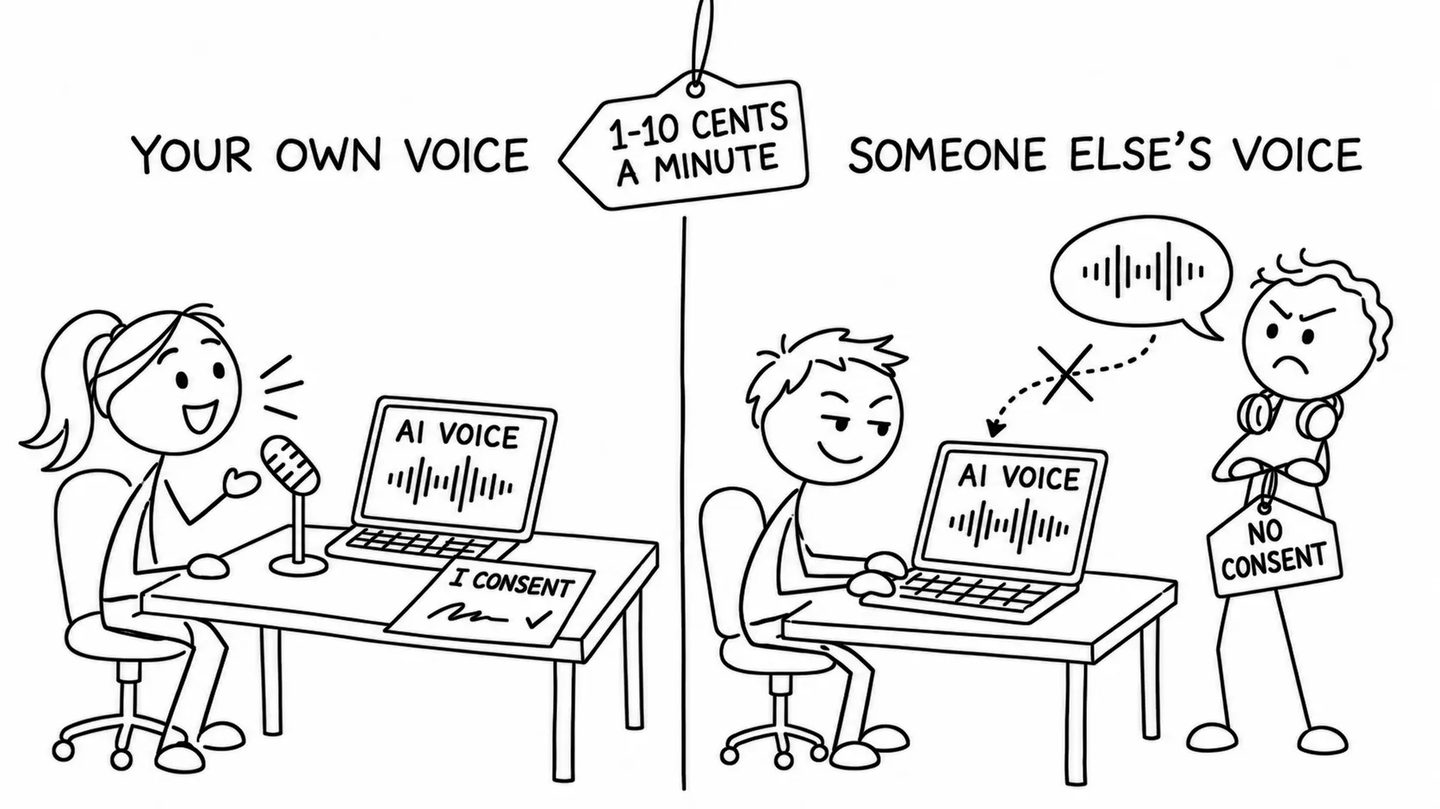
Short answer: in November 2026 ElevenLabs' Eleven v4 and v4 Turbo lead the largest blind-vote leaderboard, followed by Alibaba's Qwen-Audio, Cartesia's Sonic 3.6, Speechify's Simba 3.5 and Google's Gemini 3.8 Flash TTS. Through the makers' own APIs a minute of speech costs between about 1.4 and 10 cents, so a month of narration for a small business comes to a few dollars, and Google's and Microsoft's free monthly allowances can cover it. The plan and the voice carry more risk than the price: the free tiers of ElevenLabs, Murf, Speechify Studio and WellSaid rule out commercial use, cloning anyone else's voice needs their consent, and in the EU an AI voice that imitates a real person has needed a disclosure since 2 August 2026. OpenAI's speech models shut down on 6 January 2027.
On 29 October 2019 a Fiverr user with the screen name “tomlsg” asked Linnea Sage, a voice-over actor in New York, to record a set of scripts. When she asked what they were for, he wrote: “These are test scripts for radio ads. They will not be disclosed externally, and will only be consumed internally, so will not require rights of any sort.” She was paid $400. In May 2020 her colleague Paul Lehrman was paid $1,200 for recordings promised to stay “internal” and “academic.” The two later sued the AI voice company Lovo, alleging that its co-founder had placed the first order, that its staff had placed the second, and that Lovo sold clones of their voices to its subscribers under the names “Sally Coleman” and “Kyle Snow” (Lehrman v. Lovo, S.D.N.Y., 2025).
The businesses that used “Kyle Snow” in their videos had bought him on a paid plan, and Lovo’s terms promised its paying users “full commercial rights for all content generated using its platform.” In July 2025 Judge J. Paul Oetken ruled that copyright “does not extend to something as abstract and intangible as a ‘voice’” and dismissed the federal trademark claims, while letting the actors’ claims under New York’s civil rights law, its consumer protection law and their contracts go ahead. Lovo filed for bankruptcy in May 2026, and the case has been on hold since.
The voices on sale today are better and cheaper than Lovo’s were. On Artificial Analysis’s blind-vote leaderboard, ElevenLabs’ Eleven v4, released in September 2026, shares first place with its own Turbo version, and through the makers’ own APIs a minute of speech costs between one and ten cents. The list of makers changes under its users’ feet. OpenAI will shut down all three of its text-to-speech models on 6 January 2027, Hume closed its voice API on 13 November 2026, and Resemble AI no longer sells speech generation at all.
Which AI voice generators can a business use in November 2026?
- ElevenLabs: Eleven v4 and its faster, cheaper sibling Eleven v4 Turbo launched on 28 September 2026 and cover “90+ languages”; the older v3, Multilingual v2 and Flash v2.5 models stay on sale (ElevenLabs, 2026). It sells monthly plans for its studio app and per-character pricing for developers.
- Google: Gemini 3.8 Flash TTS, which Google calls its “flagship creative text-to-speech model”, through the Gemini API, and the Chirp 3: HD voices on Google Cloud.
- Microsoft: neural and HD voices on Azure Speech, with custom and personal voices behind a Limited Access application.
- API-first makers: Cartesia (Sonic 3.6), Speechify (Simba 3.5, launched on 21 October 2026), Alibaba (Qwen-Audio-3.1-TTS), Inworld (TTS-2), MiniMax (speech-2.8), Fish Audio and Deepgram (Flux TTS), sold to developers by the character.
- Studio apps with an editor: Murf, Speechify Studio, WellSaid and Descript, sold as subscriptions with minutes or credits included.
- Amazon Polly: standard, neural, long-form and generative voices on AWS.
- OpenAI: tts-1, tts-1-hd and gpt-4o-mini-tts “will shut down on January 6, 2027.” The model OpenAI points to instead, gpt-realtime-2.1-mini, “isn’t a supported model for
/v1/audio/speech” (OpenAI, 2026), so anything built on OpenAI’s speech endpoint needs a new home. - Gone in the past year: PlayHT, which Bloomberg reported in July 2025 had been bought by Meta, now says “We have shut down the service.” Hume ended its text-to-speech API on 13 November 2026 and said the data in its users’ accounts would be deleted after that date (Hume changelog, October 2026). Resemble AI’s voice models “are no longer offered as commercial paid products” (Resemble AI, 2026).
Which AI voice generator sounds best?
On the largest public leaderboard, ElevenLabs. Artificial Analysis plays listeners two clips of the same sentence from two hidden models, asks which sounds better, and turns the votes into scores. On 14 November 2026 Eleven v4 (1,340) and Eleven v4 Turbo (1,339) shared first place, followed by Alibaba’s Qwen-Audio-3.1-TTS-Plus (1,300), Cartesia’s Sonic 3.6 and Speechify’s Simba 3.5 (1,294 each), Google’s Gemini 3.8 Flash TTS (1,284), Fish Audio’s Drama 3, Smallest.ai’s Lightning V3.1 Pro and Inworld’s TTS-2 (Artificial Analysis, November 2026). The voices most businesses met first sit far lower: ElevenLabs’ own Eleven v3 at 23rd, Microsoft’s Azure HD at 35th, OpenAI’s tts-1-hd at 45th and Google’s Chirp 3: HD at 65th. Most votes come from a paid panel, and for the English boards “panel members are screened for native English speakers resident in the US or UK” (Artificial Analysis methodology).
In Artificial Analysis’s Controlled Voice arena every model has to clone the same eight voices, which takes each maker’s best house voice out of the contest, and there Speechify’s Simba 3.5 leads, ahead of HeyGen’s voice model, Qwen and Eleven v4 Turbo. That arena also runs in Spanish, French, German, Portuguese, Japanese, Hindi, Mandarin Chinese, Arabic and Vietnamese. The Hugging Face TTS Arena, run by volunteers’ votes, is led by two anonymous test models and lists Hume’s Octave in sixth place, a day after Hume switched it off; Eleven v4, Gemini and Sonic 3.6 do not appear on it at all.
No public board tests the language most small businesses outside the big markets need, which might be Polish, Czech or Slovak. A one-person test of eight models reading Polish, scored by speech recognition rather than by listeners, gave a clean result only to Eleven v4 (QuantSlant, October 2026). Translation tests have a similar gap: the largest one covers Czech but not Slovak. The cheapest benchmark is your own: a paragraph of your script with your prices, dates, street names and product names, generated on two or three models and played to someone who has never heard it before.
How much does an AI voice-over cost per minute?
Through the makers’ developer APIs, one minute of generated speech costs between about 1.4 and 10 cents at list prices in November 2026. Most makers bill by the character of text; Google’s Gemini bills by the second of audio. ElevenLabs counts about 1,000 characters to a minute (its 10,000-credit free plan is “~10” minutes), and the per-minute column below uses that figure. Cartesia counts 750 to 800, so for many scripts the cost per minute is lower. Prices are in US dollars before tax, as listed on 14 November 2026.
| Model | List price (API) | About per minute | Source |
|---|---|---|---|
| Eleven v4 | $0.08 per 1,000 characters | $0.08 | ElevenLabs API pricing, November 2026 |
| Eleven v4 Turbo | $0.04 per 1,000 characters | $0.04 | ElevenLabs, November 2026 |
| Gemini 3.8 Flash TTS | $9 per million audio tokens (25 a second) plus $0.50 per million text tokens; $18 and $1 from 1 January 2027 | $0.014, then $0.027 | Gemini API pricing, November 2026 |
| Google Chirp 3: HD | $30 per million characters, first million each month free | $0.03 | Google Cloud, November 2026 |
| Azure neural / HD | $15 / $22 per million characters, 500,000 a month free | $0.015 / $0.022 | Microsoft Azure, November 2026 |
| Cartesia Sonic 3.6 | plans from $5 a month for 100,000 characters to $299 for 8 million | $0.05 to $0.037 | Cartesia, November 2026 |
| Inworld TTS-2 | $25 per million characters (TTS-2 Flash $15) | $0.025 | Inworld, November 2026 |
| Deepgram Flux TTS | $45 per million characters | $0.045 | Deepgram, November 2026 |
| MiniMax speech-2.8-hd | $100 per million characters (turbo $60) | $0.10 | MiniMax, November 2026 |
| Amazon Polly generative | $30 per million characters | $0.03 | AWS, November 2026 |
A worked example. A business that publishes 20 finished minutes of narration a month (a weekly product video, a dozen short social clips and one training module) and keeps one take in three generates 60 minutes, about 60,000 characters. At the list prices above, before any free allowance, converted at the European Central Bank’s rate of $1.1052 per euro on 13 November 2026:
- Gemini 3.8 Flash TTS: $0.82 (€0.74)
- Azure neural: $0.90 (€0.81)
- Azure HD: $1.32 (€1.19)
- Inworld TTS-2: $1.50 (€1.36)
- Google Chirp 3: HD: $1.80 (€1.63)
- Eleven v4 Turbo: $2.40 (€2.17)
- Deepgram Flux TTS: $2.70 (€2.44)
- Eleven v4: $4.80 (€4.34)
- MiniMax speech-2.8-hd: $6.00 (€5.43)
The month costs under $7 on every model in the list, and the free monthly allowances on Google Cloud and Azure cover that volume entirely. Gemini’s price doubles on 1 January 2027, which takes the same month to about $1.64 (€1.48).
Most small businesses use a studio app with an editor instead and pay by the month. ElevenLabs’ plans run from Starter at $6 a month (30,000 credits, which it puts at about 30 minutes) to Creator at $22 (about 121 minutes) and Pro at $99, before tax (ElevenLabs pricing, 2026). Murf’s Creator plan costs $29 a month, or $19 a month billed yearly, for two hours of voice generation a month. WellSaid’s Starter costs $19 a month, or $10 billed yearly, for 20 downloaded minutes a month, Speechify Studio Starter is $100 a year, and Narakeet sells top-ups instead: $6 buys 30 minutes.
A human voice actor costs a different order of magnitude. Voice Crafters, a US voice-over agency that bases its rates on the Global Voice Acting Academy’s rate guide, lists $350 to $450 for one to two minutes of narration used online without paid placement, and $1,200 to $1,500 for a year of a local paid online ad (2026). The usage is part of that fee: the same recording costs more the wider and longer it runs. How the AI voice fits into the rest of a video budget is in our guide to AI video generators for business.
Can you use a free AI voice generator for business?
On most studio apps, no. The free tiers are for trying the voices, and the terms say so:
- ElevenLabs: free use is limited to “non-commercial purposes” (ElevenLabs terms, October 2026), and anything published from a free account must credit “elevenlabs.io” or “11.ai” in its title. Audio made “during a paid subscription can be used commercially, and indefinitely,” so the licence outlives a cancelled plan, while output from features marked beta “cannot be used for any commercial purpose” (ElevenLabs Help Center, 2026).
- Murf: “the free plan does not include a commercial license,” and on the paid plans “broadcasting rights are exclusive to our Enterprise Plans” (Murf Help Center, 2026). A radio or TV spot voiced on Murf’s Creator or Business plan falls outside the licence.
- Speechify Studio, WellSaid and Narakeet: Speechify’s free tier comes with “No commercial usage rights” (Speechify, 2026), WellSaid’s free trial with “no commercial rights,” and Narakeet’s plan comparison marks commercial use on the free tier as not allowed.
- Gemini API: the free tier is “Free of charge,” and Google marks the data sent through it as “Used to improve our products: Yes.” Scripts that mention a client or an unreleased product belong on the paid tier.
- Google Cloud and Azure: the first million Chirp 3: HD characters and the first 500,000 Azure neural characters each month are free under the same terms as paid use, which covers the month in the example above.
Can you clone a voice?
Your own, yes, and the makers check that it is yours. Anyone else’s voice needs their consent, and a famous voice is blocked on the largest platform and actionable in several US states.
- ElevenLabs: an Instant Voice Clone, available from the $6 Starter plan, asks you to “confirm that you have the right and consent to clone the voice.” A Professional Voice Clone is for your own voice only: “Even with their consent, you cannot clone someone else’s voice,” and the owner has to pass a voice captcha by reading a prompt aloud (ElevenLabs, 2026). A “no-go voices” filter “restricts the creation of voice clones that approximate the voices of prominent public figures.”
- Google, Microsoft and OpenAI: cloning from a recording is limited to approved customers, and each wants a recorded consent statement from the speaker. Microsoft’s personal voice requires “explicit consent from the user” and “a recorded statement” (Microsoft Learn, 2026); Google’s and OpenAI’s statements read “I am the owner of this voice and I consent to” the company “using this voice to create a synthetic voice model” (Google AI for Developers, 2026).
- Descript and Murf: Descript requires “explicit recorded authorization” in English and refuses to clone “a deceased individual” (Descript, 2026); Murf offers cloning only to Enterprise customers through its API.
In the US, a voice has been protected against imitation in advertising since before AI. When Bette Midler’s manager turned down a Ford commercial (“We are not interested”), the agency hired a former backup singer of hers to sound like her record. The Ninth Circuit held that “when a distinctive voice of a professional singer is widely known and is deliberately imitated in order to sell a product, the sellers have appropriated what is not theirs” (Midler v. Ford, 1988). Tom Waits won a $2.6 million verdict over a Doritos radio commercial that imitated his “raspy singing voice” (Waits v. Frito-Lay, 1992).
The newer statutes name synthetic voices outright. Tennessee’s ELVIS Act of 2024 gives every individual “a property right in the use of that individual’s name, photograph, voice, or likeness,” and defines voice “regardless of whether the sound contains the actual voice or a simulation of the voice” (Tennessee Public Chapter 588). In California, since 2025, a contract clause that lets a “digital replica” of a performer’s voice replace work they would otherwise have done is unenforceable unless it gives a “reasonably specific description of the intended uses” or the performer had a lawyer or a union (AB 2602, Labor Code § 927). New York’s Civil Rights Law, §§ 50 and 51, carried the Lovo actors’ claims past dismissal. A federal right, the NO FAKES Act, is not law: the Senate bill has waited on the legislative calendar since June 2026 (S.4591).
In the EU, a voice is personal data, and the European Data Protection Board says “voice data is inherently biometric personal data” (EDPB Guidelines 02/2021). Personality rights add their own consent rule country by country: Slovakia’s new Civil Code, in force from 1 July 2027, names the voice among the protected parts of a person and requires consent for “realistic digital” imitations of a recording (Act No. 260/2026, §§ 207 and 208).
Who owns an AI voice-over?
In the US, a purely generated voice-over is not a copyright work, and a voice is not something copyright protects. Copyright “does not extend to purely AI-generated material” (US Copyright Office, 2025), and a person’s voice, unlike a recording of it, “does not come within the subject matter of copyright” (US Copyright Office, 2024). The Midler court put it in five words: “A voice is not copyrightable.” What a business can own is the script it wrote and the recordings it made: in the Lovo case the court let Sage’s copyright claim over her original recording continue while rejecting one over her voice.
ElevenLabs says “you retain all rights in and to your Output” and takes a “perpetual and irrevocable” licence to what you upload, with a promise not to “commercialize your voice on a standalone basis without your permission.” WellSaid assigns you its rights in the output and adds that “the voices themselves are proprietary of WellSaid.” Descript’s terms carry the qualifier the others leave out: you own the output “to the extent protectable under applicable law” (Descript, 2025).
A library voice is available to every customer of the tool. The narrator in your product video can turn up in a competitor’s ad next week. A clone made from a voice you hold the rights to reaches other customers only if you share it in the library.
Do you have to label an AI voice?
In the EU, the AI Act gives the toolmaker one duty and the business another. Article 50(2) requires providers of AI systems that generate synthetic audio to mark the output “in a machine-readable format and detectable as artificially generated or manipulated” (Regulation 2024/1689), and tools already on the market before 2 August 2026 have until 2 December 2026 to comply (Regulation 2026/1744). ElevenLabs “embeds watermarks into audio we generate” and notes that “no other platforms can currently detect ElevenLabs watermarks”; Speechify Studio’s audio carries “an imperceptible, machine-readable watermark.” How such marks work, and what strips them, is in our article on AI watermarking.
Since 2 August 2026, a business that publishes a deep fake must disclose it, and the Act’s definition of a deep fake covers audio that “resembles existing persons” and “would falsely appear to a person to be authentic or truthful” (Articles 3(60) and 50(4)). The Commission’s guidelines list a cloned voice of a newspaper podcast’s regular presenters discussing the news as a deep fake, and AI voices for fictional characters in audiobooks, games or animation as not one “when there is no deception as to the identity of the narrators” (European Commission, 2026). A company that “merely commissions an advertising agency” without deciding how it uses AI is not the deployer under the guidelines; the agency is. A synthetic narrator who imitates nobody falls between those examples, and the guidelines leave such cases to the facts.
For audio deep fakes, the EU’s voluntary Code of Practice asks for “a short audible disclaimer in plain and simple natural language, either in the same language as the content or in English” at the start, with reminders in long content and after ad breaks (Code of Practice, 2026). A voice that talks with customers has a separate duty under Article 50(1), and the guidelines ask for “explicit spoken statements at the beginning of the interaction (e.g. ‘This is an AI-powered assistant’)”: the case of the phone line is in our guide to AI receptionists, and the rest of the Act in our guide to the EU AI Act.
The US has no general labelling rule. OpenAI’s guide states that “our usage policies require you to provide a clear disclosure to end users that the TTS voice they are hearing is AI-generated and not a human voice.” The FCC ruled in 2024 that AI-generated voices are “artificial” under the Telephone Consumer Protection Act, so calls that use one need the called party’s “prior express consent” (FCC 24-17). New York’s law on synthetic performers in ads, in force since June 2026, “shall not apply to … Audio advertisements” (N.Y. Gen. Bus. Law § 396-b).
Where do AI voices earn their keep for a small business?
- Narration that would otherwise not exist. Training modules, product explainers, how-to videos and audio versions of long pages, where the alternative is silence. At a few cents a minute, a script can be fixed and regenerated the day a price or a process changes.
- Test on your own script before you pay for a year. Prices, dates, phone numbers, abbreviations and names trip the models first; Deepgram warns that in its early-access languages “numbers, dates, and abbreviations are read as written.”
- Pay for the plan that licenses your use. On ElevenLabs, Murf, Speechify Studio and WellSaid the free tier rules out commercial use, and a broadcast spot on Murf needs its Enterprise plan.
- Use a library voice or your own, and keep the paperwork. A clone of an employee or a voice actor needs their written consent, naming the uses, the period and what happens when they leave. A sound-alike of a celebrity invites the Midler and Waits claims whatever the tool allows. On ElevenLabs a library voice’s owner can withdraw it after a notice period of 30 days to two years.
- Keep the scripts and the audio files. PlayHT and Hume have shut, and OpenAI’s speech models go on 6 January 2027. A script kept as plain text can be voiced elsewhere in minutes; a cloned voice stays with the vendor that built it.
- Hire a person where the voice is the brand. A radio campaign, or a voice customers will hear for years, gets direction, takes and a contract that names the rights.
If you want the script, the voice and the edit handled together, that is part of our content production work, and you can send us the script you have.