

Is Shopify Worth It in 2027? What a Small Store Pays in a Year, and What It Can Take When It Leaves
- Published —
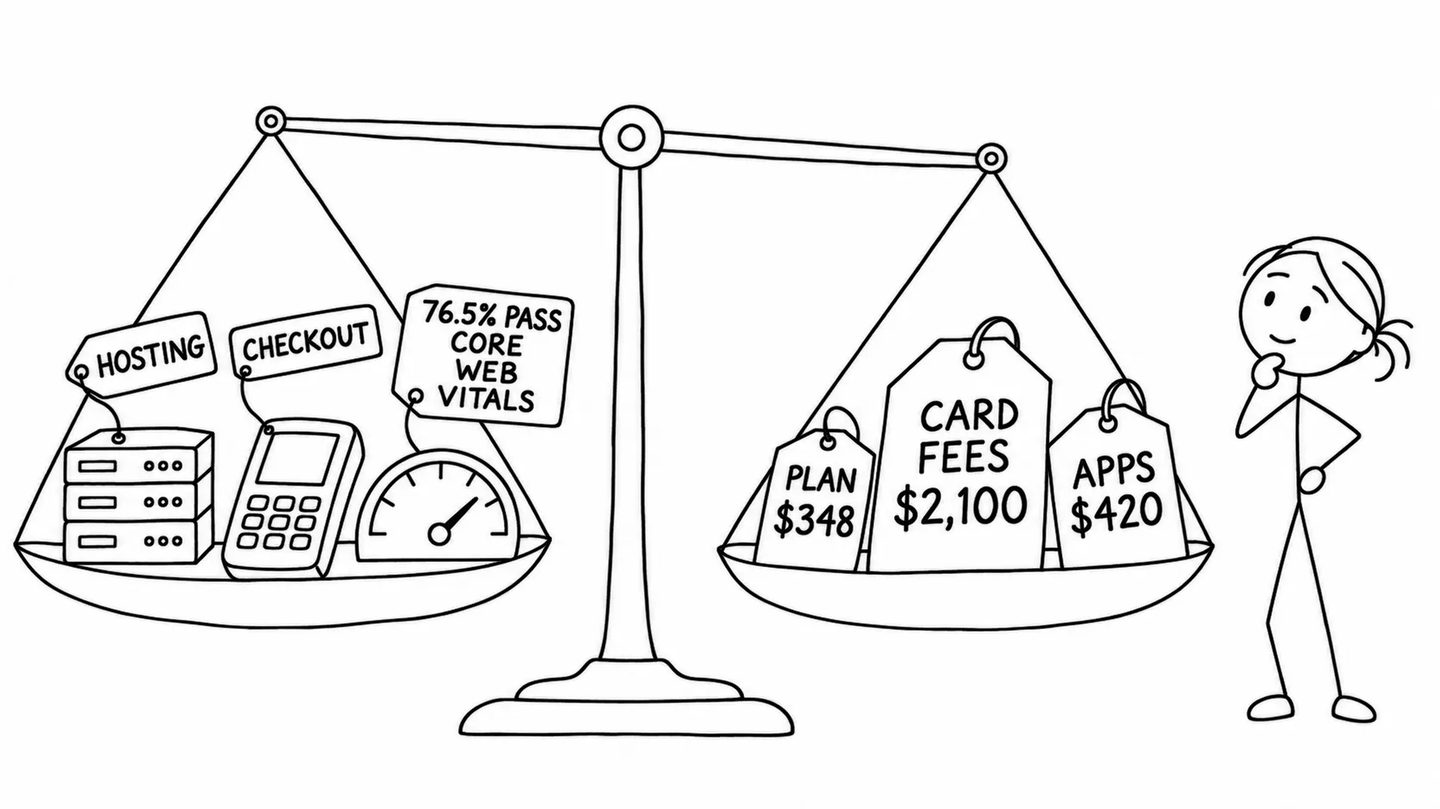
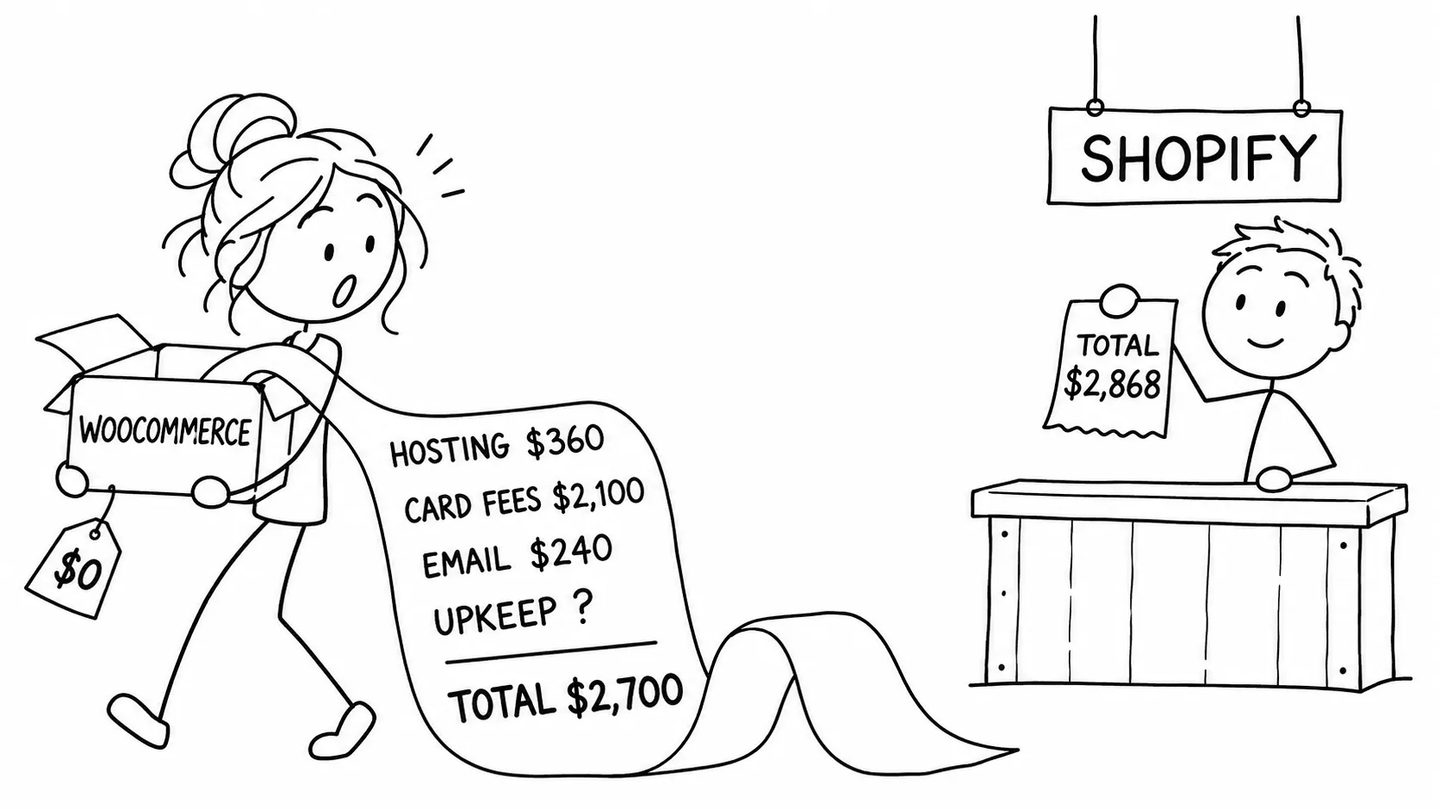
Short answer: for most small shops that sell physical goods from a country where Shopify Payments works, yes. Shopify runs hosting, checkout and security well, 76.5% of its stores pass Google's Core Web Vitals on mobile against 40.6% on WooCommerce, and the monthly plan is the smallest line on the bill. A store selling $5,000 a month on the Basic plan pays about $2,870 a year, and three quarters of that is card processing, which a store pays on any platform. Shopify is a weaker fit for a business that sells mostly content or services, needs to own its code, or runs from a country without Shopify Payments, where Shopify adds 0.2 to 2% of every card sale on top of the provider's own fee.
Shopify’s annual report for 2025 lists, among the risks to its own business, that “the difficulty and cost to switch to a competitor may not be significant for many of our merchants” (Shopify Form 10-K, 2026). Shopify counts its own merchants’ freedom to leave as a business risk, which is a useful fact for a merchant deciding in late 2026 whether to build on it.
Most of Shopify’s revenue comes from merchant solutions, the line that holds Shopify Payments. In the quarter to 30 September 2026, Shopify booked $836 million from subscriptions and $2.906 billion from merchant solutions, and 68% of the $119.1 billion of goods sold on the platform went through Shopify Payments (Shopify Form 10-Q, 2026). Payment processing also accounts for most of a store’s bill.
How much does Shopify cost per month in 2026?
Shopify sells four plans to a new store in the US, priced on its own pricing page on 12 November 2026:
| Plan | Billed monthly | Online card rate (Shopify Payments) | Fee with another payment provider | Extra staff accounts |
|---|---|---|---|---|
| Basic | $39 a month ($29 billed yearly) | 2.9% + 30¢ | 2% | none |
| Grow | $105 a month | 2.7% + 30¢ | 1% | 5 |
| Advanced | $399 a month | 2.5% + 30¢ | 0.6% | 15 |
| Plus | from $2,300 a month on a 3-year term, $2,500 on 1 year | 2.25% + 30¢ | 0.2% | unlimited |
The yearly prices for Grow and Advanced have not held still. Archived copies of the pricing page show $79 and $299 a month until mid-October 2026, then $89 and $359 on some days and the old figures on others, through 12 November; Shopify has published no explanation. Monthly prices did not move.
New stores get three days free, then pay $1 a month for three months. The cheaper Starter plan “isn’t available to new stores,” according to Shopify’s Help Center. In its place the pricing page now lists an Agentic plan at $0 a month “for selling in AI channels”: products go into Shopify’s Catalog, you choose which assistants to sell in, and you “only pay when you make a sale,” at card rates from 2.9% + 30¢.
The rates in the table are for standard cards. Premium cards cost 3.5% + 30¢ on Basic, international cards add 1%, Shopify charges 1.5% to convert currency for a US store, and a chargeback costs $15, returned if you win it (Shopify Help Center, 2026). In person, through Shopify POS, Basic pays 2.6% + 10¢. The Theme Store has 24 free themes, and its 1,349 paid ones cost $100 to $500 each, paid once (Shopify Theme Store, 2026).
How much does Shopify take from a $20 sale?
On the Basic plan with Shopify Payments, a $20 order paid with a standard US card costs $0.88, or 4.4%: 2.9% is $0.58, and the fixed 30¢ comes on top. A premium card makes it $1.00, an international card $1.08. The fixed part weighs most on small orders: a $10 sale loses 5.9%.
With a different payment provider, Shopify adds its own third-party transaction fee of 2% on Basic, $0.40 on that $20 sale, and “your third-party payment provider charges you their credit card rates themselves, separately” (Shopify Help Center, 2026). PayPal payments escape the fee only if Shopify Payments is your main provider. The fee does not apply to point-of-sale orders or to manual methods such as cash on delivery and bank transfers (Shopify Help Center, 2026).
That rule applies everywhere, including the countries where Shopify Payments is not offered. Shopify Payments works in 41 countries and territories, among them the US, Canada, the UK, Australia and every EU member state except Slovakia (Shopify Help Center, 2026). A store based anywhere else pays both the provider and Shopify on every card sale.
What does a year on Shopify cost a small store?
Take a US store that sells $5,000 a month, 100 orders of $50, paid with standard US cards. It runs the Basic plan billed yearly on a free theme and pays for two apps: Judge.me’s Awesome plan for product reviews at $15 a month and Klaviyo’s email plan at $20 a month for up to 500 contacts (Shopify App Store, 2026).
| Line | Per year |
|---|---|
| Basic plan, billed yearly ($29 × 12) | $348 |
| Card processing, 1,200 orders × $1.75 | $2,100 |
| Two apps ($35 × 12) | $420 |
| Total | $2,868 |
That is 4.8% of $60,000 in sales, or €2,578 at the European Central Bank’s rate of $1.1127 on 11 November 2026. The plan is 12% of the total and card processing 73%, a cost a store pays to some payment provider on any platform. Billed monthly, the plan adds $120. A paid theme adds $100 to $500 in the first year, and a domain, shipping labels, advertising and the owner’s hours sit outside the table.
The same store using another payment provider would pay Shopify $1,200 a year more in third-party fees, 2% of its sales, before the provider’s own charges. With both plans billed monthly, moving from Basic to Grow costs $792 more a year and cuts the card rate by 0.2 percentage points. The savings cover the additional subscription cost once card sales pass about $33,000 a month. Below that, the reasons to pay for Grow are its five staff accounts and its other features.
What is Shopify good at?
- Speed without maintenance: in October 2026, 76.5% of the 450,878 Shopify sites in the Chrome UX Report passed all three Core Web Vitals on mobile, against 40.6% of WooCommerce sites, 80.9% of Wix sites and 71.0% of Squarespace sites (HTTP Archive Core Web Vitals Technology Report, 2026). The gap with WooCommerce is mostly loading speed: 88.9% of Shopify sites have a good Largest Contentful Paint, against 44.9%. WooCommerce sites do slightly better on responsiveness (INP).
- Checkout: hosting, security, the checkout and the payment processor come from one company, and Shopify’s Shop Pay keeps returning customers’ details. Shopify claims “as much as 50% better conversion compared to guest checkout,” citing a study it ran with an unnamed “Big Three global management consulting firm” in April 2023 (Shopify, 2026); it is the vendor’s own figure. Baymard Institute’s independent count puts average cart abandonment at 70.22%, with 18% of US shoppers leaving because the site wanted them to create an account (Baymard Institute, October 2026), which is the problem a stored one-tap checkout addresses. Our guide to raising a website’s conversion rate covers the other factors.
- A large market for help: W3Techs finds Shopify on 32.7% of the sites it surveys that run a known e-commerce system, second to WooCommerce at 47.1% (W3Techs, 12 November 2026). Developers, designers and apps for it are easy to find; the App Store lists more than 16,000 apps.
- Shop and store in one system: the same catalogue, stock and customer list serve the website and Shopify POS in a physical shop.
- AI work included: Sidekick, Shopify’s assistant in the admin, comes with every plan (“Does using Sidekick cost money? No,” says Shopify). The version rebuilt for the October 2026 Edition can “run calculations, write code, search the internet, and remember what a merchant teaches it” (Shopify, 2026).
Shopify promises 99.9% uptime. On 3 June 2026, between 13:06 and 14:52 UTC, an “infrastructural issue” caused errors across the admin, POS, storefronts and checkout, and also cut off Shopify Support, according to its own status page (Wayback Machine copy, 2026). That incident page now redirects to the status homepage, whose public history lists no incidents after June 2025.
What is the downside to Shopify?
- Features arrive as apps: reviews, subscriptions, advanced email, local carriers and invoicing usually come from third-party apps, each with its own monthly price and its own terms. Shopify’s annual report warns that developers “may change the features of their apps, themes and other offerings or alter the terms… in a manner that is adverse to us and our merchants.”
- A fee that steers you to Shopify Payments: the 0.2 to 2% third-party fee makes any other provider more expensive, and in countries without Shopify Payments the only ways around it are manual payment methods and in-person sales through Shopify POS.
- Prices you do not control: the Terms of Service (updated 20 October 2026) allow Shopify to change its fees with 30 days’ notice, and the 10-K says, “We have changed our pricing models from time to time and expect to do so in the future.” The yearly prices that changed in October 2026 without an announcement are an example.
- A landlord who can switch you off: section 14 of the terms reads, “we may suspend or terminate your Account or the Terms of Service for any reason, without notice and at any time (unless otherwise required by law),” with no refund of fees. Reviews of Shopify’s support are harsh: Trustpilot shows 1.3 out of 5 from 5,304 reviews, though many of them come from shoppers who bought from Shopify stores rather than from merchants.
- Upgrades on Shopify’s schedule: Shopify retired checkout.liquid, the old way to customise checkout, and stores on plans below Plus had until 26 August 2026 to move their Thank you and Order status pages to its newer system (Shopify Help Center, 2026). Shopify Scripts, a Plus feature, stopped running on 30 June 2026, and the legacy customer accounts have been deprecated, with a final date “to be announced later in 2026.” Custom code a store paid for can stop working when Shopify decides.
What changes on Shopify heading into 2027?
The largest change is a new sales channel. Since the week of 24 March 2026, Agentic Storefronts has been on by default for eligible stores, putting their products into ChatGPT, Google AI Mode and Gemini, Microsoft Copilot and Meta’s apps with “no transaction fees beyond standard processing rates” (Shopify, 2026). The October 2026 Edition, one of Shopify’s regular feature releases, added selling in Google Search, connectors for nine assistants including ChatGPT, Claude, Copilot, Gemini and Perplexity, and a rule that “nothing Shopify drafts reaches an agent without the merchant’s sign-off.” The channels are US-first: ChatGPT requires a store that sells to customers in the United States, Google to the US, Canada or Australia, and Meta’s list of eleven countries includes none in the EU (Shopify Help Center, 2026). How much of this turns into sales is covered in our report on what agentic commerce means for a shop.
- B2B on more plans: Shopify’s B2B features reached more plans “at no extra cost” in the June 2026 Edition.
- No announced price change: Shopify’s own pages announce no fee change for 2027 as of 12 November 2026; the terms guarantee 30 days’ notice of any.
- US imports: duty-free treatment of parcels under $800 has been suspended since 29 August 2025, CBP’s rule of 24 June 2026 requires formal or informal entry for those that do not come by post, and the One Big Beautiful Bill Act ends the exemption in law on 1 July 2027 (Federal Register, 2026). A store that dropships or imports small parcels loses the duty-free route whatever platform it runs.
Can you leave Shopify?
Yes, with some losses. Products export to a CSV file, but “the images associated with each product aren’t included in the CSV file,” and collections do not export at all (Shopify Help Center, 2026). Customers and orders can also be exported as CSV files. Larger order exports arrive by email. The theme stays behind: “Themes are licensed only to the store you originally buy it for.” Reviews, email lists and subscriptions held by apps sit with each app’s maker under its own terms.
After you close a store, Shopify keeps its data for two years in case you reopen, and once it is deleted the store cannot be reactivated. A custom domain is disconnected when the store is deactivated, which is one reason to keep the domain at a registrar in your own name; our guide to choosing a domain name explains who owns it. A store that leaves keeps its catalogue, customers and order history and rebuilds the design, the URLs and every app integration.
Who should use Shopify, and who should not?
Shopify suits a store that sells physical products from a country with Shopify Payments, wants hosting, security and checkout handled, and has no developer on staff. It suits a store that also sells in person, or wants its products in AI assistants as soon as those channels open to its customers. It also takes over the hosting and speed work that a self-hosted store leaves to its owner, a trade-off our review of whether WooCommerce is still competitive against Shopify prices for the same store.
It suits a business less well when:
- you are still testing whether anyone will buy: a marketplace that charges per sale costs less than a store you have to bring traffic to yourself, because Shopify sends you no buyers.
- your site is mostly content or services: a website builder or WordPress gives more room for articles and pages at a lower monthly cost, as our breakdown of website costs shows.
- your checkout or catalogue does not fit a template: configurators, unusual B2B logic or deep ERP links point toward open-source or a custom build, the trade-off set out in our guide to renting a store or building one.
- you sell from a country without Shopify Payments: Shopify’s third-party fee is added to every card sale, so calculate the annual costs for a store in your country before you migrate.
If you want a second pair of eyes on a Shopify setup or a migration, it is part of our e-commerce development work, and you can send us your numbers.