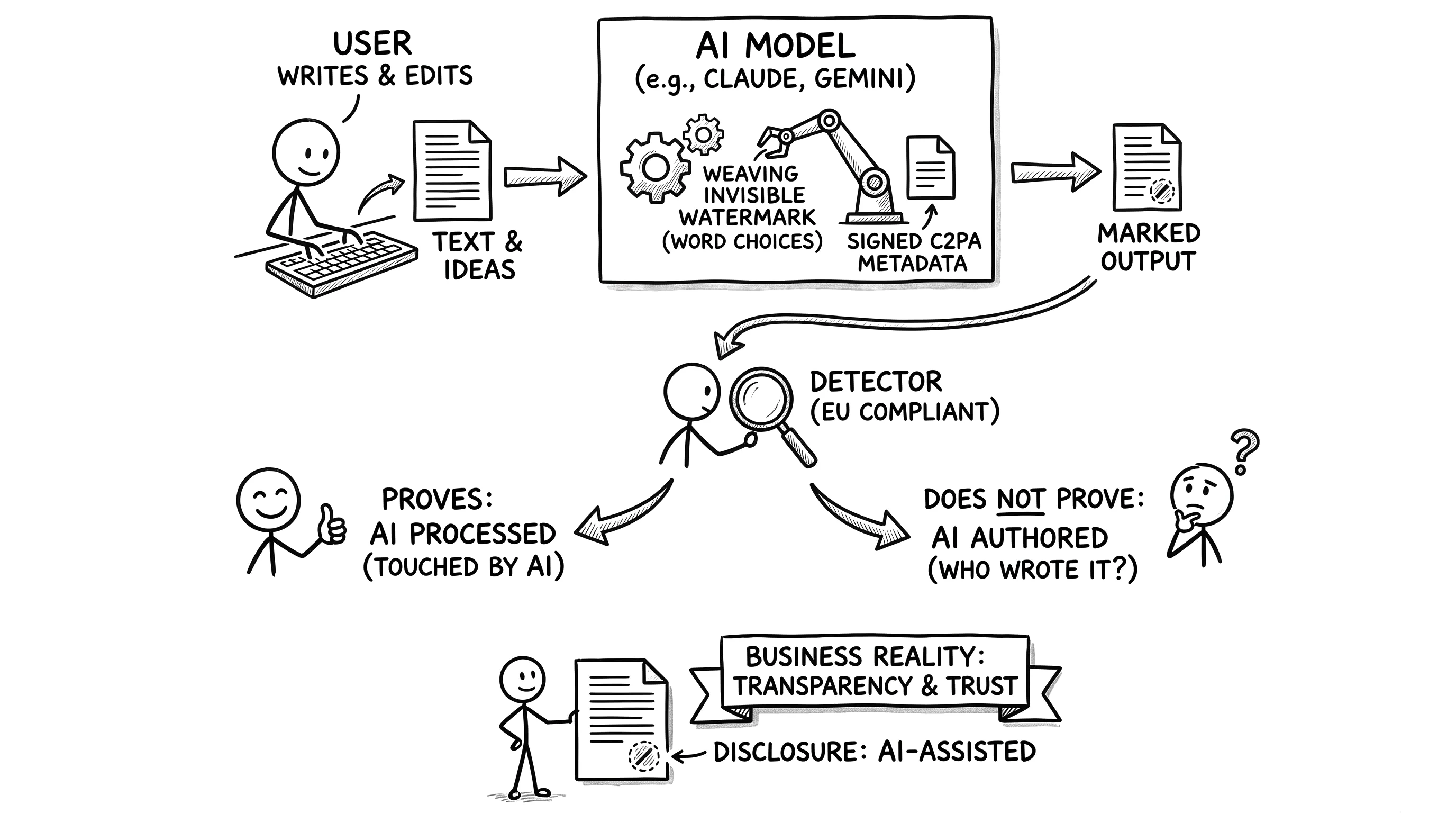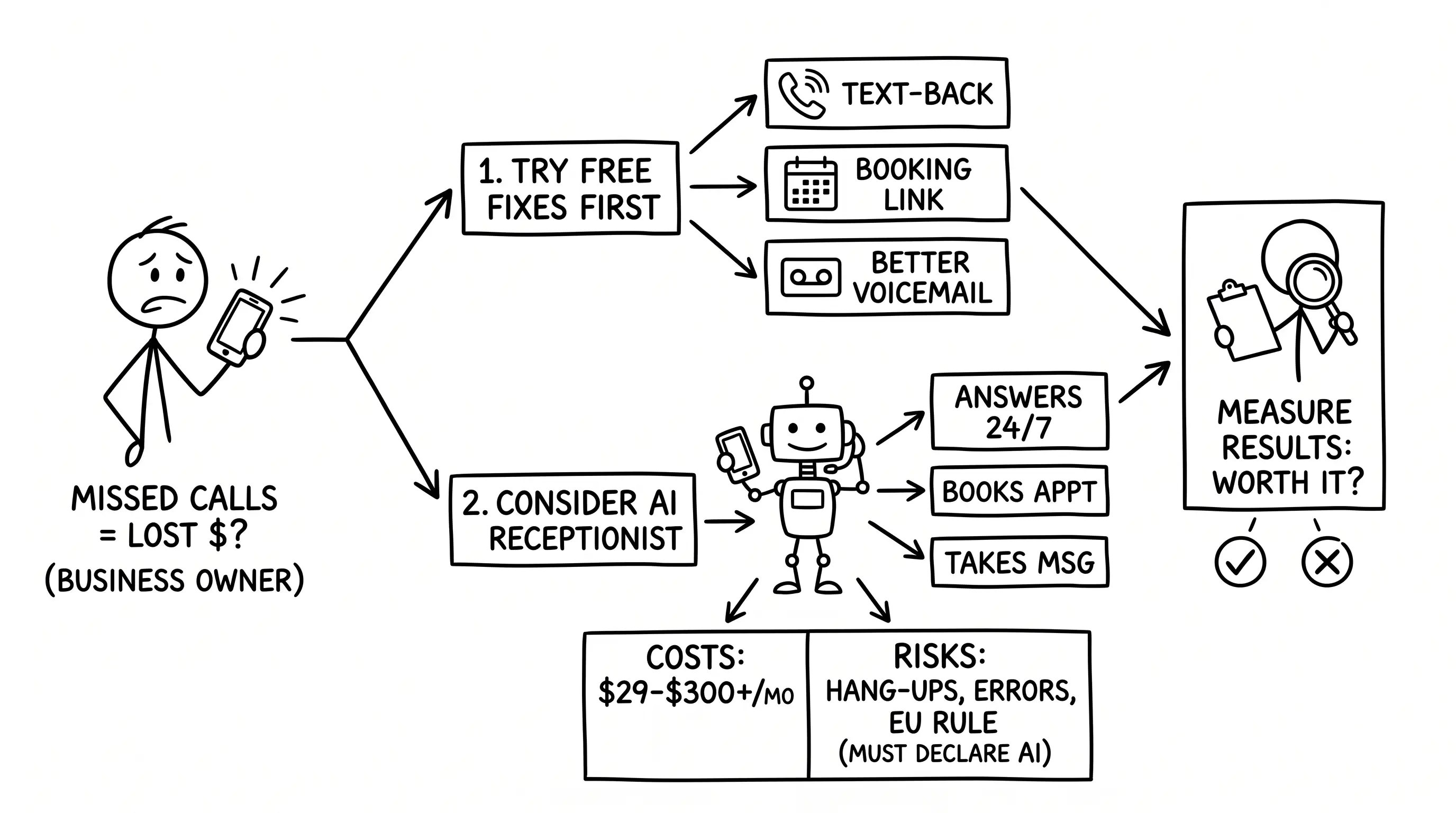


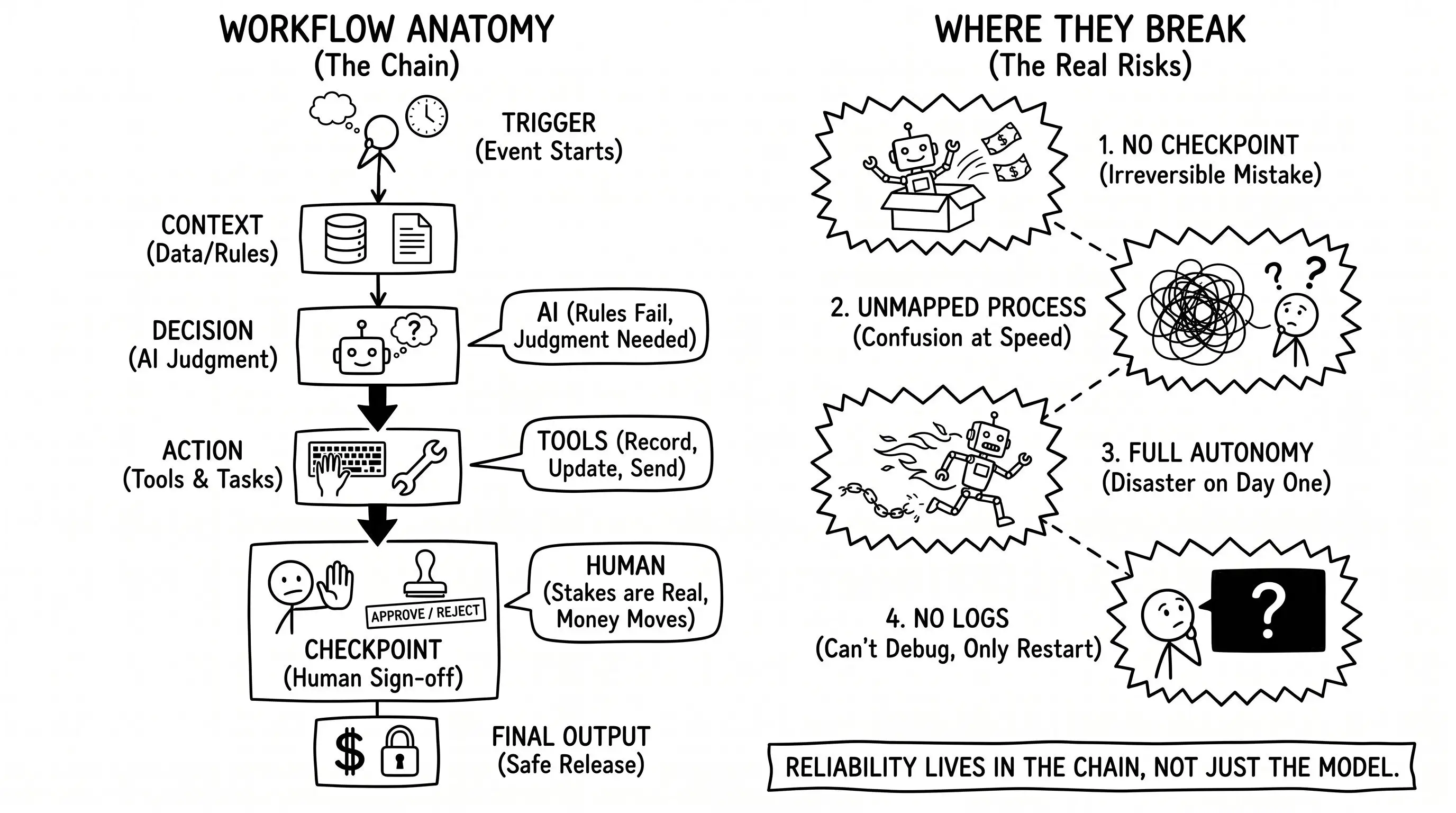
An AI agent workflow is the chain a piece of software follows to finish a job on its own: a trigger starts it, it gathers context from your systems, makes the judgment call a fixed rule cannot, acts through your tools, and stops for a human wherever the stakes are real. The agent is one link in that chain. The chain is what does the work, and it is what this guide takes apart.
The least interesting part of a working AI agent workflow is the agent. The results people credit to AI come from the machinery around the model: the trigger that starts a job, the data the agent is allowed to read, the actions it is allowed to take, and the checkpoint where a person signs off. Get that chain right and a mid-priced model does excellent work. Get it wrong and the best model on the market produces confident mistakes faster than you can catch them.
This is the second of our two guides on agents. The first covered what an agent can do for a small business: the use cases, the costs, what to automate first. This one takes the machine apart. Search demand explains why that is worth doing: queries about AI agents run to tens of thousands a month in the US alone, while questions about how a workflow is actually assembled number in the hundreds (Google search demand data, mid-2026). Plenty of interest, very little anatomy.
What is an AI agent workflow?
An AI agent workflow is a multi-step process in which software finishes a job on its own: an event starts it, it gathers what it needs from your systems, makes a judgment call, acts through your tools, and stops for a human wherever the stakes are high. IBM defines agentic workflows as AI-driven processes where agents make decisions, take actions, and coordinate tasks with minimal human intervention (IBM, 2026). Accurate, but hard to build from. The version you can build from is structural. Every dependable agent workflow we have seen breaks down into the same five parts:
- Trigger: the event that starts a run. An inquiry lands, an order is placed, an invoice arrives, a date passes.
- Context: what the agent reads before deciding. The order in your e-shop, the customer’s history, the policy that applies.
- Decision: the single step where judgment replaces rules. Classify the message, match the document, choose the route, draft the reply.
- Action: what it carries out across your tools. Creates the record, updates the ledger, books the slot, files the draft.
- Checkpoint: where a person approves. Anything irreversible, anything that moves money, anything a customer will read.
The capabilities vendors advertise, reasoning, tool use, memory, self-review, all live inside the middle three parts. The two ends, the trigger and the checkpoint, involve no AI at all. They are design decisions, and they are where most of the reliability comes from.
Is an AI agent the same thing as a workflow?
No, and the difference decides how much you can trust the system. Anthropic drew the line in its engineering guide Building Effective Agents (2024): in a workflow, the model follows steps you designed; an agent chooses its own path toward a goal you set. The guide’s less quoted finding is the practical one: the most successful implementations its authors had seen ran on simple, composable patterns rather than elaborate autonomous frameworks.
Almost everything worth deploying in a business sits between those two poles. The spine is a fixed workflow: deterministic, testable, cheap to run. Judgment is added at the one or two steps where the inputs are too messy for rules. Full autonomy, an agent planning its own steps end to end, is rarely what a company needs and never where it should start. When this guide says agent workflow, it means that hybrid: rules where rules work, judgment where they fail, a person where it counts.
What does a real agent workflow look like?
Take returns in an e-shop, a job annoying enough to be worth automating and sensitive enough to show why the anatomy matters.
A customer writes that she wants to send back a jacket. No order number, and the message comes from a different address than the one she bought with. That message is the trigger. The workflow looks up the order by name and date, pulls the return policy for that product category, and checks how the purchase was paid — that is the context. Then comes the decision, the one step that needs judgment: a standard return inside the window, a warranty claim, or an exception no rule settles? For the standard case the workflow acts: it creates the return authorization, generates the shipping label, drafts the reply, and prepares the refund in the payment admin. Then it stops. The refund waits at the checkpoint until a person presses the button, because the agent never moves money on its own.
Now delete the agent from that chain and look at what still runs: the order lookup, the label, the records, the notifications. All of it works, because all of it is ordinary integration. The agent covers a single step, reading an unstructured human message and turning it into a decision. In our builds the AI is roughly a tenth of the system; the other nine tenths decide whether the whole thing can be trusted.
The same skeleton carries the other jobs from the first guide: inquiry triage, invoice intake, weekly reporting. The nouns change. The five parts do not.
Where do agent workflows break?
Agent workflows rarely fail because the model is too weak; they fail around the model. Four patterns account for most of the damage:
- No checkpoint before an irreversible step. The workflow that drafted refunds gets promoted to sending them, runs fine for a month, then refunds the same order twice on a Friday night. Keep a person on the button until months of logs argue otherwise.
- Automating a process nobody has mapped. If the person doing the job cannot list its steps and exceptions on one page, the agent inherits that confusion at machine speed. Map first, automate second.
- Full autonomy on day one. Trust is built in shadow mode: the workflow runs alongside the person for weeks, its output compared against theirs, before it touches anything real.
- No record of why. When an output looks wrong, you need to see what the agent read and what it decided. A workflow without logs cannot be debugged, only restarted, and a restart teaches you nothing.
How do you build your first agent workflow?
Slowly, and in this order.
- Pick the job by the boring test: high volume, clear rules, expensive when it slips. Our guide to what AI agents can do for a business walks through the shortlist and the costs.
- Do the job by hand one more time and write down every step, including the exceptions you handle without noticing. That transcript is the workflow design; the tooling comes later.
- Build the deterministic spine first: integrations, lookups, record-keeping, notifications, and no AI in any of it. This is most of the build and nearly all of the reliability.
- Add judgment at the single messiest step. One decision, clearly fenced, with a defined set of allowed outcomes. Resist adding a second until the first has run for a month.
- Run in shadow mode, then add the checkpoint, then let it act. Measure the two numbers that matter: hours returned, and errors against the human baseline.
Scoping that chain, from choosing the process to fencing the judgment step, is the substance of our AI & automation work; if you have a process in mind and want an honest read on whether it needs an agent at all, walk us through it.