

How to Run Meta Ads in 2026: A Guide to the Platform Facebook Ads Became
- Published —
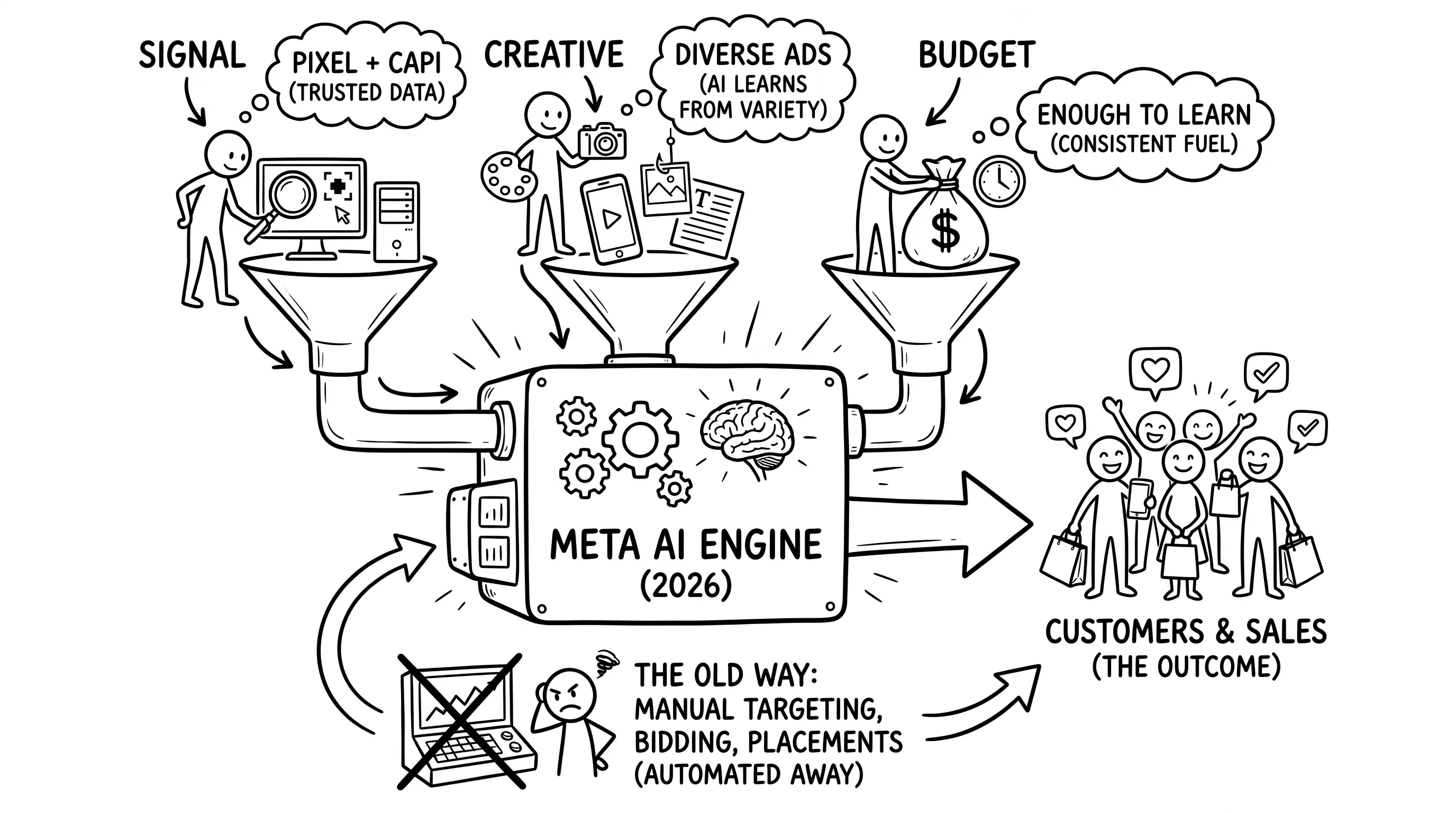
Short answer: you run Meta ads well in 2026 by feeding the machine the three inputs it actually learns from. A conversion signal it can trust (the pixel plus the Conversions API, with consent handled), creative worth stopping for in real variety, and a budget large enough to clear the learning phase. Targeting, placement, and bidding have mostly been automated away. Skip the Boost button for anything that must sell, switch off the enhancements that redraw your ads, and judge results by the week, never the day.
Mark Zuckerberg has already described the finish line for Meta advertising: you tell the system your objective and connect a bank account, and “you don’t need any creative, you don’t need any targeting demographic, you don’t need any measurement” (Stratechery, May 2025). The Wall Street Journal has reported, via people familiar with the plans, that Meta wants ad creation fully automated by the end of 2026. That is the machine you are learning to operate when you open Ads Manager today: one designed to need less of you every quarter.
The vocabulary is changing to match. In the search-demand data we pulled this July, “meta ads” overtook “facebook ads” in Google searches for the first time in November 2025, and every how-to phrasing of the new name is growing at triple digits year over year. The renaming is the visible part; underneath it, people are re-learning a rebuilt platform, and most of what ranks for the question was written for the one Meta retired. This guide covers the current version: what the automation genuinely does well, the handful of settings still worth deciding yourself, and the honest arithmetic of whether your budget can work at all. It is written by an agency that runs these campaigns for clients, with nothing to sell you inside the article.
Facebook ads, Instagram ads, Meta ads: one system
Meta ads are the paid placements bought through Meta Ads Manager and delivered across Facebook, Instagram, Messenger, Threads, WhatsApp, and Meta’s Audience Network of partner apps. “Facebook ads” and “Instagram ads” are not separate products; they are placements of the same ad, bought in the same auction, managed in the same account. You do not choose between advertising on Facebook or Instagram so much as decide whether to let one campaign serve both, which is now the default and usually the right call.
Three names cause most of the confusion, so here they are in one place:
- Meta Ads Manager: the actual campaign tool, where objectives, budgets, audiences, and ads live. Searches for it have more than tripled year over year, which says something about how many people are being sent there for the first time.
- Meta Business Suite: the free management layer above it: your Pages, inboxes, and a simplified view of ads. You need a Facebook Page to advertise; Business Suite is where it lives.
- Boost: the blue button under a post. It creates a real ad, but a limited one, and it deserves its own section below.
One practical note if you manage ads for someone else: work inside their business portfolio through partner access, never from your own ad account. The account that spends builds the history, and the history should belong to the business.
What changed while you were calling them Facebook ads
If you learned this platform before 2023, your mental model is stale in dated, specific ways:
- Targeting options keep shrinking. Meta removed detailed targeting options it classed as sensitive in January 2022, retired detailed targeting exclusions for new campaigns in July 2024, and switched off another batch of interest options on 15 January 2026 (Meta; trade reporting, 2024–2026). The interest-stacking craft that defined the 2019 era is mostly gone because the dials were removed.
- Advantage+ stopped being a product and became the default state. In February 2025 Meta folded its Advantage+ shopping campaigns into a streamlined setup where sales, leads, and app campaigns simply start with “Advantage+ on” (Meta, 2025). You no longer choose an AI campaign type. You get one, and opt out of pieces deliberately.
- The machinery under the auction was rebuilt. Andromeda, the retrieval engine that picks which few thousand ads even enter ranking, shipped in December 2024 with an 8% ads-quality improvement on selected segments (Meta Engineering, 2024). GEM, a ranking foundation model Meta describes as trained at LLM scale, followed in 2025 (Meta Engineering, 2025). This is why current practitioner advice obsesses over creative variety: the system can now use it.
- The AI now makes the ads as well as matching them. By mid-2026, more than 9 million small businesses were using at least one of Meta’s generative AI creative tools, and Meta reported its video generation features lifting conversion rates around 3% in tests (Meta earnings calls, April and July 2026). At Cannes in June 2026 it previewed an end-to-end AI creative workspace with “brand memory.” Most of that is still in testing; the direction is not subtle.
- Measurement changed underneath you. In May 2026 Meta retired last-click as the default lens and now lets you choose incremental attribution at the ad-set level, its estimate of conversions your ads actually caused rather than merely touched (Meta Performance Marketing Summit; trade reporting, 2026).
- The deadline is unconfirmed but close. Meta has never publicly committed to the WSJ’s end-of-2026 date, and has neither confirmed nor moved it since. That checkpoint has now passed: on the Q2 2026 earnings call of 29 July, with five months left on the reported deadline, no executive mentioned end-to-end ad automation or any timeline for it, and no analyst asked. What Meta did announce was narrower and creative-specific, “new end-to-end creative solutions that help advertisers translate performance data into their creative decisions” (Meta, July 2026). Read the silence as you like; plan for a platform that automates steadily rather than for a switch thrown in December.
Every date above is a reason generic tutorials mislead. The screens look similar. The consequences changed.
Before you spend a euro: the three inputs the machine learns from
Strip away the interface and Meta’s system learns from exactly three things you control: the conversion signal you send back, the creative you give it to test, and the budget that buys its training data. Everything else in this article is detail on those three.
The signal comes first. Install the Meta Pixel on your site, then add the Conversions API and send the same events through both; Meta’s own best-practice page calls this a redundant setup and deduplicates the overlap (Meta Business Help Center, 2026). The pixel alone misses events to blockers and page-load failures; the server-side API fills them in. Events Manager scores your setup with an event match quality number from 0 to 10, and raising it with fields like email and click ID is some of the highest-leverage work in the whole system. Optimizing toward a purchase or a qualified lead only works if the machine reliably hears about them.
In the EU, consent decides how much signal exists at all. A consent banner must gate the pixel and the Conversions API; server-side events are personal data too, and sending them without consent is the same violation with extra steps. Since January 2026, EEA users also pick between personalized and “less personalized” ads under Meta’s arrangement with the European Commission, and the less-personalized pool is harder to target and measure by design (EC; Meta, 2025–2026). Budget for the reality that some of your European audience is reachable only bluntly.
Then the landing page, before the first campaign. The auction sets what a click costs; the page decides whether it pays. A slow site, a vague offer, or a nine-field form will quietly defeat excellent ads, and no Advantage+ toggle can fix it. If that is where your weakness is, fix the website first.
Should you just boost the post?
This June, Meta’s own business page advised small businesses to create their first Meta ad on any budget by boosting a post and scaling from there. The advice is not wrong so much as incomplete, and Meta’s own documentation is candid about the difference: boosted posts optimize for engagement, visits, and awareness-style goals, while objectives such as leads, app promotion and sales exist only in Ads Manager (Meta Business Help Center, 2026). Boosting also limits your placements and audience tools, and A/B testing lives in Ads Manager alone.
The honest rule: boost when attention is the outcome you want. Putting a genuinely strong post in front of more locals, promoting an event this weekend, giving a proof-heavy customer story a wider audience: fine, boost it, spend your €30. The trap is running a business on the Boost button because it was the nearest ad product, then concluding that “Facebook ads don’t work” after buying a pile of likes from people the system never had a reason to convert. Meta’s machine optimizes for exactly what you ask. The button asks for applause; Ads Manager lets you ask for customers.
How do you set up a Meta ads campaign in 2026?
The build takes under an hour, and the structure matters more than the clicks. Interface labels drift; the shape below does not.
- Set up the container first. Create the business portfolio in Meta Business Suite, add or claim your Facebook Page, connect your Instagram account, add billing, and set up the pixel and Conversions API before any campaign exists. No legal entity is required to run ads, whatever the forums say; a Page, a payment method, and in some cases identity or business verification are.
- Open Ads Manager and pick the objective that matches money. Six objectives exist: awareness, traffic, engagement, leads, app promotion, sales. Pick sales or leads if a sale or lead is the point, and resist the beginner instinct to buy traffic because clicks are cheap. Ben Heath, whose agency reports over $300M in managed spend, explains the trap precisely: Meta’s optimization is literal, so ask for link clicks and it finds people likely to click, who “don’t necessarily go on to convert” (January 2026). The sales objective hunts buyers instead, and with it the campaign starts in the Advantage+ state automatically (Meta Business Help Center, 2026).
- Keep the structure almost insultingly simple. One campaign, one or two ad sets, three to five genuinely different ads per ad set, budget set at the campaign level. Meta’s delivery system consolidates learning; fragmenting spend across many small ad sets is the classic way to keep every one of them starved and permanently “learning limited.” Complexity is no longer a strategy. It is a tax.
- Give the audience section less than you think. Set the location and any hard legal constraints, add your customer list as a signal, and stop. The detailed-targeting era ended mostly because Meta removed its dials; broad delivery with strong creative is the practitioner consensus and the direction every platform default now pushes. The exception is retargeting: when you specifically want past visitors or your customer list only, switch off the audience expansion so the system respects the boundary.
- Upload creative variety, not one polished ad. Different hooks, formats, and first three seconds. The sections below cover which automation to accept, what the machine actually wants from your creative, and what it costs to feed it properly.
Which Advantage+ settings should you keep on?
Advantage+ is not one switch but a family of them, and the right answer differs by toggle. As of mid-2026, a campaign shows “Advantage+ on” when campaign budget, Advantage+ audience, and Advantage+ placements are all active (Meta Business Help Center, 2026).
- Advantage+ placements: keep it. Letting delivery roam across Facebook, Instagram, Messenger, Threads, and the rest is genuinely where the system earns its keep, finding cheap attention you would not have picked manually. Opt out only for placements that actively hurt the brand, knowing exclusions flip the state off.
- Advantage+ audience: keep it, with controls. Age minimums, location, language, and custom-audience exclusions survive as hard controls; most other inputs are now suggestions the system may expand beyond. Use the controls for real constraints (an 18+ product, a delivery radius) rather than recreating 2019-style interest stacks.
- Advantage+ creative enhancements: audit them one by one. These let Meta adjust your images, text, and video: brightness, crops, overlays, AI variations. Meta’s help page says plainly that “the media and text you upload may be adjusted” and that some enhancements are on by default (Meta Business Help Center, 2026). Practitioners routinely report approved creative shipping in altered form, which in a regulated industry is a compliance problem and in any industry is a brand decision you did not make; they switch off individually under Set up creative → Enhancements, a few only from the ad’s Advanced preview. The counterpoint deserves airtime too: Jon Loomer, who tests these features more rigorously than almost anyone, asks advertisers who turn everything off what evidence they have that the enhancements were hurting results, and keeps several on himself (July 2026). The defensible position is deliberate either way: know which are on, disable what touches brand or compliance, and test the rest instead of following reflex.
- Advantage+ campaign budget: keep it. Budget flows to whichever ad set performs, which is the point of the simple structure above. Judge results at the campaign level, not by comparing starved siblings.
If you have read our piece on Google’s equivalent choice, the pattern will feel familiar: the platforms have converged on the same bargain, where the AI runs delivery and your leverage moves to inputs and guardrails.
Creative is the targeting now
When Meta removed the targeting dials, the work did not disappear; it moved into the ads themselves. The retrieval and ranking systems Meta shipped in 2024 and 2025 select from enormous candidate pools per person, which means different creative angles now do the audience-splitting that interest checkboxes used to do. A pain-point video finds one buyer, a price-led image finds another, and the system routes each to whoever responds. Jon Loomer condensed the practitioner consensus into one sentence this July: creative diversification is the new targeting lever, and your job is supplying diverse assets the system can match to the right people (jonloomer.com, 2026).
Practically, that means launching with three to five genuinely different concepts, not five crops of the same ad. Vary the hook above all; creative strategists who ship ads at volume, like Savannah Sanchez, treat the first three seconds as the actual ad and everything after as supporting material (2025). Vary the format too: vertical video for Reels and Stories placements, stills for feeds, and at least one ad that does not look like an ad. And before making anything, spend ten minutes in Meta’s Ad Library, where every ad delivered in the EU is public along with its targeting parameters; your competitors’ creative playbook is documented there, and so is yours. On the AI question, the field is split in an instructive way. Meta reports that video generation features lift conversions in tests, and over 9 million small businesses now touch its generative tools; meanwhile Sanchez works AI-free and puts it bluntly: one good ad is worth a thousand bad AI ads (2025), and Ben Heath’s mid-2026 read is that creator partnership ads outperform precisely because nobody’s favorite creator is AI-generated (June 2026). The synthesis is not complicated. Use generative tools for variations, backgrounds, and speed; keep a human judgment on whether the result would stop you; and remember the ad is content first, which is the same discipline as knowing what to post organically.
Is $5 a day enough for Meta ads?
The budget question has a mechanical answer, because Meta documents what the system needs to learn. An ad set exits the learning phase after roughly 50 optimization events in a week; below that pace it flags “learning limited” and performance stays erratic (Meta Business Help Center, 2026). Practitioners turn that into a floor: a workable daily budget is roughly seven times your expected cost per result, so a €20 lead implies something like €140 a day for a purchase-optimized setup. That number surprises people, and it is the honest one.
It is not the end of the story. Optimize for a cheaper, more frequent event (an add-to-cart, a qualified landing, a message) and the same arithmetic lands at a fraction of the spend, at the cost of optimizing one step short of money. Practitioner floors cluster in the same zone the math implies: Ben Heath calls anything under about $20 a day a tiny budget, workable with patience measured in months (Heath Media, 2025), while agencies managing SMB accounts commonly put the reliable-learning floor around $1,500 a month (M.Wolf Media, 2026). And $5 a day genuinely can work for boosted-post-style local awareness, where the goal is attention rather than algorithmic optimization; it is only sales optimization that starves at that spend.
Two budget rules from Meta’s current documentation are worth knowing before your first invoice, because most guides still quote the old ones. On high-opportunity days Meta may now spend up to 75% over your daily budget, balancing out so a calendar week never exceeds seven times the daily figure (Meta Business Help Center, 2026); the widely repeated 25% figure is out of date. And if you use a cost-per-result goal, the system wants your daily budget at least five times that goal. Set budgets you can leave alone: significant edits, including budget jumps and any creative change, restart learning.
What do Meta ads cost in 2026?
Costs are rising, and for once the cleanest evidence is first-party: Meta’s own earnings releases show the average price per ad up 9% to 12% year over year in every recent quarter (Meta, Q3 2025 through Q2 2026, which came in at the top of that band). You are bidding into an auction whose seller reports its price increases in public.
What you will actually pay varies so much by market and objective that any single “average CPM” is fiction; the useful thing is the spread of published panels. Gupta Media’s global tracker across its own managed spend put Meta CPMs around $8 through 2025; Triple Whale’s panel of roughly 35,000 e-commerce brands measured a median of $14.19, up 20% year over year; SuperAds’ multi-account dataset averages over $20 globally and about $23 in the US (all 2025–2026 editions). On clicks and leads, LocaliQ’s benchmarks of about 1,300 US campaigns put median CPCs at $0.70 for traffic and $1.92 for lead campaigns, with a median cost per lead of $27.66 (LocaliQ, 2025). Central European rates run far lower: agencies publishing their own client averages in Slovakia and Czechia report CPMs around €2.50 to €6 and traffic clicks from roughly €0.20 to €0.60 (Poď Podnikať, 2025; LK Media, 2026). The pattern across every panel agrees on two things: costs peak hard in November and December, and they drift upward every year.
So treat “what does it cost” as three numbers you can estimate for your own case: the CPM you will discover within days of spending, the click-through rate your creative earns, and the conversion rate your page delivers. A €5 CPM with a 1.5% click-through is a €0.33 click; at a 3% conversion rate that is an €11 lead. Run your own numbers with your own margins before the first campaign, and the worth-it question mostly answers itself.
Reading results without fooling yourself
- Give it a week before judging anything. Daily numbers wobble by design, learning takes days, and budget over-delivery balances weekly. React to seven-day trends.
- Choose your attribution lens consciously. Since May 2026 you can view results through standard attribution or Meta’s incremental estimate of conversions the ads caused; the second is the humbler, usually smaller number worth knowing (Meta, 2026). Whichever you pick, cross-check against the only ledger that cannot flatter you: did sales, calls, or bookings actually move?
- Treat Opportunity Score as a salesperson, not a referee. The 0–100 score in Ads Manager measures how many of Meta’s recommendations you have applied, and Meta’s own documentation states the score “does not reflect your actual or future performance” and warns against switching off campaigns because the score is low (Meta Business Help Center, 2026). Read the recommendations; apply the ones that match your strategy; feel no guilt about the rest.
- When ads “don’t work,” check in this order: the offer (would a stranger want it at that price?), the creative (would you stop scrolling?), the signal (is match quality decent, are conversions recording?), the budget (is the ad set learning limited?). The algorithm is rarely the culprit; it is the part that gets blamed because it is the part you cannot see.
Are Meta ads still worth it in 2026?
For businesses whose arithmetic closes, yes, and the scale argues for taking the question seriously: advertisers keep bidding prices up 9–12% a year precisely because the system converts, and Meta’s own analysis of a million campaigns claims an average $4.13 in revenue per dollar spent, a number best read as the platform grading its own homework but not inventing the category (Meta at Cannes, 2026). Paid social remains the strongest tool for creating demand among people who were not searching for you, which is exactly the half of advertising search ads cannot do.
The caution half is just as real. Costs compound annually while attention fragments; advertiser forums in 2026 are full of accounts describing CPMs that doubled year over year and performance that swings week to week, and the complaints cluster among small budgets, which have the least data to stabilize delivery. Some products simply do not work on Meta, and the honest diagnosis is often product-market fit or margin, not settings. If a €30 product carries a €25 acquisition cost, the campaign did not fail; the arithmetic did. And a slice of your audience is now structurally harder to reach: EEA users who chose less personalized ads, and everyone drifting hours into AI assistants where the ad inventory is only now being invented. Meta ads in 2026 are a precise, expensive machine for turning good offers and good creative into customers. They are not a rescue plan for a weak offer, and anyone selling them as one is selling.
What not to buy
The re-learning wave has its own merchandise stand, and most of it can be walked past.
- Courses recorded before 2025: they teach interest stacking, manual placements, and campaign types that no longer exist. Meta’s Blueprint courses are free and current, and the platform now explains itself better than most paid courses do.
- Guaranteed-ROAS agencies and “agency account” rentals: nobody controls an auction, and renting someone’s “whitelisted” ad account is a policy violation dressed as a growth hack. An honest agency shows you the inputs it controls: creative cadence, signal quality, structure, and testing discipline.
- Third-party AI optimization layers: tools promising an AI that “beats the algorithm” are reselling you what Advantage+ already does, with less data than Meta has. The AI worth paying for in 2026 sits in creative production, not bid management.
- Engagement bought with boosts: a page of boosted posts with thousands of likes and no sales is the most common Meta ads portfolio in existence. Applause is cheap to buy and worth what it costs.
Where Meta ads go next
The inventory keeps widening: WhatsApp Status ads launched in 2025 and have been reaching EU accounts gradually through 2026, and Threads ads rolled out to every user worldwide starting this January, on by default under Advantage+ placements (Meta; trade reporting, 2025–2026). The buying side is opening too; since April 2026, Meta’s Ads AI Connectors let outside assistants like Claude and ChatGPT read and even build campaigns, with anything AI-created landing paused for human review (Meta; Digiday, 2026). The “run your ads with AI” videos flooding YouTube describe something real, but the useful version today is analysis and creative iteration, not surrendering the account.
All of it points the same direction as the Zuckerberg quote this article opened with: toward advertising where the machine handles assembly and delivery, and what a business actually competes on is the offer, the proof, the creative raw material, and the first-party signal it feeds in. Those compound. Dashboards do not. If the machine is going to run the campaign anyway, the businesses that win are the ones that give it something worth running, and that is as true of what you post organically as of what you pay to promote. Where the auction itself goes next, as ads arrive inside AI assistants, is its own story.
Meta ads in 2026 reward a strange combination of trust and suspicion: trust the delivery machine with more than feels comfortable, and audit the defaults that spend your money and redraw your ads. If you would rather have someone who does this daily build and govern it with you, that is what our advertising service is for, and if you want a second opinion on an account you already run, talk to us.